Blogs

  • News
  • |
  • Art
  • |
  • History
  • |
  • Food and Travel
  • |
  • Science
Dinosaur Tracking

Where paleontology meets pop culture

Hominid Hunting

Meet the members of the tangled human family tree

Innovations

How human ingenuity is changing the way we live

Surprising Science

Ideas, news and discoveries from the world of science


December 18, 2012

The Scientific Reason Why Reindeer Have Red Noses

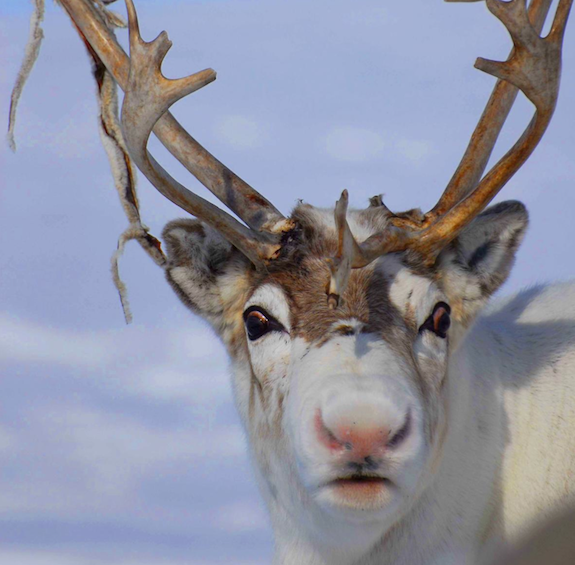
Some reindeer really do have red noses, a result of densely packed blood vessels near the skin’s surface. Image courtesy of Kia Krarup Hansen

In 1939, illustrator and children’s book author Robert May created Rudolph the Red-Nosed Reindeer. The character was an instant hit—2.5 million copies of May’s booklet were circulated within a year—and in the coming decades, Rudolph’s song and stop-motion TV special cemented him in the canon of cherished Christmas lore.

Of course, the story was rooted in myth. But there’s actually more truth to it than most of us realize. A fraction of reindeer—the species of deer scientifically known as Rangifer tarandus, native to Arctic regions in Alaska, Canada, Greenland, Russia and Scandinavia—actually do have noses colored with a distinctive red hue.

Now, just in time for Christmas, a group of researchers from the Netherlands and Norway have systematically looked into the reason for this unusual coloration for the first time. Their study, published yesterday in the online medical journal BMJ, indicates that the color is due to an extremely dense array of blood vessels, packed into the nose in order to supply blood and regulate body temperature in extreme environments.

“These results highlight the intrinsic physiological properties of Rudolph’s legendary luminous red nose,” write the study’s authors. “[They] help to protect it from freezing during sleigh rides and to regulate the temperature of the reindeer’s brain, factors essential for flying reindeer pulling Santa Claus’s sleigh under extreme temperatures.”

Obviously, the researchers know reindeer don’t actually pull Santa Claus to deliver gifts around the world—but they do encounter a wide variation of weather conditions on an annual basis, accounting for why they might need such dense beds of capillary vessels to deliver high amounts of blood.

To come to the findings, the scientists examined the noses of two reindeer and five human volunteers with a hand-held video microscope that allowed them to see individual blood vessels and the flow of blood in real time. They discovered that the reindeer had a 25% higher concentration of blood vessels in their noses, on average.

They also put the reindeer on a treadmill and used infrared imaging to measure what parts of their bodies shed the most heat after exercise. The nose, along with the hind legs, reached temperatures as high as 75°F—relatively hot for a reindeer—indicating that one of the main functions of all this blood flow is to help regulate temperature, bringing large volumes of blood close to the surface when the animals are overheated, so its heat can radiate out into the air.
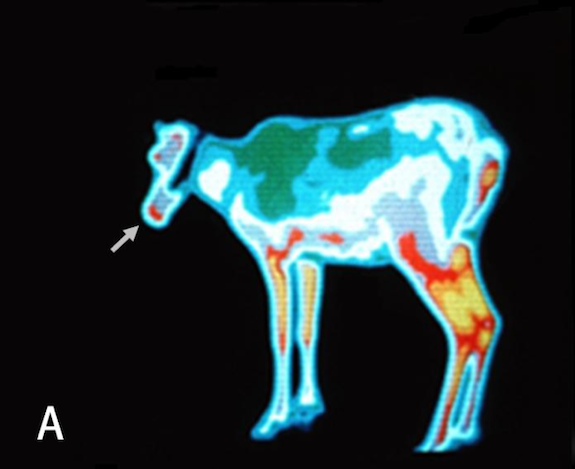
In an infrared image, a reindeer’s nose (indicated by arrow) is shown to be especially red, a reflection of its temperature-regulating function. Image via Ince et. al.

Read more articles about the holidays in our Smithsonian Holiday Guide here


***

Sign up for our free email newsletter and receive the best stories from Smithsonian.com each week.

18 Comments »

  1. Kelvin says:

    Hmmm,and here I thought it was because of global Warming.

  2. Joe Marfice says:

    “…the color is due to an extremely dense array of blood vessels, packed into the nose in order to supply blood and regulate body temperature in extreme environments.”

    Don’t /most/ blood vessels supply blood? ;)

  3. Jackie says:

    So… kind of like humans??

  4. Mike says:

    Wait, you put a reindeer on a treadmill and didn’t show us footage of that?!?

  5. Tarara Boumdier says:

    I don’t know if you remember, but Santa actually has NINE reindeer.
    You know; “Olaf the other reindeer…”

  6. JoelB says:

    Look closely at the first picture of the reindeer. That’s no reindeer! That’s a unicorn!

  7. And I thought all along that reindeer along with their humans who look after them were given schnaps to dilate those facial blood vessels…so, what do ya know? Ain’t this site just grand?

  8. Bob77021 says:

    It’s not “Olaf the other reindeer”.

    It’s “Olive, the other reindeer”. Therefore, there are only TWO reindeer. Rudolph and Olive.

    Merry Christmas !!!

  9. Larry says:

    If only a fraction of reindeer have red noses and the red noses are due to the dense array of blood vessels, do the rest of the reindeer (Olaf the others) NOT have a dense array of blood vessels in their noses?

  10. ana says:

    …..and when they have a layover in Hawaii?

  11. Kenneth Hicks says:

    Well, Rudolph is the ninth, Olaf must be 10th and of course it’s Olive, the other reindeer.

    But in truth, the packed red nose creates a bubble of heat which radiates back as the reindeer fly, creating warmth and light in particularly nasty winter weather . . . once they cross the equater, the packed nose then radiates excess heat outward, creating a streaming beacon across the southern night skies!

  12. Mike says:

    Interesting! I hope that everyone’s Sunday is going great and safe and I hope that they have a merry Christmas.

  13. Bill Moniz says:

    …and all along I thought Santa had a Duracell battery pack and light bulb attached to Rudy’s nose.

  14. J L clin says:

    It’s not Olaf, it’s Olive the other reindeer.

  15. Doc Z says:

    With a ‘damaged rack’ like this deer has, a red nose is the least of his problems.

  16. pamella says:

    I love these Smithsonian blogs; but please don’t stress out the reindeer. Can’t you feed him instead in his natural habitat and show footage of that.

  17. Tim Upham says:

    The Saami did not like it, when their reindeer grazed on lichens covered with ice. Because it put too much water into their stomaches. So they led them to where there was snow, where they could paw through the snow for lichens. But before Christianity came to the Saami people, they like all polar peoples believed in a sun deity, which came and warmed the land, after a long, hard cold winter. It was reindeer, who flew up to greet the arrival of this deity. Where the Christmas story of flying reindeer came from. Probably brought to the United States by Scandinavian immigrants.

  18. Is this the true story of Rudolph? thestoryofrudolph.blogspot.com

RSS feed for comments on this post. TrackBack URI

Leave a comment

Comments are moderated, and will not appear until Smithsonian.com has approved them. Smithsonian reserves the right not to post any comments that are unlawful, threatening, offensive, defamatory, invasive of a person's privacy, inappropriate, confidential or proprietary, political messages, product endorsements, or other content that might otherwise violate any laws or policies.

Spam protection by WP Captcha-Free

Advertisement


Follow Us


Travel with Smithsonian


Advertisement