
This 33,000-Year-Old Skull Belonged to One of the World’s First Dogs
A new DNA analysis confirms that an ancient skull found in a Siberian cave was an early ancestor of man’s best friend
/https://tf-cmsv2-smithsonianmag-media.s3.amazonaws.com/accounts/headshot/joseph-stromberg-240.jpg)
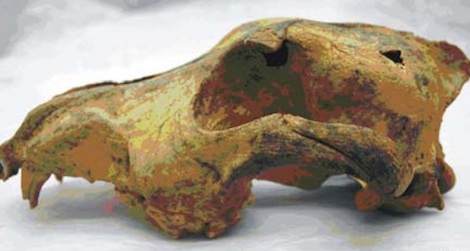

A new DNA analysis confirms that this ancient skull, found in a Siberian cave, was an early ancestor of man’s best friend. Image via PLOS ONE/Ovodov et. al.
In 1975, a team of Russian archaeologists announced that they’d made a remarkable find: From a cave in the Altai Mountains of Siberia, they’d unearthed a 33,000-year-old fossil skull that resembled a wolf. In 2011, an anatomical analysis suggested that the fossil was a hybrid of a wolf (with its large teeth) and a dog (with its shortened snout), raising the possibility that it was a partly domesticated wolf—in other words, one of the oldest ancestors of the modern dog ever discovered.
At the time, though, DNA analysis was needed to make certain that the fossil came from an ancestor of man’s best friend. A paper published today in the journal PLOS ONE confirms that fact, indicating that the creature was more closely related to modern dogs than wolves, and forcing scientists to reconsider the dog’s evolutionary family tree.

A top view of the skull. Image via PLOS ONE/Ovodov et. al.
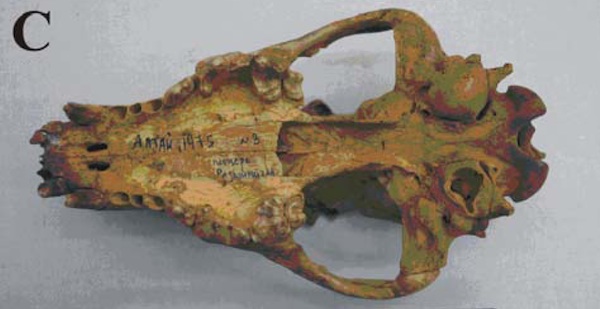
A bottom view of the skull. Image via PLOS ONE/Ovodov et. al.
To come to the finding, a team led by Anna Druzhkova of the Russian Academy of Sciences sequenced mitochondrial DNA taken from one of the skull’s teeth. This type of genetic material comes from an organelle inside each cell called the mitochondria, which has a distinct type of DNA that’s separate from the cell’s normal chromosomes. For each individual, mitochondrial DNA is inherited directly from one’s mother without any modifications and thus remains relatively constant over generations, except for the gradual effect of mutations. Similarities found in such DNA collected from various animals helps scientists understand the evolutionary relationships between species.
The research team compared their sample of mitochondrial DNA from the ancient skull with samples from 70 different modern breeds of dog, along with 30 different wolf and 4 different coyote DNA samples. Their analysis found that the fossil’s DNA didn’t match any of the other samples perfectly, but most closely resembled the modern dog breeds, sharing the most similarities with Tibetian Mastiffs, Newfoundlands and Siberian Huskies in particular.
Scientists know that dogs evolved as a result of the domestication of wolves, but the specific time and location of this domestication is still poorly understood—and this discovery further complicates that picture. Most experts agree that dogs predate the invention of agriculture (which happened roughly 10,000 years ago), but some say that domestication may have occurred as long as 100,000 years ago.
This finding—and the previous radiocarbon dating of the skull which established its age—set that event to at least 33,000 years ago. However, dogs may have been domesticated from wolves multiple times, and this breed of Siberian dog may have actually gone extinct, rather than serving as an ancestor for modern dogs. Archaeological evidence indicates that, with the onset of the last glacial maximum (around 26,000 years ago), humans in this area of Siberia may have stopped domesticating dogs, maybe due to food scarcity. In that case, an independent domestication elsewhere may have led to the dogs of today.
On the other hand, domestication in the vicinity of the Altai Mountains, as evidenced by this finding, may have led to the geographic spread of dogs elsewhere in Asia and Europe, even if they died out in Siberia. Previously, many have suggested that the first domestication occurred in the Middle East or East Asia, but this skull could force scientists to rethink their theories. The research team behind the analysis notes that finding more ancient dog remains will help us in putting together the puzzle.
Sign up for our free newsletter to receive the best stories from Smithsonian.com each week.
/https://tf-cmsv2-smithsonianmag-media.s3.amazonaws.com/accounts/headshot/joseph-stromberg-240.jpg)