
Video: This Mini 3D Display Could Show up on Next Generation Smartphones
The new technology can be packed into a tiny space, requires no glasses and can project images and video in full color
/https://tf-cmsv2-smithsonianmag-media.s3.amazonaws.com/accounts/headshot/joseph-stromberg-240.jpg)
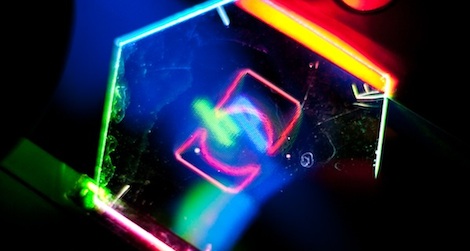

The new technology can be packed into a tiny piece of glass, requires no glasses and can project images and video in full color. Image via Nature/Fattal et. al.
Most of the research that goes into producing cutting-edge commercial technology goes on in corporate R&D departments, away from the public eye. Every so often, though, some of that work gets published in a scientific journal, giving us a sneak preview of the capabilities we might see in our smart phones and devices in the years to come.
That’s certainly the case with a study in week’s issue of Nature, in which researchers from Hewlett-Packard detail their new invention: A mini 3D display that can be installed in a millimeter-thick piece of glass and works without special glasses. The system, the researchers say, can project static images or video in a range of colors.
In other words, when you buy a phone (if we’re still calling them “phones”) in ten or twenty years from now, chances are good that it will be equipped with a 3D system like this one, allowing you to see textures and depths-of-view as if you were in the scene rather than through holding a device in your hand. The team presents their display’s features in the video below:
The system works, as all 3D displays do, by sending a different image to each of our eyes, utilizing the fact that each of our eyes receiving a slightly different view of our surroundings is responsible for the fact that we see the world in 3D in the first place. But this display’s means of accomplishing the feat—and thereby simulating, to our brain, an image with depth—is different from previous ones.
Glasses-based 3D systems use various filtering mechanisms to show each of our eyes a different view. Some have shutters that rapidly open and close for each eye, and are synced with alternating images presented on the screen that are intended for one eye or another. A simpler, more common system (that you’re probably familiar with if you’ve gone to see a 3D movie) involve a pair of glasses with a blue lens and a red one, which cause two differently colored images on the screen to each reach one eye.

The illusion of 3 dimensions is a result of light scattered in many directions, so each of the viewer’s eyes see a different image no matter where they’re situated (part C). Image via Nature/Dodgson
This new display, though, works without glasses, encoding the mechanism in the screen itself. It does this by reflecting light (produced along its edges) with specialized “grated pixels” that project light in several different directions, rather than straight to the eye. When you look at a screen tiled with grated pixels, each of your eyes sees a slightly different image that’s been projected from the screen, creating the illusion of depth no matter where you stand.
But the technology’s real trick is creating this illusion for a relatively broad viewing angle—in this case, one that’s 90 degrees wide. The Nintendo 3DS, by contrast, uses the same pixel-directed technique, but just sends out light in two directions, so it only works for a user located a particular distance from the machine, directly in the center, where the two beams of light intersect (as in part A of the image to the right). Because the 3DS is a gaming device, this isn’t much of a problem, because users typically hold it right in front of them at arm’s length when they play.
The new HP display, though, is intended to someday be part of smartphones and tablets, so the researchers wanted to create a 3D projection that multiple viewers can crowd around and see from a variety of angles. They did this by using grated pixels that can split light in 14 different directions, instead of merely two.
As a result, differently-directed beams of light intersect at a number of spots in front of the display, so a user can be located nearly anywhere in front of it and still have each eye see a different image—and thus get the 3D illusion (as in part C of the image). The current technology does still leave some blind spots, but the researchers say they plan to increase the number of light directions from 14 to 64 in the future, further improving the amount of viewing angles saturated by the display.
Of course, this is a proof-of-concept, not a technology ready for immediate industrial application, so it’ll probably be a little while before we start to see this sort of 3D display popping up in devices on the market. Still, the technology gives us a hint of what researchers are working on for the future—and suggests that R2-D2′s 3D hologram projector isn’t so far-fetched after all.
/https://tf-cmsv2-smithsonianmag-media.s3.amazonaws.com/accounts/headshot/joseph-stromberg-240.jpg)