
How The Fukushima Exclusion Zone Shows Us What Comes After The Anthropocene
Images of the evacuated area around the Fukushima Daiichi power plant offer a glimpse at a world without humans
/https://tf-cmsv2-smithsonianmag-media.s3.amazonaws.com/accounts/headshot/smartnews-colin-schultz-240.jpg)
/https://tf-cmsv2-smithsonianmag-media.s3.amazonaws.com/filer/2012072912100507_29_2012_earth-from-space.gif)
We are currently living in the Anthropocene—the “age of man.” In a world-view shifting story last year, The Economist describes the (still unofficial) new epoch of life on Earth:
In 2000 Paul Crutzen, an eminent atmospheric chemist, realised he no longer believed he was living in the Holocene. He was living in some other age, one shaped primarily by people. From their trawlers scraping the floors of the seas to their dams impounding sediment by the gigatonne, from their stripping of forests to their irrigation of farms, from their mile-deep mines to their melting of glaciers, humans were bringing about an age of planetary change. With a colleague, Eugene Stoermer, Dr Crutzen suggested this age be called the Anthropocene—“the recent age of man”.
Christie Nicholson writes at Smart Planet about the main question raised by the anthropocene: Do we have even more power over the planet than we previously imagined?
If technological innovation brought humans to a population of 7 billion can it also make the future planet livable? Can we innovate our way out of climate and geologic problems?
There are loads of brilliant and dedicated scientists and engineers working on this problem, so hopefully we’ll be fine. But what if we aren’t?
To imagine a world without humans raises visions of Yellowstone National Park or other heavily preserved patches of wilderness. But to imagine a world that is post-human–as Alan Weisman did in his seminal book The World Without Us–is a different thing altogether. Unfortunately, we continue to create places on Earth that suggest what that world could look like.
It’s been almost a year and a half since the magnitude 9.0 Tohoku-Oki earthquake struck off the coast of Japan, spawning a tsunami that knocked out the Fukushima Daiichi power plant. People living within 20 kilometers of the plant were evacuated, and filling in that voids were plants, lots of plants.
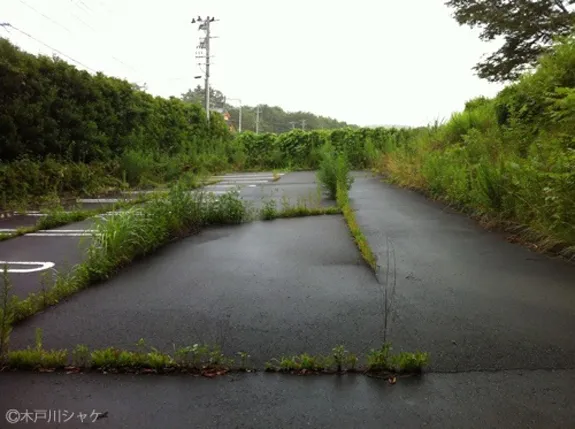
Japanese news website GetNews, (discussed in English by Kotaku), has a series of photos from within the town of Ōkuma. The photos are reminiscent of those from Pripyat, a ghost town left by the 1986 Chernobyl nuclear disaster.
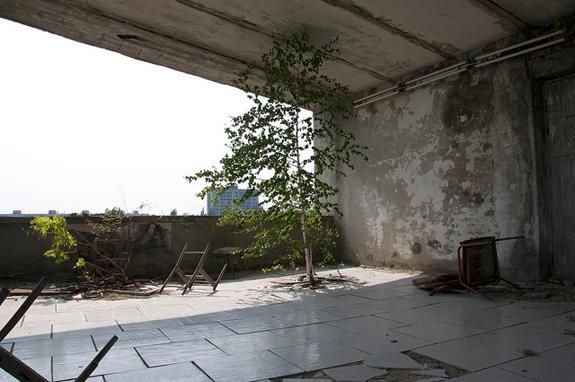
Humans may be taking control of the planet, but when we’re gone, the Earth will have no problems taking it back.
More from Smithsonian.com:
Accepting the Idea of Extinction
Top Ten Places Where Life Shouldn’t Exist… But Does
/https://tf-cmsv2-smithsonianmag-media.s3.amazonaws.com/accounts/headshot/smartnews-colin-schultz-240.jpg)