Blogs

  • News
  • |
  • Art
  • |
  • History
  • |
  • Food and Travel
  • |
  • Science
SmartNews

Keeping You Current

Around the Mall

Scenes and sightings from Smithsonian museums and beyond


August 9, 2012 8:00 am

The History of the Exclamation Point

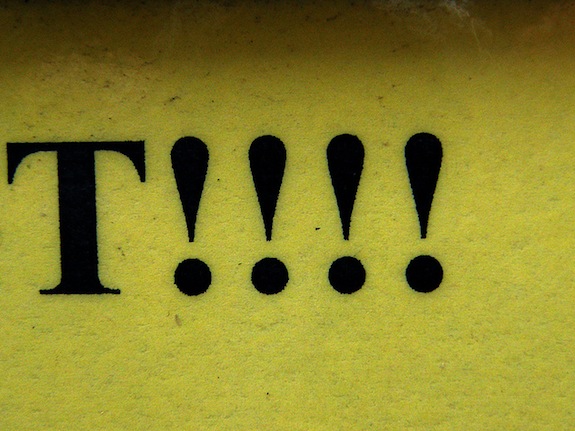
Does this sign really need four exclamation points? Image: Eva the Weaver

Hey!! Have you noticed that everyone who emails you seems to be super excited all the time!? Those are some perky emails!!

Maybe it’s because, online, we can’t really convey what we mean. Or maybe we’re all just way perkier these days! But whatever the reason, the exclamation point is creeping into nearly every online interaction. And everyone loves to complain about it. But where did the punctuation come from in the first place, and are we really over using it?

Everyone seems to have their own rules about the exclamation point in online correspondence. Some will only use one, at the end of the email. “Thanks!” Others use them in the subject to convey importance. Others use them willy nilly, like they’re the most excited and happiest person in the whole world. At the New York Times, opinion writer Ben Yagota learns another rule about exclamation point usage:

 A friend’s 12-year-old daughter once said that in her view, a single exclamation point is fine, as is three, but never two. My friend asked her where this rule came from and the girl said, “Nowhere. It’s just something you learn.”

But where did the exclamation point come from? Any why  does it seem to be creeping into everything we do?

Turns out, no one really knows the history of the punctuation mark. The current running theory is that it comes from Latin. In Latin, the exclamation of joy was io, where the i was written above the o. And, since all their letters were written as capitals, an I with an o below it looks a lot like an exclamation point.

But it wasn’t until 1970 that the exclamation point had its own key on the keyboard. Before that, you had to type a period, and then use the backspace to go back and stick an apostrophe above it. When people dictated things to secretaries they would say “bang” to mark the exclamation point. Hence the interobang (?!) – a combination of a question (?) and an exclamation point (!). In the printing world, the exclamation point is called “a screamer, a gasper, a startler or a dog’s cock.”

There are even a few places with exclamation points in their names:

  • Westward Ho!, a town in England, is named after the Charles Kingsley novel.
  • Saint-Louis-du-Ha! Ha! is a real town in Quebec.
  • Hamilton, Ohio, changed its name to Hamilton! in 1986.

But complaining about this incessant exclaiming isn’t new. The Guardian quotes several writers who are less than pleased with the punctuation mark.

“Cut out all those exclamation marks,” wrote F Scott Fitzgerald. “An exclamation mark is like laughing at your own jokes.”

Elmore Leonard wrote of exclamation marks: “You are allowed no more than two or three per 100,000 words of prose.” Which means, on average, an exclamation mark every book and a half. In the ninth book of Terry Pratchett’s Discworld series, Eric, one of the characters insists that “Multiple exclamation marks are a sure sign of a diseased mind.” In Maskerade, the 18th in the series, another character remarks: “And all those exclamation marks, you notice? Five? A sure sign of someone who wears his underpants on his head.”

Sometimes, those exclamation points do their job. Victor Hugo once sent a telegram to his publisher that simply read “?” to which he received back “!”. Hugo wanted to know how his book was doing, and it was doing quite well. There, the exclamation point serves its purpose.

But today, The Guardian and the New York Times both argue, we are overusing our exclamations. There is even a blog chronicling the incessant use of the bang, called Excessive Exclamation!! Maybe they’re right, or maybe we all just need something to argue about. Discuss!!!


More from Smithsonian.com:

Don Foster Has a Way With Words

Baking a Punctual Cake


***

Sign up for our free email newsletter and receive the best stories from Smithsonian.com each week.

11 Comments »

  1. I think Elmore Leonard is being just a bit too restrictive, but it is a good rule. Once every 43,512 words is about as generous as is necessary with a exclamation point.

    Comment by steven — August 9, 2012 @ 11:56 am


  2. Interrobang

    Comment by BROKALAKIS — August 9, 2012 @ 4:56 pm


  3. I use exclamation points frequently only in emails, and I think it’s because it’s difficult to express tone in emails like you can express tone in your voice. We use emails so much for professional conversations these days — rather than picking up the phone or walking over to speak to someone in person — and I don’t want people to feel I’m barking at them (unless I am barking at them). I over-compensate by using exclamation points to lighten the tone. Perhaps a lot of people do the same thing.

    Comment by Kelly — August 9, 2012 @ 5:24 pm


  4. When I was in college I rarely used an exclamation point when writing. Now, many years later, I find I use them all the time, especially in emails and on Facebook. I think it is to help express tone since you can’t do that otherwise. Congrats. You are saying it out of duty. Congrats! You are happy for the person. Congrats!!! You know it’s a big deal and are really happy for the person. Congrats!!!!!! Squeal, jump up and down and give a huge hug, you are so happy for the person and know what this means to them and you want to express that.

    Comment by fraucade — August 9, 2012 @ 9:43 pm


  5. Putting some sort of arbitrary limit on exclamation points is like demanding that all people should express themselves with the same demeanor. Haven’t we all met someone who is too loud, or seems to be a bit too perky? Sure, but sometimes those people lighten an otherwise boring day. (Fraucade got it right on!) I have experienced plenty of folks laugh at their own jokes and it is not always annoying or inappropriate if you laugh together. Counter to the Latin joy theory, an exclamation is also used to raise the level of anger or urgency, not only elation. (So be careful Kelly, because an exclamation point can also enhance the bark, even when not intended.) Perhaps excessive exclamation points are similar to ALL CAPS, a digital etiquette no-no, that most newbies eventually learn to respect. To those who still want to apply some limit, just remember that you are only allowed one frown a day, so even if you don’t like my comment, you are not allowed to say so at least until tomorrow.

    Comment by CP — August 10, 2012 @ 4:29 am


  6. Latin did not only have capital letters, as said here. They had cursive writing too. Capitals are better known because they were used for inscriptions on stone and other hard materials (straight lines easier than curved ones in such circumstances).

    Comment by MS — August 12, 2012 @ 4:08 pm


  7. “Everyone seems to have their own rules about the exlamation point” Including, it would seem, their own rules about spelling it.

    Comment by vanderleun — August 26, 2012 @ 2:09 pm


  8. F. Scott Fitzgerald said that an exclamation point is like laughing at your own joke.

    Comment by G. W. Rutler — August 26, 2012 @ 4:52 pm


  9. Allegedly, the Beatles’ movie “Help!” was originally titled “Help” but there was another film being made under that name so they added the exclamation point to get around any copyright issues.

    Comment by T Herling — August 27, 2012 @ 11:30 am


  10. Gee, that’s interesting. I have just checked one of the seven old typewriters I have (an Hermes from 1960s) and it has an exclamation mark. As well, I took dictation for decades, and prior to 1970, or after, I have NEVER had anyone say “bang” or “interrobang” (whatever) to me. NEVER. So … don’t know whether this was a regional thing somewhere in US, or what … but this is not 100% true (my typewriter), AND perhaps other ancient secretaries’ recollection … feel BAD criticisng research at The Smithsonian though … :) Good day.

    Comment by Marie Payne — October 19, 2012 @ 1:48 pm


  11. I think the comment about the typewriter not having an exclamation in a regular place on the keyboard until 1970 is incorrect.

    I worked with a number of typewriters which significantly predated 1970, and all of them had an exclamation in the “Shift-1″ location. (The typewriters were a mix of IBM and Smith-Corona models mostly, with one or two antique oddities thrown in here and there for good measure)

    Comment by MgS — October 19, 2012 @ 3:54 pm


RSS feed for comments on this post. TrackBack URI

Leave a comment

Comments are moderated, and will not appear until Smithsonian.com has approved them. Smithsonian reserves the right not to post any comments that are unlawful, threatening, offensive, defamatory, invasive of a person's privacy, inappropriate, confidential or proprietary, political messages, product endorsements, or other content that might otherwise violate any laws or policies.

Spam protection by WP Captcha-Free

Advertisement


Trending Today New Research Cool Finds

Follow Us


Travel with Smithsonian


Advertisement