
The Olympic Salute We Don’t Use Anymore Because it Looked too Much Like Heiling Hitler
Saluting Hitler and saluting the Olympics look basically identical, which is why you never see anybody saluting the Olympics anymore.
/https://tf-cmsv2-smithsonianmag-media.s3.amazonaws.com/accounts/headshot/Rose-Eveleth-240.jpg)
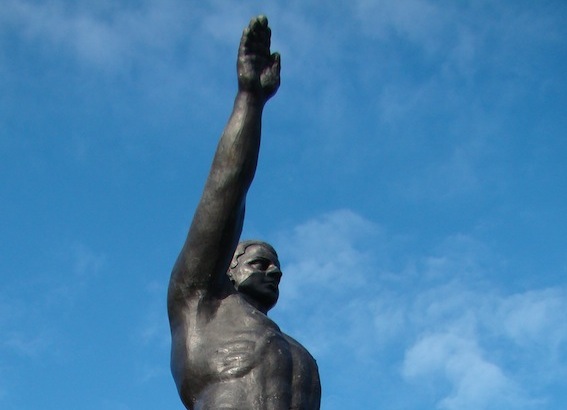
This statue is saluting the Olympics. Image: Arch

If you really loved the Olympics, you would do the official Olympic salute. It goes like this: right arm out slightly and pointed upward, fingers together, palm out. Kind of like you’re raising you’re hand in class. Unfortunately, it also kind of looks like you’re heiling Hitler. Which is why no one uses the official Olympic salute anymore.
At Today I Found Out, they dig up the history, and confusion, caused by the salute. Apparently the Olympic salute came long before Hitler’s gesture, but it caused all sorts of confusion in the 1936 Berlin Olympics. Apparently no one could tell which teams were saluting Hitler, and which were saluting the Olympics. The French team, who were trying to salute the Olympics, got a standing ovation from the German crowd who thought they were saluting the Fuhrer.
The origin of the salutes is unclear. Some people think that both the Olympic and the Nazi versions came from an imaginary Roman salute (imaginary because there are no Roman accounts of this salute, but 19th and 20th century artwork all portrayed Romans doing it). It was adopted by the Olympics, and then also by the Italian Fascist Party. From there, the Nazi party swiped the salute to use for their own rituals. Although that’s not how Hitler tells it. Here’s his story, as Today I Found Out quotes from a “Table Talk” from 1942:
I made it the salute of the Party long after the Duce had adopted it. I’d read the description of the sitting of the Diet of Worms, in the course of which Luther was greeted with the German salute. It was to show him that he was not being confronted with arms, but with peaceful intentions. In the days of Frederick the Great, people still saluted with their hats, with pompous gestures. In the Middle Ages, the serfs humbly doffed their bonnets, whilst the noblemen gave the German salute. It was in the Ratskeller at Bremen, about the year 1921, that I first saw this style of salute. It must be regarded as a survival of an ancient custom, which originally signified: “See, I have no weapon in my hand!” I introduced the salute into the Party at our first meeting in Weimar. The SS at once gave it a soldierly style. It’s from that moment that our opponents honored us with the epithet “dogs of Fascists”.
The salute was commonly used in Olympic posters, like this one from the 1924 Paris Olympics. In 1948 the Ottawa Citizen reported that the salute would probably be discontinued after the 1948 games. They write: “The Swiss propose a new salute, consisting of turning the head sharply to the right while keeping the hands to the side.” But it wasn’t really necessary to ban the thing – after 1936 it all but disappeared from use.
More at Smithsonian.com:
The Little-Known History of How the Modern Olympics Got Their Start
Hitler’s Very Own Hot Jazz Band
/https://tf-cmsv2-smithsonianmag-media.s3.amazonaws.com/accounts/headshot/Rose-Eveleth-240.jpg)