
Curiosity Nails It: Mars Used to Have Flowing Water
Scientists report what they suggest is the best evidence yet that water flowed on Mars
/https://tf-cmsv2-smithsonianmag-media.s3.amazonaws.com/accounts/headshot/smartnews-colin-schultz-240.jpg)
/https://tf-cmsv2-smithsonianmag-media.s3.amazonaws.com/filer/MarsEarth-hero-631.jpg)
In a news release, NASA scientists working with the imagery being passed back to Earth by the Curiosity rover report what NPR is calling “definitive proof” that Mars once saw flowing surface water.
To be clear, NASA did not find flowing water but rather the signs that liquid water once flowed on the red planet, likely billions of years ago. The evidence for this remarkable claim comes from two tangential lines of evidence. First, the images collected by the rover show rocky outcrops, with small pebbles and rocks trapped within a matrix known as a conglomerate. The shapes of the embedded rocks, NASA says, are reminiscent of those found along a riverbed after they’ve been transported across long distances. Further, the pebbles are too large to have been lifted up and carried by the wind, suggesting that it was water, not air, that carried them to their resting place.
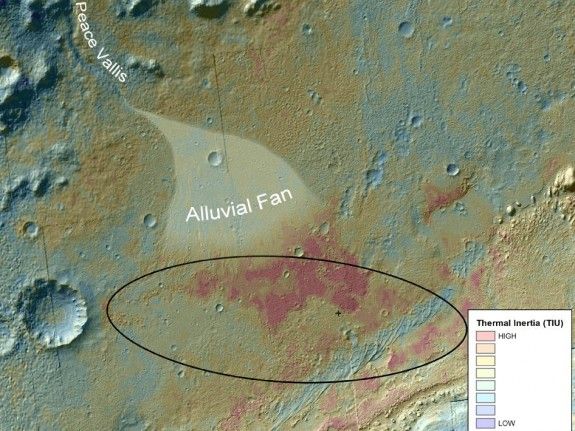
Adding weight to the claim of ancient Martian water is the larger geological setting within which the outcrops were found. At the northern end of Gale crater, the site of Curiosity’s daring landing nearly two months ago, lies an alluvial fan. Alluvial fans form when water flows down a steep slope onto a shallow plain. The sudden shift in slope causes the water to slow down and to lose its ability to carry rocks and other sediment, causing a build-up of material at the bottom of the hill. Scientists know of at least a few dozen such alluvial fans on Mars, but this is the first time one has ever been sampled up close. Mars’ alluvial fans are predominantly thought to have been formed over millions of years, with the process ending more than 3.5 billion years ago.
Evidence of flowing surface water on Mars has been proposed in the past, though not all has held up to the scrutiny that followed. Water is, however, known to exist in Mars ‘ polar ice caps and in its atmosphere. This evidence stems from imagery and context, but follow-up research with Curiosity’s geology toolkit could help firm up the claim.
More from Smithsonian.com:
Dirty Curiosity Rover Could Seed Mars With Earthly Bacteria
/https://tf-cmsv2-smithsonianmag-media.s3.amazonaws.com/accounts/headshot/smartnews-colin-schultz-240.jpg)