Blogs

  • News
  • |
  • Art
  • |
  • History
  • |
  • Food and Travel
  • |
  • Science
SmartNews

Keeping You Current

Around the Mall

Scenes and sightings from Smithsonian museums and beyond


September 4, 2012 4:01 pm

The Genetics Behind Venus, the Mysterious Two-Faced Cat

Photo: Venusmommy

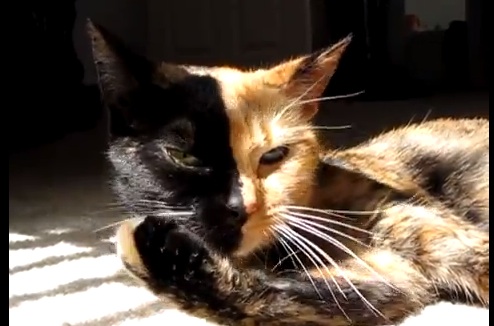
A cat named Venus is one of the most famous felines on the planet. The three-year-old torty has her own Facebook page and has collected more than a million views on YouTube, in addition to making appearances on the Today Show and in other news venues. The reason behind Venus’ fame? Her striking two-face markings: half black-with-yellow eye, half orange-with-blue-eye.

National Geographic investigates the possible genetic anomalies that contribute to Venus’ unique look. Cat geneticist Leslie Lyons of the University of California, Davis, told NatGeo that she’s never seen a kitty quite like Venus. “She is extremely, extremely rare,” she said.

Venus is not necessarily a chimera, or an animal whose cells contain two sets of DNA caused when two embryos fuse together during development. But Lyons said to find out for sure whether or not Venus is a chimera, she’d need to perform genetic testing.

If the cat is no chimera, what would explain her striking pattern? “Absolute luck,” Lyons told NatGeo. For example, the black coloration could have randomly activated in all of the cells on one side of her adorable kitty face, while cells coding for orange coloration kicked in on the other side. The two patches then met in the middle as she developed in the womb.

But it’s Venus’ single blue eye, Lyons points out, is the real mystery. Cats usually sport yellow or green eyes, while those with baby blues tend to have Siamese heritage and include predominantly white coats. Venus, however, only has a small white patch on her chest, not enough to explain the blue eye.

Genetically, Lyons admits, “She is a bit of a mystery.”

Check out Venus in her natural habitat:

More from Smithsonian.com:

Cats as Pets and Predators  
A Brief History of House Cats 


***

Sign up for our free email newsletter and receive the best stories from Smithsonian.com each week.

6 Comments »

  1. I think Venus is very beautiful! She is aptly named after the Roman goddess of love and beauty.

    Comment by Odyssey8 — September 4, 2012 @ 4:44 pm


  2. Shoulda named her “Gemini”! ;-)

    Comment by Lucie — September 4, 2012 @ 8:52 pm


  3. what an interesting feline

    Comment by Rodney Porter — September 5, 2012 @ 4:14 am


  4. To the smithsonian. Venus is not alone with the two face. My cat Chihiro has the almost opposite split in the face. It is her left side that is black. But her eyes went from blue to yellow/green/Brown when she was 5 month old, like most cats. She has a facebook page to, But is not so famous :)
    Perhaps it is not that unusual.
    Best regards
    Louise

    Comment by Louise Kirkegaard — September 5, 2012 @ 1:59 pm


  5. Gene expression, structure and orientation might be slightly different between the right and left part of the body
    Abstract
    I observed the right and left kidneys, ovaries and testicles in the cows, calves, sheep and the rams. There was an obvious asymmetry, changing species to species and their’s individuals. In the one of the calves right kidney was heavier 300 gram and longer 3 cm than the left. Human body has a bilateral structure but there is an internal and external asymmetry.
    Genotype determines phenotype. To produce the left-right asymmetry, there must be some differences in the same gene expression,structure and orientation between the right and left part of the body.I think there is also a handed mechanism here.
    I tried to explain how this asymmetric phenotype might be programmed and oriented at the DNA leveI between the right and left part of the body
    (This artcle is written and sent to Nature,Science at March 28,2008)

    Comment by Engin Sayin — September 25, 2012 @ 7:58 am


  6. My cat had a face split in two. One half grey and one half a light brown. She had yellow/green eyes though. Never had blue, or not that I can remember. Just saying. Maybe its not so “extremely rare.”

    Comment by Kenda Heffner — January 30, 2013 @ 12:36 am


RSS feed for comments on this post. TrackBack URI

Leave a comment

Comments are moderated, and will not appear until Smithsonian.com has approved them. Smithsonian reserves the right not to post any comments that are unlawful, threatening, offensive, defamatory, invasive of a person's privacy, inappropriate, confidential or proprietary, political messages, product endorsements, or other content that might otherwise violate any laws or policies.

Spam protection by WP Captcha-Free

Advertisement


Trending Today New Research Cool Finds

Follow Us

Travel with Smithsonian


Advertisement