
Archaeologists Uncover Massive Stone Age Complex in Scotland
A 5,000-year old temple complex may have been the centre of Stone Age British culture
/https://tf-cmsv2-smithsonianmag-media.s3.amazonaws.com/accounts/headshot/smartnews-colin-schultz-240.jpg)
/https://tf-cmsv2-smithsonianmag-media.s3.amazonaws.com/filer/10_08_2012_ness-of-brodgar-470.jpg)
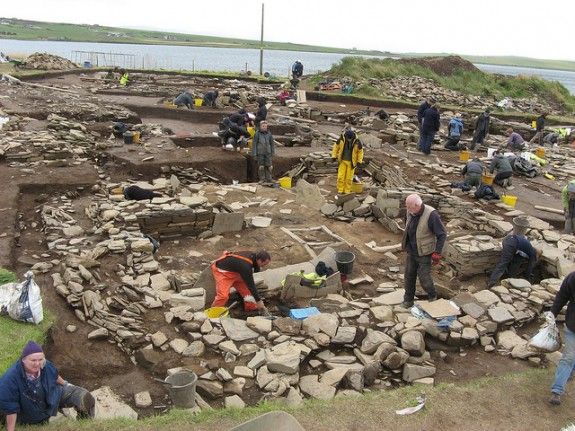
A new find in the region surrounding the Ring of Brodgar, a stone-pillar construction mounted atop a sloping terrain, has overthrown the scientific conception of Stone Age life in the British Isles. Archeologists have uncovered a six-acre temple complex of painted stone and paved walkways, which was built five thousand years ago—before the pyramids of Egypt or even Stonehenge.
As Robin McKie writes in The Guardian, although the Ring of Brodgar has long been a focus of archeological excavation, a geophysical survey of the Ness of Brodgar, the region around the temple, “revealed that for all their attention, scientists had completely overlooked a Neolithic treasure that utterly eclipses all others on Orkney – and in the rest of Europe.”
What archaeologists thought to be a natural moraine, a pile of dirt and rock left over by a receding glacier, turned out to be much more. Buried beneath the dirt were “two giant walls, each more than 100m long and 4m high.” Within these walls, says McKie,
he complex at Ness contained more than a dozen large temples – one measured almost 25m square – that were linked to outhouses and kitchens by carefully constructed stone pavements. The bones of sacrificed cattle, elegantly made pottery and pieces of painted ceramics lie scattered round the site. The exact purpose of the complex is a mystery, though it is clearly ancient. Some parts were constructed more than 5,000 years ago.
According to scientists working on the dig, the findings suggest the northern Orkney Islands may be spawning point for much of Stone Age British culture. As Nick Card with the Orkney Research Centre for Archaeology told The Guardian,
Orkney was the centre for innovation for the British isles. Ideas spread from this place. The first grooved pottery, which is so distinctive of the era, was made here, for example, and the first henges – stone rings with ditches round them – were erected on Orkney. Then the ideas spread to the rest of the Neolithic Britain. This was the font for new thinking at the time.
More from Smithsonian.com:
Romancing the Stones
This post has been updated for clarity.
/https://tf-cmsv2-smithsonianmag-media.s3.amazonaws.com/accounts/headshot/smartnews-colin-schultz-240.jpg)