
Maya Holy Snake Queen’s Tomb Unearthed in Guatemala
/https://tf-cmsv2-smithsonianmag-media.s3.amazonaws.com/accounts/headshot/Rachel-Nuwer-240.jpg)
/https://tf-cmsv2-smithsonianmag-media.s3.amazonaws.com/filer/ed/cf/edcfb452-bd8a-4a45-8630-be1db1f656e7/tikal.jpg)
During an excavation of the royal Maya city of El Perú-Waka’ near Tikal, in northwestern Guatemala, a team of archaeologists from Washington University in St. Louis unearthed a surprising discovery. Within a burial chamber, the scientists came across a small, carved alabaster jar depicting the head and arm of a mature woman, a strand of hair in front of her ear. Four glyphs carved into the jar indicated that it belonged to Lady K’abel, a seventh-century Maya Holy Snake Lord, who is considered one of the great queens of Classic Maya civilization.
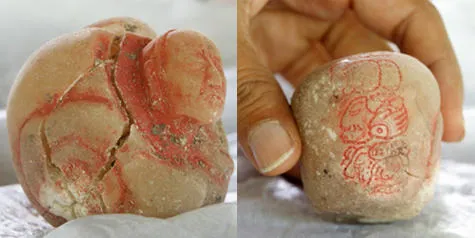
The archaeologists also found ceramic vessels and stone carvings that further convinced them they had stumbled across K’abel’s final resting place. For Maya history, the discovery stands out not only because of K’abel’s important place in Maya culture, but because of the mix of both archaeological and historical records—texts and images—found in her tomb. Finding both of these components in the Maya area happens only rarely.
The team originally set out to uncover “ritually-charged” Maya features such as shrines and alters, though in retrospect they think it makes sense that K’abel’s people chose to bury her in such a spiritually prominent place in their city. Moreover, K’abel’s tomb explains why the temple site was so revered in the Late Classic period.
K’abel ruled with her husband, K’inich Bahlam, between the years 672 to 692 A.D. She carried the title “Kaloomte’,” or “Supreme Warrior,” and held a higher authority than her husband. She served as the military governor of the Wak kingdom for her family, also known as the imperial house of the Snake King.
More from Smithsonian.com:
El Mirador, the Lost City of the Maya
Secrets of the Maya: Deciphering Tikal
/https://tf-cmsv2-smithsonianmag-media.s3.amazonaws.com/accounts/headshot/Rachel-Nuwer-240.jpg)