
The Man Who Deserved ’66 Percent of the Credit’ for Cloning Dolly Has Died
Earlier this week Keith Campbell, one of the scientists responsible for Dolly, died at the age of 58
/https://tf-cmsv2-smithsonianmag-media.s3.amazonaws.com/accounts/headshot/Rose-Eveleth-240.jpg)
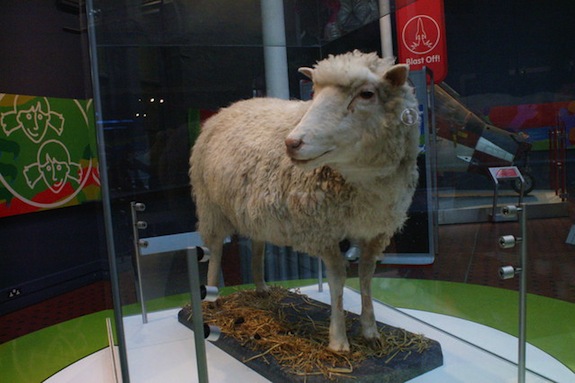
Dolly, stuffed. Image: Mike Pennington

In 1996, when scientists announced they had cloned a sheep, the world basically exploded. Dolly, the cloned sheep in question because an international celebrity. Her birth was evidence of a new age, one that was scary to many, but also amazing and full of discovery. Earlier this week Keith Campbell, one of the scientists responsible for Dolly, died at the age of 58. The New York Times explains just how Dolly was born:
In January 1996, he and his colleagues took cells from the udder of a 6-year-old sheep, starved them and introduced them into eggs donated by other sheep. Of the nearly 300 eggs they fused in this way, only a handful developed fully enough to be implanted in the wombs of adult ewes.
Edinburgh Evening News puts Campbell’s contribution to Dolly this way:
Sir Ian Wilmut, who led the team and became known as the sheep’s creator, was reported to have said Prof Campbell deserved “66 per cent of the credit” for his contribution.
Campell’s work, on both Dolly and other projects, has advanced modern science in a number of ways. CNN spoke with Jose Cibelli from Michigan State University, who said:
“We anticipate that within the next five years, patients suffering from degenerative diseases will be treated — if not cured — using technology introduced by Dr. Campbell,” the university quoted him as saying. “All these scientific breakthroughs Professor Campbell gave us did not happen by chance; they are the product of years of study, hands-on experimentation and above all, a deep love for science.”
Dolly died in 2003, but not before giving birth to six lambs. Her body is mounted at the National Museum of Scotland.
More from Smithsonian.com:
/https://tf-cmsv2-smithsonianmag-media.s3.amazonaws.com/accounts/headshot/Rose-Eveleth-240.jpg)