
This Is What Happens When a Black Hole Eats a Black Hole
A super-computer simulation calculates what happens when two black holes merge
/https://tf-cmsv2-smithsonianmag-media.s3.amazonaws.com/accounts/headshot/smartnews-colin-schultz-240.jpg)
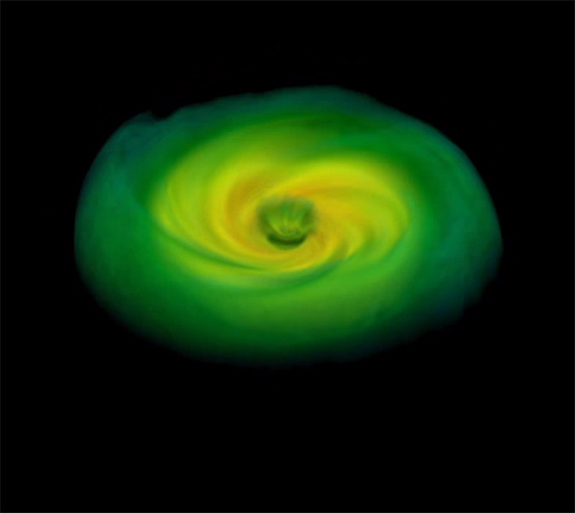
Black holes are the ultra-dense, ultra-compact, ultra-massive pits of overwhelming gravity that have a pull so strong that, for the most part, nothing can escape their grasp—not even light. When something comes within range of a black hole, whether it be a star, a cloud of gas or a truly unfortunate intergalactic traveler, that thing is stretched thin and ripped apart, atom by atom. So, the obvious follow-up question to all of this is: What happens when two black holes try to eat each other?
Universe Today knows: “The short answer? You get one super-SUPERmassive black hole.”
The longer answer, they say, is being worked out by a team of supercomputer-enabled scientists. When two super-massive black holes approach one another, the disks of orbiting gas and dust that surround them merge, creating a “towering vortex that extends high above the center of the accretion disk.”
The “towering vortex” identified in the simulation, says Bruno Giacomazzo in a NASA release, “is exactly the type of structure needed to drive the particle jets we see from the centers of black-hole-powered active galaxies.”
The merging process, NASA says, would kick out gravitational waves—distortions in the fabric of space-time that could be seen by satellites orbiting above the Earth. But, in order to see these potential gravitational waves, a finding that could help round out our understanding of many facets of the universe, scientists need to know what sort of sign to look for. Hence, the above computer simulation of two merging black holes.
While gravitational waves promise to tell astronomers many things about the bodies that created them, they cannot provide one crucial piece of information — the precise position of the source. So to really understand a merger event, researchers need an accompanying electromagnetic signal — a flash of light, ranging from radio waves to X-rays — that will allow telescopes to pinpoint the merger’s host galaxy.
More from Smithsonian.com:
Astronomers Find More Than 1,500,000 New Black Holes
/https://tf-cmsv2-smithsonianmag-media.s3.amazonaws.com/accounts/headshot/smartnews-colin-schultz-240.jpg)