
What If You Replaced All of New York City’s Carbon Dioxide Emissions with Big Blue Bouncy Balls?
Watch New York City get buried under its own carbon emissions
/https://tf-cmsv2-smithsonianmag-media.s3.amazonaws.com/accounts/headshot/smartnews-colin-schultz-240.jpg)
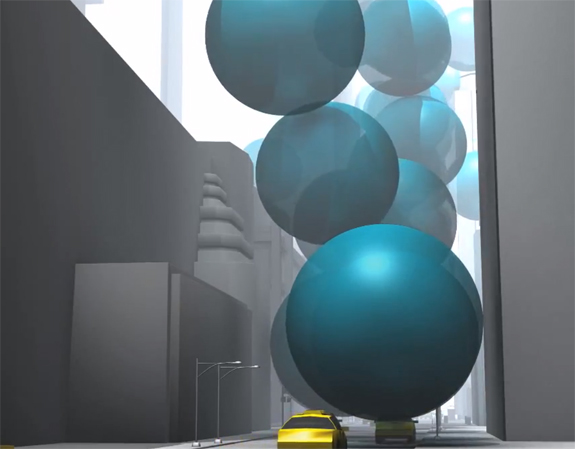
Global warming is a tricky problem, a dilemma not at all aided by the fact that greenhouse gases are invisible. If you can’t see something, if you don’t interact with it during your daily life and if it doesn’t have any obvious, specific effect on you now, then it is easier for it to slip to the back of your mind.
New Yorkers, for instance, pumped out roughly 54 million metric tones of carbon dioxide in 2010, a 7 million ton drop over 2005 levels, according to a report from New York City’s Mayor’s office. To give a sense of what carbon dioxide emissions would look like if we could see them, the Environmental Defense Fund partnered with Carbon Visuals to produce the above video, showcasing what it would look like if, instead of New York City’s carbon dioxide drifting off into the atmosphere, it hung around as giant one-ton balls of gas.
This isn’t the first time people have tried to visualize carbon dioxide emissions. ABCNews recently partnered up with imaging company FLIR to demonstrate the greenhouse gases flowing all around us.
More from Smithsonian.com:
There’s a Reason It’s Called Global Warming: European Emissions Rise on Exported American Coal
China’s Per Capita Carbon Emissions Nearly on Par With Europe’s
/https://tf-cmsv2-smithsonianmag-media.s3.amazonaws.com/accounts/headshot/smartnews-colin-schultz-240.jpg)