
Researchers Find Fracking Might Cause Earthquakes After All
New research makes the previously-tangential relationship between fracking and earthquakes much more firm
/https://tf-cmsv2-smithsonianmag-media.s3.amazonaws.com/accounts/headshot/smartnews-colin-schultz-240.jpg)
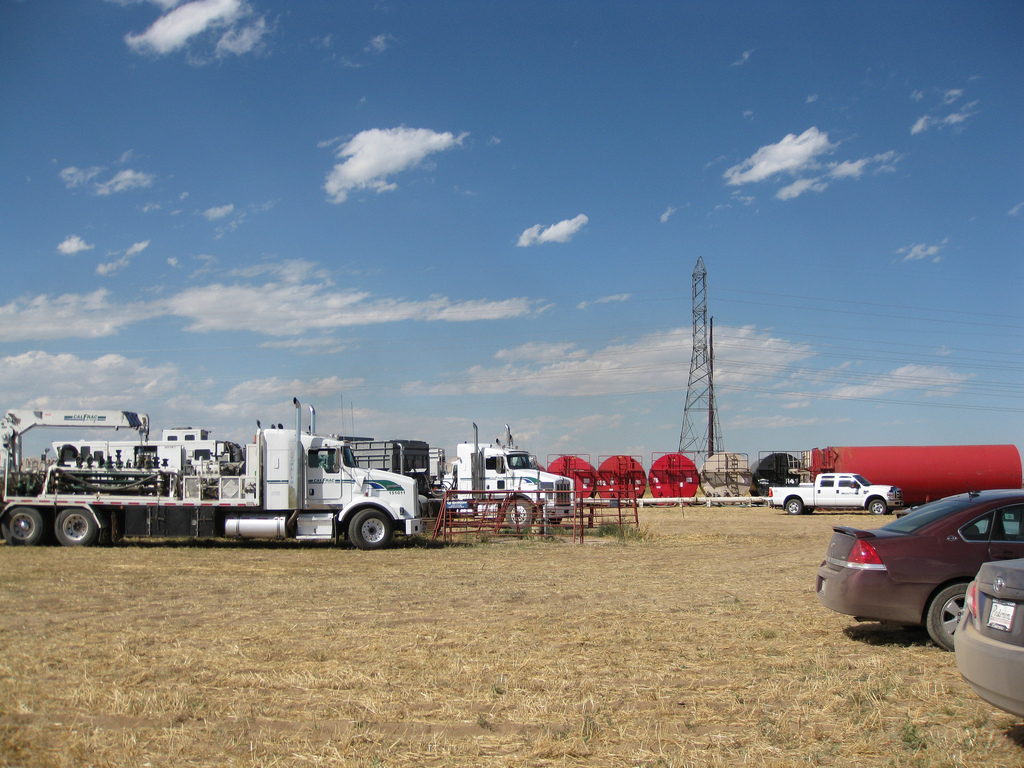
A hydraulic fracturing site near Platteville, Colorado. Photo: Mark Udall
Hydraulic fracturing, the process of pumping high-pressure liquid and sand into a gas well to crack open the surrounding rock, has come under fire by those who argue that fracking could cause earthquakes around the extraction site. The technique is often employed with the intent of extracting otherwise difficult-to-reach natural gas, and based on the known scientific research, those claiming that “fracking causes earthquakes” have been, for the most part, wrong. Or, more delicately, not quite correct. But that may be changing.
Drawing on scientific research and reports by government agencies, Smart News and Smithsonian‘s Surprising Science blog have written that, as the National Research Council puts it, “there is no evidence to suggest that hydraulic fracturing itself is the cause of the increased rate of earthquake.” The known link between fracking and earthquakes has been to do with the waste disposal process, not the fracking itself: inappropriate disposal of waste water used during the fracking process has triggered induced earthquakes.
A recent report by the British Columbia Oil & Gas Commission, however, finds that fracking actually can cause earthquakes.
Earthquake monitoring equipment in northern British Columbia, Canada, says the report, recorded 216 small earthquakes clustered in a small area around an ongoing fracking project in the northern end of the province. Of those earthquakes, 19 of them were rated between 2 and 3 on the Richter magnitude scale. Only one of them was strong enough to be felt at the surface. By comparison, in the past week alone, Southern California experienced 333 earthquakes, with 29 of those having magnitudes from 2.0 to 3.9.
Focusing in on a subset of the earthquakes, the report says,
Eighteen magnitude 1.9 to 3.0 events were selected from dense array microseismic plots. These events were selected because they were located adjacent to hydraulic fracturing stages and could be connected to a single stage fluid injection with some confidence. Evidence strongly suggests that all events were triggered by fluid injection at adjacent stages.
They found that eight of those earthquakes happened while the fracking was ongoing and that all eighteen happened within 24 hours of the fracking injections. The fracking-induced earthquakes happened when the fluid injection caused pre-existing faults within the Earth to slip. The strength of the earthquakes got bigger or smaller the closer or further the fracking was from the fault.
This isn’t the first time a link has been seen between fracking and earthquakes, but the pool of observations remains extremely limited—the report cites other known instances in England and in Oklahoma.
More from Smithsonian.com:
North Carolina Rep Pushes Wrong Button and Approves Fracking in the State
‘Fracking’ for Natural Gas Is Linked With Earthquakes
Two Companies Want to Frack the Slopes of a Volcano
/https://tf-cmsv2-smithsonianmag-media.s3.amazonaws.com/accounts/headshot/smartnews-colin-schultz-240.jpg)