Blogs

  • News
  • |
  • Art
  • |
  • History
  • |
  • Food and Travel
  • |
  • Science
SmartNews

Keeping You Current

Around the Mall

Scenes and sightings from Smithsonian museums and beyond


November 27, 2012 3:26 pm

The First Use of OMG Was in a 1917 Letter to Winston Churchill

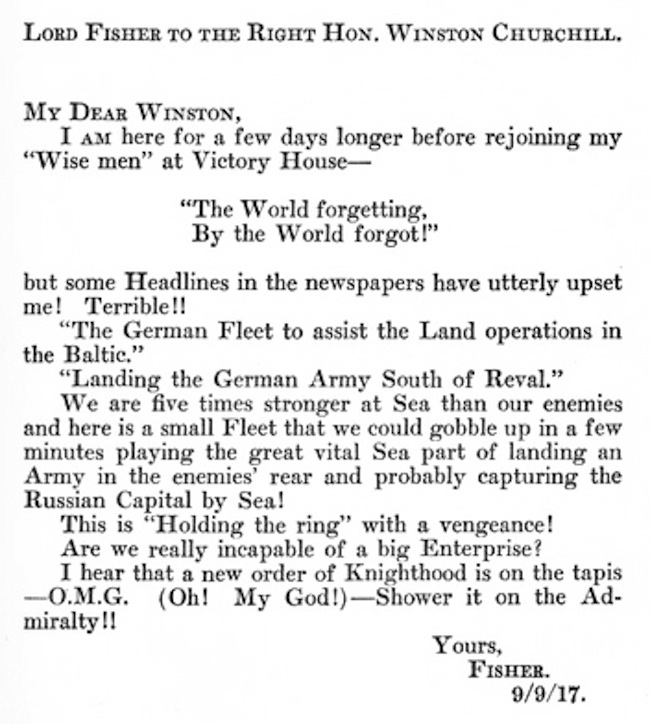
Anorak uncovered this little jewel, the first example of the now-ubiquitous OMG!

IT’S 1917 and Winston Churchill receives a letter from Lord Fisher. It contains the earliest example of OMG |(Oh My God). Did the toffs invent text speak? WTF! (Winston Talks French!)

Fisher was an admiral and naval innovator, who began World War I as First Sea Lord but resigned in 1915. By 1917, his naval career was over. Here’s the letter:
More from Smithsonian.com:

Contemplating Churchill 
Hitler Plotted to Kill Churchill with Exploding Chocolate 


***

Sign up for our free email newsletter and receive the best stories from Smithsonian.com each week.

7 Comments »

  1. Note that this is not a use of OMG as an interjection but rather a suggestion for a new order of knighthood analogous to OBE.

    Comment by Alan Shaw — November 28, 2012 @ 2:40 am


  2. Further to Alan’s perceptive correction, it might be worth pointing out that other orders in the UK have long had humorous alternative readings.

    —8<—-

    From the 1980s series, "Yes, Minister"

    Bernard Woolley: In the service, CMG stands for Call Me God. And KCMG for Kindly Call Me God.
    Hacker: What does GCMG stand for?
    Bernard: God Calls Me God.

    —8<—-

    Official meanings:

    CMG: Companion of the Order of St Michael and St George
    KCMG: Knight Commander …
    GCMG: Grand Cross …

    Comment by Mat Morrison — November 28, 2012 @ 10:36 am


  3. The ‘new’ order of Knighthood ‘on the tapis’ would be the Order of the British Empire, founded in 1917, ”in recognition of the large numbers of people in the British Isles and other parts of the Empire who were helping the war effort both as combatants and as civilians on the home front” Fisher’s allusion is, I assume, ironic since he is saying that the Navy is incapable of operations outside home waters.

    Fisher, in retirement, writing to Churchill about German landings in the Baltic is rubbing salt into a wound; Fisher had bitter arguments with Churchill against the disastrous Gallipoli campaign, pushed through at Churchill’s insistence, and had, instead, been a strong proponent of using the navy for Baltic landings to attack Berlin.

    Comment by Michael Robinson — November 29, 2012 @ 5:28 pm


  4. Obviously, the author has never read the Bible.
    Improper use of OMG in ancient Israel was in vogue, as God himself so condemns.
    Re: Exodus 20:7 and Deuteronomy 5:11 and Leviticus 24:11

    Though “ubiquitous” today, OMG is also considered by many in this world as profane.

    When Christ comes again…then and only then is OMG appropriate.
    For the righteous, OMG will be a term of praise.
    For the wicked, well each may say “OMG. All is lost; for I have sinned.”

    Comment by Michael Maughan — November 29, 2012 @ 9:48 pm


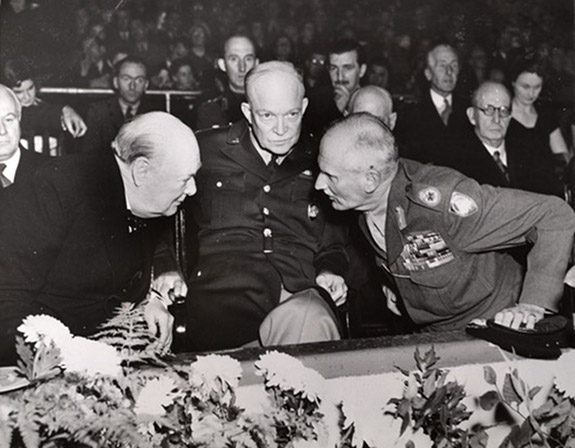
  5. The article references Churchill during the First World War, yet uses a post WW II photo, and one that doesn’t even have him as the focal point. I find it hard to believe a better photo could not be found.

    Comment by Steve Robillard — November 29, 2012 @ 11:53 pm


  6. Quite often someone utters “OMG” in reaction to a tragedy or something else shocking. In those instances, the words are offered up more as a prayer or a plea to God to be watching over the victims than as something profane.

    Comment by Kathy Barber — November 30, 2012 @ 4:01 pm


  7. The jocular versions of CMG etc long predate the TV comedy “Yes, Minister”. GCMG, incidentally, stands for Knight Grand Cross of the Order …

    Comment by Dick Hughes — December 22, 2012 @ 6:15 pm


RSS feed for comments on this post. TrackBack URI

Leave a comment

Comments are moderated, and will not appear until Smithsonian.com has approved them. Smithsonian reserves the right not to post any comments that are unlawful, threatening, offensive, defamatory, invasive of a person's privacy, inappropriate, confidential or proprietary, political messages, product endorsements, or other content that might otherwise violate any laws or policies.

Spam protection by WP Captcha-Free

Advertisement


Trending Today New Research Cool Finds

Follow Us

Travel with Smithsonian


Advertisement