
Your Cell Phone Could Soon Become Part of a Massive Earthquake Detection System
In the future, your cell phone’s accelerometer could help detect earthquakes
/https://tf-cmsv2-smithsonianmag-media.s3.amazonaws.com/accounts/headshot/smartnews-colin-schultz-240.jpg)
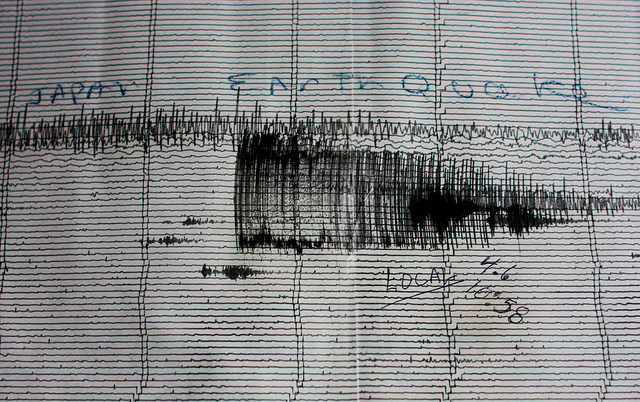
A seismograph in Hawaii recorded the seismic waves of the 2011 Japan earthquake. Photo: Joe Parks
Many new cell phones are bristling with an array of sensors—a compass, a gyroscope, a GPS sensor and an accelerometer—that help the phone figure out where it is and which way it’s pointing, a boon when using mapping or other location-based applications.
But the potential wrapped up in these well-equipped, connected and increasingly ubiquitous devices seems to falling sort of flat, since all we really tend to use these high-tech detectors for is driving in circles in racing games or checking in to yet another Starbucks on Foursquare.
University of California, Berkeley, graduate student Qingkai Kong wants to put these sensors—in particular, the accelerometer—to better use, says Jonathan Amos for the BBC, by turning your smartphone’s three-dimensional motion detector into a little seismic wave detection system.
So far, the cell phone seismometer idea is still in its infancy. But, the researchers have managed to detect simulated earthquakes equivalent to a magnitude 5.0 event in the lab. They hope that the sensitivity will improve as cell phone accelerometers get better.
There are some obvious issues that would get in the way of using such a phone-based seismic network, however. For one, isolating the shaking due to the earthquake from shaking due to pretty much everything else your phone might go through would be pretty much impossible.
he team believes it can solve this problem as well, and has developed an algorithm that will subtract the human “noise” in the data.
“The pattern recognition algorithm sees typical human activities such as walking, running and driving, and we use that information to disengage those activities from the earthquake signal,” said Mr Kong.
The other potential way around this could be to have thousands, or hundreds of thousands, of cell phones working together, such that the consistent blip of the earthquake could be pulled from all the noise.
Working from all this data, says Amos, “a smartphone seismic network has potential to feed directly into the early warning system,” maybe giving people those few precious seconds to brace themselves.
The project is reminiscent of another proposed detection network, where researchers sought to use shipboard GPS systems to track the passing of a tsunami wave—potentially adding hours to early-warning times.
More from Smithsonian.com:
100 Years of Earthquakes On One Gorgeous Map
Did Zoo Animals Anticipate the August East Coast Earthquake?
/https://tf-cmsv2-smithsonianmag-media.s3.amazonaws.com/accounts/headshot/smartnews-colin-schultz-240.jpg)