Blogs

  • News
  • |
  • Art
  • |
  • History
  • |
  • Food and Travel
  • |
  • Science
SmartNews

Keeping You Current

Around the Mall

Scenes and sightings from Smithsonian museums and beyond


January 9, 2013 11:30 am

There Are Whales Alive Today Who Were Born Before Moby Dick Was Written

In Alaska’s North Slope, the population of bowhead whales seems to be recovering. But that’s really not the coolest part of this Alaska Dispatch story. Instead, it’s this, noticed by Geoffry Gagnon:

Image: Twitter

That’s right, some of the bowhead whales in the icy waters today are over 200 years old. Alaska Dispatch writes:

Bowheads seem to be recovering from the harvest of Yankee commercial whaling from 1848 to 1915, which wiped out all but 1,000 or so animals. Because the creatures can live longer than 200 years — a fact [Craig] George discovered when he found an old stone harpoon point in a whale — some of the bowheads alive today may have themselves dodged the barbed steel points of the Yankee whalers.

Herman Melville wrote Moby Dick in 1851, after a brief stint on a whaling ship. (You can hear the whole book read aloud here.) Sparknotes summarizes the trip this way:

Finally, driven to desperation at twenty-one, Melville committed to a whaling voyage of indefinite destination and scale on board a ship called the Acushnet. This journey took him around the continent of South America, across the Pacific Ocean, and to the South Seas, where he abandoned ship with a fellow sailor in the summer of 1842, eighteen months after setting out from New York. The two men found themselves in the Marquesas Islands, where they accidentally wandered into the company of a tribe of cannibals. Lamed with a bad leg, Melville became separated from his companion and spent a month alone in the company of the natives. This experience later formed the core of his first novel, Typee: A Peep at Polynesian Life, published in 1846. An indeterminate mixture of fact and fiction, Melville’s fanciful travel narrative remained the most popular and successful of his works during his lifetime.

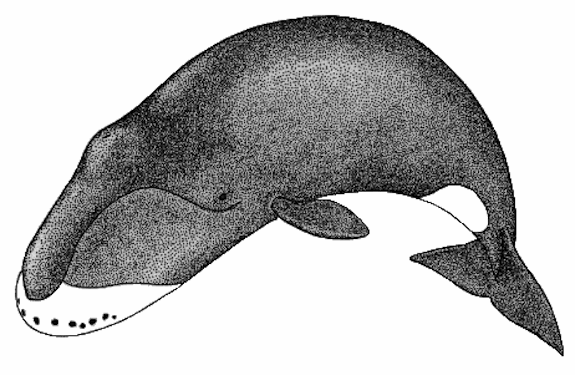
Thirty four years ago, scientists counted 1,200 whales. Today there are about 14,000 of the mammals out there. Bowhead whales get their name from their heads, says NOAA:

The bowhead whale has a massive bow-shaped skull that is over 16.5 feet (5 m) long and about 30-40% of their total body length. This large skull allows the bowhead whale to break through thick ice with its head. The bowhead whale also has a 17-19 inch (43-50 cm) thick blubber layer, thicker than any other whale’s blubber.

None of the whales in Alaska, as far as we know, are white.

More from Smithsonian.com:

Whales on the Table
How Did Whales Evolve?


***

Sign up for our free email newsletter and receive the best stories from Smithsonian.com each week.

27 Comments »

  1. The one piece of evidence cited in the article for the extraordinary longevity of the Bowhead Whale is the presence of a single stone harpoon point.

    Is that enough? How was it dated? Do not some indigenous northern people occasionally hunt using traditional methods?

    I’m certainly not saying it’s not true… but the evidence cited seems feeble. Is any further analysis or evidence available?

    Comment by Dan Priven — January 9, 2013 @ 6:11 pm


  2. I agree with Dan Priven. Although I want to believe this story, the evidence is sketchy, especially considering that today we have much advanced technology available !!

    Comment by Pranab Mukherjee — January 13, 2013 @ 10:41 am


  3. Interesting and Happy New Year!

    Comment by Mike — January 13, 2013 @ 11:05 am


  4. Why was it necessary to say that none of the whales were white?

    Comment by Moira — January 13, 2013 @ 3:19 pm


  5. There is a critically endangered population of bowhead whales around Svalbard. I wonder if some from the Hudson Bay population, might be able to link up with them. Now that their longevity has been disclosed.

    Comment by Tim Upham — January 13, 2013 @ 6:47 pm


  6. Wow, had no idea they lived so long. They are true survivors !!

    Comment by Victoria mathew — January 14, 2013 @ 1:51 am


  7. Hi Moira,

    It was a joke referring to Moby Dick. In the book, the main character Ahab is obsessed with hunting a white whale. Not a very funny joke, but that’s what I meant.

    Rose

    Comment by Rose Eveleth — January 14, 2013 @ 8:12 am


  8. @Dan Priven,

    Wikipedia sources http://www.alaskareport.com/science10065.htm on Bowhead and other whale longevity.

    In general, part of the problem in getting an accurate estimate of age is that the Alaska whale ‘fisheries’ would not have opened up until the mid-late 19th century, which would limit the incidence of wounds inflicted by Anglo whalers and their more easily-dated weapons.

    Comment by Carrington Ward — January 14, 2013 @ 7:23 pm


  9. There’s plenty of evidence for the longevity of bowheads. Scientists also now believe North Atlantic right whales may live to similar ages.

    http://www2.gi.alaska.edu/ScienceForum/ASF15/1529.html

    http://www.nature.com/news/2007/070619/full/news070618-6.html

    Comment by Philip Hoare — January 15, 2013 @ 4:02 am


  10. Um obviously these people have never read Moby Dick. Dumbasses, he’s not a bowhead, but a sperm whale. Jessh read a book and get yer facts straight!

    Comment by Ahab — January 16, 2013 @ 4:33 pm


  11. @Moira: Read the title of the article and see Mobi Dick in it. Then read Mobi Dick, an American classic. Then realize why your racially charged comment makes you look ignorant and racist.

    @Rose: The joke was quite funny, and witty. Not every use of color in an article needs to be scrutinized for racism, nor should the joke be shunned because some are unnecessarily, overly sensitive.

    Comment by Jack — January 17, 2013 @ 9:04 pm


  12. @rose Beluga whales are white…

    Comment by Jesse — January 18, 2013 @ 3:36 am


  13. @Jack What on earth makes you think that Moira’s comment was in any way “racially charged”? There was something she didn’t understand in the article, and she asked about it. She certainly didn’t look “ignorant and racist”, and it’s a bit rich to criticize someone for not reading the title of the article and to then yourself repeatedly misspell Moby-Dick as “Mobi Dick”.

    If I might be so bold: Not every use of color in a comment needs to be scrutinized for racism, nor should the comment be shunned because some are unnecessarily, overly sensitive.

    Comment by SimonK — January 18, 2013 @ 10:14 am


  14. Why don’t they just cut one in half and count the rings?

    Comment by Norm King — January 18, 2013 @ 8:53 pm


  15. @Jack You’re the one who brought up racism, and then insulted other people for making a normal article about race. Irony…

    Growing up in California, going out in kayaks to see the whales migrating off the coast was always one of my favourite things to do. Miss these giants. Glad to see that their numbers are up so drastically.

    Comment by Michelle — January 19, 2013 @ 8:31 pm


  16. @Jack Wow, calm down.

    Comment by Knox — January 20, 2013 @ 3:09 am


  17. What does japan have to say about this? :[

    Comment by JW — January 20, 2013 @ 3:24 am


  18. The line, “Thirty four years ago, scientists counted 1,200 whales. Today there are about 14,000 of the mammals out there.” makes it sound like their population grew by 12,800 in 34 years. The source article states, “Since George and his colleagues began recording whale numbers 34 years ago, their counts have increased from 1,200 animals in 1978 to 3,400 in 2011.”

    So the number of whales they’ve counted per the year noted has increased by 2,200, which is a subset of the total estimated population.

    Comment by Josh — January 20, 2013 @ 3:34 am


  19. I read elsewhere that in fact the harpoon part was dated to a pretty specific time consistent with the story.

    Comment by paul — January 20, 2013 @ 4:01 am


  20. interesting article, and also now curious if it is likely someone can/will catch one to try @Norm King’s methods for testing their age…

    does counting the rings work with all animals?

    Comment by thomouse — January 20, 2013 @ 4:31 am


  21. I appreciate that the title of your article uses ‘Who,’ for they are. :)

    Comment by Laura Miller — January 24, 2013 @ 10:11 am


  22. Probably a trite statement but Melville’s book was written only 162 years ago. I know that 200 years old, is a great hook for your story but stone harpoons have been traditionally used by the Inuit. Why not try again with your story with out hyperbole.

    Comment by Pete McNesbitt — February 9, 2013 @ 9:25 pm


  23. “Bowhead whales get their name from their heads, says NOAA:”

    Whoa, imagine that. And here I thought they were named “Bowhead” because their feet were shaped like bows. ;)

    Comment by Vince C — February 10, 2013 @ 10:05 am


  24. What are you…a bunch of grade school children?? You could at least try to appear mature.

    Comment by PegLeg — March 5, 2013 @ 10:07 pm


  25. I have a whale bone my dad picked up from an Aleutian Island in 1988. I wonder how old it is, or what kind of whale it came from.
    It could be hundreds of years old!

    Comment by Meg — March 14, 2013 @ 2:30 pm


  26. The now-known life-spans of these magnificent animals are all the more reason why they should be protected against all ‘harvesting’ – whether aboriginal hunting or ‘pseudo-scientific’ (read hunting) harvesting. Moreover, known nursery areas and feeding areas should be set aside. I want, and I am sure the majority of civilised people want, whales to share the planet with them and with their descendents. In this respect, people of all political factions and nationalities should get together and make this known to those who condone and enact the killing of such a wonderful co-inhabitant.

    Comment by Jack Dunster — May 11, 2013 @ 1:23 am


  27. I have eaten Whale, sad to say, In 1958, I was 10yrs old, and My Dad took the family to “The Blue Ship Tea Room” in Boston, I ordered the clams, which I loved, My Grandgather, was a Merchant Marine in 1917, and sailed on the ship “Erne”, yes the ship that lost it’s Captain, wife of the captain and a friend that was onboard, to get back to my comment, My Grandfather offered me a bite of his steak, which I took. it tasted like steak, but with a hint of liver. yes it was Whale, I was shocked! I don’t know of many people that have dined on these beautiful creatures but even now, it makes me sad. If you would like to read and see a photo of my Grandfather, Able bodied seaman Walter Alfred Willis, the information is in Edward Rowe Snow’s 1967 book “Incredible Mysteries and Lengends of the Sea” Mary Willis Paquette

    Comment by Mary Paquette — May 19, 2013 @ 2:52 pm


RSS feed for comments on this post. TrackBack URI

Leave a comment

Comments are moderated, and will not appear until Smithsonian.com has approved them. Smithsonian reserves the right not to post any comments that are unlawful, threatening, offensive, defamatory, invasive of a person's privacy, inappropriate, confidential or proprietary, political messages, product endorsements, or other content that might otherwise violate any laws or policies.

Spam protection by WP Captcha-Free

Advertisement


Trending Today New Research Cool Finds

Follow Us

Travel with Smithsonian


Advertisement