Blogs

  • News
  • |
  • Art
  • |
  • History
  • |
  • Food and Travel
  • |
  • Science
SmartNews

Keeping You Current

Around the Mall

Scenes and sightings from Smithsonian museums and beyond


March 4, 2013 10:31 am

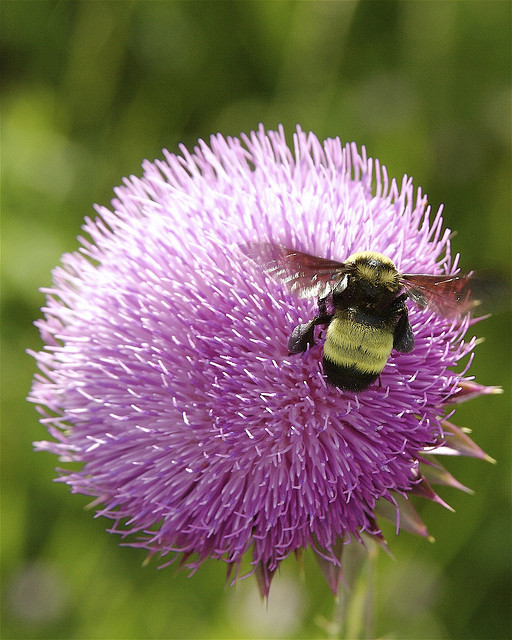
The American Bumblebee Is Crashing, Too

A “big fuzzy” American bumblebee. Photo: Dan Mullen

You may have heard of a little thing called Colony Collapse Disorder—a “disorder” with no pinned-down cause that leads bees to abandon their hives or get lost on the way home. Beekeepers, says the U.S. Department of Agriculture, report hive population losses of up to 90 percent, but the cause of CCD isn’t definitively known. Possible culprits range from stress to parasites to pesticides to fungus, or a combination of them all. Colony Collapse Disorder, however, has not been affecting all bees—it targets honey bees. But now, says the Associated Press’ Seth Borenstein, bad news for the American bumblebee:

 ”It was the most dominant bumblebee in the Midwest,” [University of Illinois entomologist Sydney] Cameron said, saying it now has pretty much disappeared from much of its northern range. Overall, its range has shrunk by about 23 percent, although it is still strong in Texas and the West, she said.

People call them the big fuzzies,” Cameron said. “They’re phenomenal animals. They can fly in the snow.

A research team who spent weeks in the field cataloguing southern Illinois’ bees could find but one lonely American bumblebee, Borenstein reports. And, the humble bumblebee wasn’t the only thing missing: compared to the observations of a 19th century naturalist, the researchers could find only 54 of 109 expected bee species. The current dearth of bees, he says, could be due to forces similar to those affecting honey bees—”a combination of disease and parasites,” according to the AP.

The absence of bumblebees aligns with previous research described by Smithsonian Magazine‘s Sarah Zielinski a few years ago:

A group of biologists from Illinois and Utah examined the current and historical distributions of eight species of bumblebees from the genus Bombus, looking at thousands of museum records and data from recent nationwide surveys. They found that the abundances of half of those species (B. affinis, B. occidentalis, B. pensylvanicus and B. terricola) have declined by up to 96 percent and their ranges have contracted by 23 to 87 percent in the last 20 years. The other four species, however, remain abundant and widespread.

More from Smithsonian.com:
Honey Bees Still Struggling
Honey Was the Wonder Food That Fueled Human Evolution (And Now It’s Disappearing)


***

Sign up for our free email newsletter and receive the best stories from Smithsonian.com each week.

3 Comments »

  1. Bad science…”could be due to …” Well, that’s true, but the loss “could be” due to aliens…that’s a joke, btw. This appears to be an attempt to piggyback BB research on the $ available for CCD.

    I like BB’s, and have seen them decline on our place outside Bozeman, MT. But the decline happened a decade before CCD became prominent. I think BB decline is due to loss of safe habitat – spreading subdivisions, with their gardens+pesticides & their speeding car windshields, perhaps. I’d welcome more study of why the BB decline, and what we can do about it. So far, though, the reasons for CCD have not been nailed down, so pinning BB loss on CCD is silly. A local professional beekeeper opined that CCD was due to the importation of sick Australian bees. Could be, but he’s biased, of course.

    Comment by Brooks Martin — March 10, 2013 @ 11:54 pm


  2. I might add that the Germans have correlated potential BB decline with the increase of Honey Bees. The bees compete for food. Unless you have a diverse, abundent population of flowers, BB’s are at risk. Ag producers rent HB hives (its a bigger business than honey&wax). When you have mulitple hives of 10,000 HB’s competing with a BB nest of a 100 BB’s, it’s easy to see that starvation could be driving our BB’s out of the picture.
    From German article:
    “Many modern
    agricultural landscapes are poor in floral
    resources, at least in late summer. Under conditions
    of food shortage, detrimental effects of
    locally high honeybee densities on wild bee
    populations cannot be excluded.”

    http://www.apidologie.org/index.php?option=com_article&access=doi&doi=10.1051/apido:2006035&Itemid=129

    Comment by Brooks Martin — March 11, 2013 @ 12:12 am


  3. All the latest studies are pointing to Bayer and Syngenta neonicotinoids, so if we want to get to the bottom of ccd these neurotoxins must be temporarily if not permanently banned.

    Comment by Jill — April 12, 2013 @ 4:23 pm


RSS feed for comments on this post. TrackBack URI

Leave a comment

Comments are moderated, and will not appear until Smithsonian.com has approved them. Smithsonian reserves the right not to post any comments that are unlawful, threatening, offensive, defamatory, invasive of a person's privacy, inappropriate, confidential or proprietary, political messages, product endorsements, or other content that might otherwise violate any laws or policies.

Spam protection by WP Captcha-Free

Advertisement


Trending Today New Research Cool Finds

Follow Us


Travel with Smithsonian


Advertisement