
The Long Journey of Chief Joseph’s War Shirt
Important Native American artifact seen in Smithsonian portrait fetches $877,500 at Nevada auction
/https://tf-cmsv2-smithsonianmag-media.s3.amazonaws.com/accounts/headshot/emily-spivack-240.jpg)
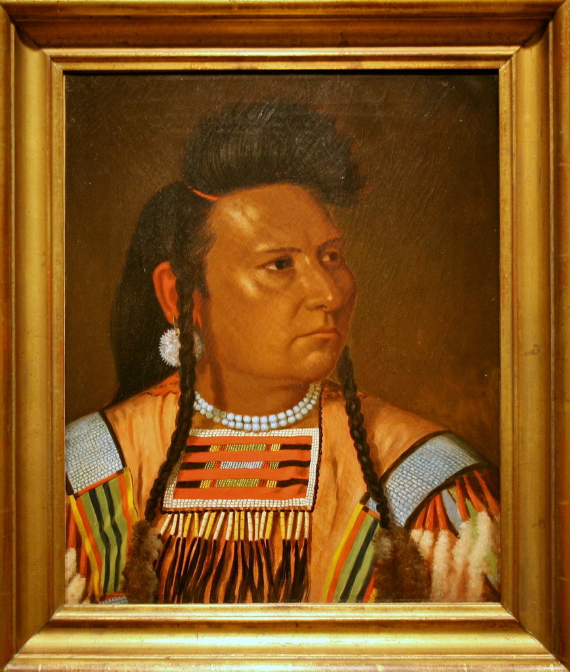
Chief Joseph painting by Cyrenius Hall at the National Portrait Gallery.
You know Chief Joseph, even if you don’t know him by name. He’s not Sitting Bull, or Geronimo, but you probably recognize Chief Joseph, leader of the Nez Perce tribe, whose famous image was commemorated by the U.S. Postal Service with the 6-cent stamp in 1968. Notice what he’s wearing—a tan garment with blue beaded brocade that was his war shirt , which just sold to an anonymous buyer at the annual Coeur d’Alene Art Auction in Reno, Nevada, for $877,500.
The whopping sum doesn’t just come from the beauty of the well-preserved garment (although it’s a stunner), but its provenance: It’s one of the most important Native American artifacts to come to auction, according to Mike Overby, the event’s organizer. And a story made for Antiques Roadshow. The shirt was sold at a Native American relic show in the 1990s and changed hands again before anyone realized its historical importance.
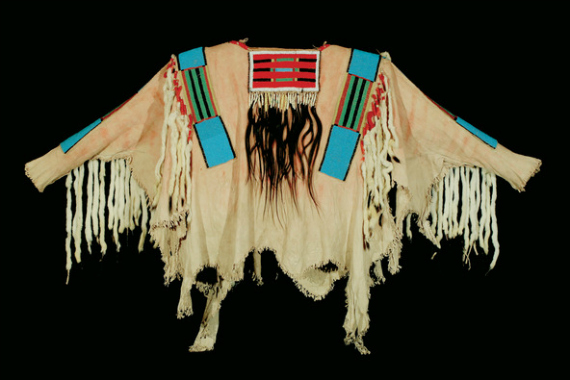
Chief Joseph’s auctioned war shirt.
Chief Joseph was documented wearing his deerskin war shirt not once, but twice: first, in an 1877 photograph taken by John Fouch just after the Nez Perce had surrendered to U.S. soldiers in Montana. Joseph, whose heroic retreat and eloquence in surrender helped form his legacy, still had frostbite on his fingers from snowbound combat, and yet he still looked proud, sitting for Fouch in his war shirt, his hair done up in a warrior pompadour.

Reproduction of Chief Joseph’s portrait on a 1968 stamp
The shirt makes a second appearance when Chief Joseph, imprisoned at Fort Leavenworth in Kansas, agreed to pose for a portrait by Cyrenius Hall in 1878. The painting of the disheartened resistance leader, festooned in his resplendent garment, now hangs in the Smithsonian’s National Portrait Gallery. That is the portrait that appeared on the 1968 stamp.
With detailed beadwork and blocks of bold, geometric color representing what scholars call the “Transmontane art style,” it’s striking how much today’s Native American-inspired designs have derived from this graphic style–for better or worse. The auction describes the shirt’s detailing:
The shirt is of the classic sleeved poncho type, made of two soft thin skins, probably deerskin. The skins were cut in two behind the front legs, and the two back halves were joined at the shoulders to form the front and back of the shirt. The two front halves of the skins were folded to make the sleeves, with the forelegs retained below the open armpits. Thus, the natural shape of the animal skin was preserved as much as possible in the design of the shirt, thereby honoring the animal’s spirit. Sewn onto the front and back of the neck opening is a hide flap or bib covered with red wool trade cloth and partially beaded. Provided by family or friends were the long tassels of human hair, their quill wrappings attached to the base of the neck flap. Though symbolic of personal war experiences they are not ‘scalp locks.’
Now the question remains: Who bought the famed shirt (and when can we all see it publicly displayed)?
/https://tf-cmsv2-smithsonianmag-media.s3.amazonaws.com/accounts/headshot/emily-spivack-240.jpg)