
Faces From Afar: A Frightening and Fascinating Journey Through North Korea
/https://tf-cmsv2-smithsonianmag-media.s3.amazonaws.com/accounts/headshot/Off-Road-alastair-bland-240.jpg)
/https://tf-cmsv2-smithsonianmag-media.s3.amazonaws.com/filer/e8/62/e8622843-0ab5-4f2d-b293-eef0cc86dc6c/northkorealarissa-michael-top-of-rocky-stepsbig.jpg)
“Faces From Afar” is a new series in which Off the Road profiles adventurous travelers exploring unique places or pursuing exotic passions. Know a globetrotter we should hear about? E-mail us at [email protected].
On September 6, 2011, excited North Korean soccer fans took part in a "wave"—that tradition of American baseball games in which spectators stand in unison row at a time, creating the effect of a moving swell of people that surges around the stadium. It may have been among the first waves to occur in Pyongyang international soccer stadium. To Michael and Larissa Milne, the two American tourists who helped initiate that particular wave, the incident bore underlying elements of conformity, fear and repressed freedom of expression. The wave took easily within the seating section of the Milnes' 50-person tour group. The North Korean spectators, however, were wary, trained from birth in the arts of restraint, caution and passivity. They resisted through several false starts—but finally, the wave overpowered their inhibitions. Maybe it just seemed safer at this point to join. Anyway, the wave surged along with the seemingly unstoppable force of rapture and critical mass—before stopping dead as perhaps only the wave can in a dictatorship.
As Michael Milne described it on his blog Changes in Longitude, "When it finally reached the central seating area set aside for party VIPs, not a fanny left its seat. The wave didn’t just ebb there but was stopped cold, like it broke against an unyielding stone jetty."
The party, of course, rules North Korea, where a line of dictators has run the nation with almost superhuman power since the years following the Korean War. While citizens are sternly guarded from outside influences—including Internet access and global film culture—traveling here is surprisingly easy for tourists. Thus, when the Milnes sold their Philadelphia home and most of their possessions in the summer of 2011 and commenced on a long and ambitious world tour, they quickly struck upon the wild idea of visiting one of the world's most mysterious and forbidding places. They made mandatory arrangements with one of several government-permitted tour companies, paid a slight visa fee at the border crossing from China, temporarily forfeited their cellphones, computers, other handheld tech gadgets and even their books, and took a five-day plunge into full darkness.
"In North Korea, you're totally cut off from the outside world," Michael told me from New York City during a recent phone interview. "You have no idea what's going on outside. We didn't even know how the Phillies were doing." (They made it as far as the National League Division Series.)
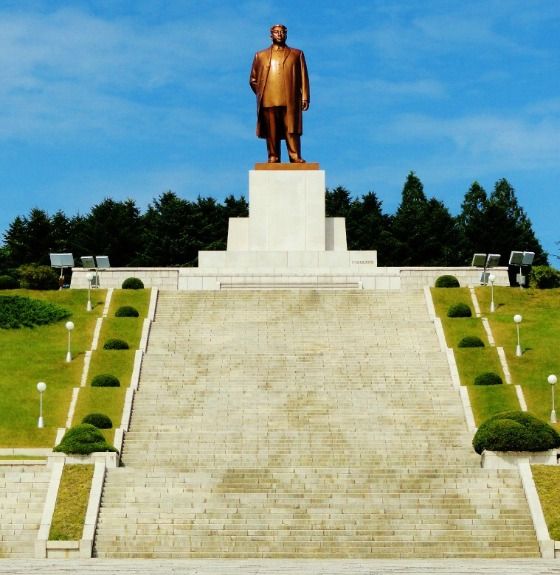
Military omnipresence and jeering loudspeakers bring the classic Orwellian distopia to life. Party members in North Korea are well-fed and prosperous, while citizens walk in straight lines and speak softly—and Big Brother is always watching. For natives, there is no exit. But tourists enjoy surprising liberty. They must remain either in the company of the group tour or within the confines of their hotel, and photography is restricted in places, like during bus rides between tourist attractions. Otherwise, outsiders may mingle with the people—whom the Milnes describe as being just as friendly and gregarious as can be—and take photos of the country's grandest features. Popular tourist attractions include monuments honoring former national leader Kim Il Sung, who died in 1994 and is now known both as Great Leader and Eternal President, various museums and the Demilitarized Zone (DMZ) on the border between the two Koreas. Here, no physical barrier separates the nations, and soldiers from each side stare coldly at one another. The DMZ offers tourists a rare opportunity for a telling side by side comparison of North and South Koreans.
"The soldiers on the South Korean side are muscular, vigorous," Michael said. "But the North Koreans are swimming in their uniforms, and these are the soldiers they've chosen to put on display."
The difference in stature can be attributed, the Milnes told me, to hunger. Food is of poor quality in North Korea, they said, and many people can't afford it. Restaurants for tourists are a different story, providing lavish feasts that may leave visitors impressed by North Korea's evident opulence—or just embarrassed, as the Milnes were, by the needless waste.
The Arch of Triumph is another showpiece proudly presented to all tourists. The monument was built in 1982 to honor Kim Il Sung and commemorate North Korea's military resistance to Japan. It was also built a few inches taller than the Parisian Arc de Triomphe—which tour leaders, who speak a transparent curriculum of government-mandated material, are quick to point out.
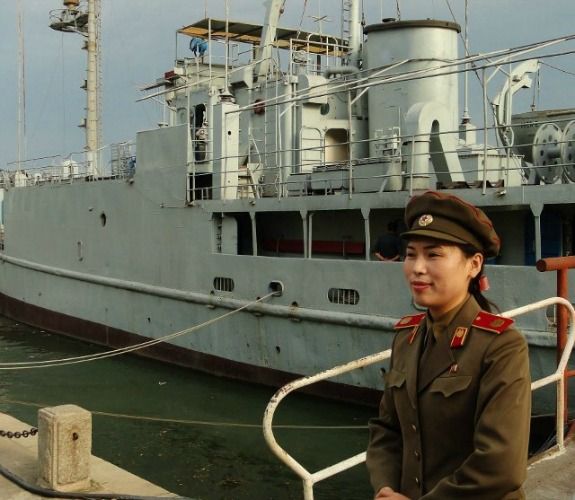
Propaganda sounds from all directions in North Korea, and for outsiders it's easy to identify. For example, state-run media perpetuates an altered history of World War II in which the military forces under Kim Il Sung supposedly defeated Japan singlehandedly. The Milnes also visited the ship-turned-museum USS Pueblo, which North Korean authorities captured, detained and kept as a military trophy in 1968. Here they saw a piece of U.S. Naval history wiped clean of fact and refurnished with exaggerations. The ship is now presented as a symbol of North Korea's dominion over the United States—considered a great enemy of the state. Larissa, also on conference call, said to me, "For America, the Pueblo incident was a minor blip in a series of many, many world events, but for them, it's a bright and shining event. It really shows how North Korea clings to the past."
During an outing to a North Korean amusement park called the Pyongyang Fun Fair, the Milnes and the other tourists quickly noticed that something strange was at play here: There were no laughter, shrieks or cries of joy. The people were silent. "An amusement park without noise is a strange thing," Michael said. Surely, the physiology of North Koreans is not immune to that electric thrill that most of us know from roller coaster free falls—but nobody dared raised their voice. At least, they didn't dare until the British and American tourists did so first. Then, the effect turned contagious; whoops and cheers spread through the crowds, and vocal chords chronically underused began to explore uncharted territory of decibel levels.
The trained passivity of the people showed itself, too, at the aforementioned soccer match between Tajikistan and North Korea. Though the home team would ultimately beat the visitors 1-0, the Milnes watched North Korea play with a troubling absence of spirit. Michael wrote on his blog at the time that the players, after maneuvering the ball past the legs of the defending Tajikistanis all the way down the field, would turn sluggish, unambitious and reluctant each time it appeared there was a chance to score. Repeatedly, just shy of the goal, the North Koreans appeared to intentionally divert the ball away from the net. Michael and Larissa attributed this pattern to the North Koreans' reluctance to be noticed and their fear of failure.
"This is a society where no one wants to be the standing nail," Michael said.
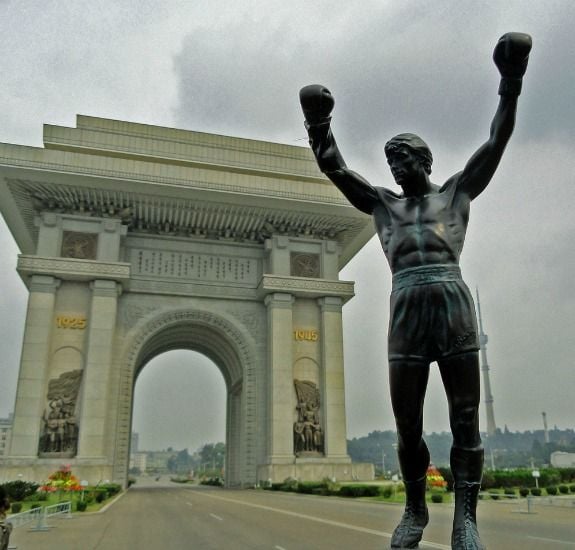
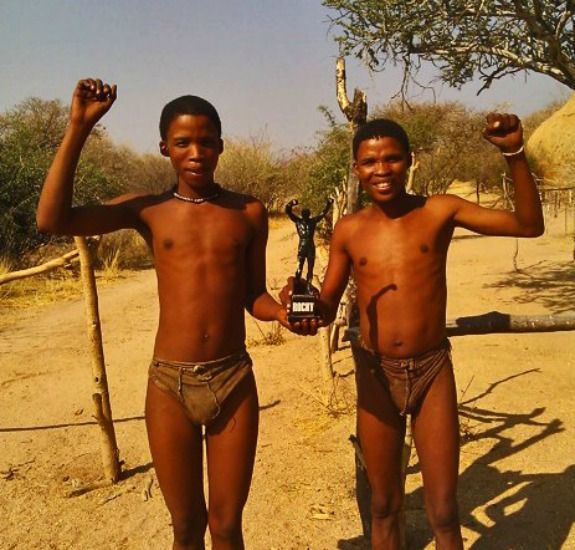
Throughout their world tour, the Milnes had used a creative and surprisingly effective tool for breaking ice and building bridges across cultures: a six-inch-tall statue of perhaps the world's most famous boxer, Rocky Balboa. Many times during interactions with strangers, when words between the people could not be produced, the Milnes took their little plastic prize fighter from a day pack, and what followed was nearly always laughter, cheers and shouts of "Rocky!" But when the Milnes took out "Little Rocky" for a photo op at the North Korean Arch of Triumph—part of an ongoing series featuring Little Rocky around the world—nobody in a group of bystanders recognized or knew the name of the muscled likeness of Sylvester Stallone, his arms raised, boxing gloves on his hands. It was only one of two times that Rocky was not recognized (the other was in the Kalahari, when the Milnes produced Little Rocky for a photo op with a group of San people). North Koreans, of course, are deprived of Internet access, of literature, magazines and newspapers from the wider world, of popular television and of most films. That a movie glorifying an American fighting champion has never publicly screened in North Korea is hardly a surprise.
The Milnes are currently resting in New York and plotting their next moves—which may include writing a travel memoir as well as beginning a tour of North America. Whatever they do, they don't want to settle just yet. They are enjoying a rare level of freedom, a nomadic lifestyle void of belongings as well as that thing most of us believe is only a blessing—a home.
/https://tf-cmsv2-smithsonianmag-media.s3.amazonaws.com/accounts/headshot/Off-Road-alastair-bland-240.jpg)