Blogs

  • News
  • |
  • Art
  • |
  • History
  • |
  • Food and Travel
  • |
  • Science
Food & Think

A heaping helping of food news, science and culture

Off the Road

The travel adventures of a nomad on the cheap


March 20, 2013

Is Taking Your Pet on an Airplane Worth the Risk?

These dogs are crated and ready for departure on an international flight. They will be carried in the plane’s cargo hold, where dozens of animals die each year from heat and stress. Photo courtesy of Flickr user ilovemytank.

If you think flying is stressful, just imagine how the experience must impact an innocent, unknowing dog or cat when packed away in the cargo hold of a commercial jet. Air travel, in fact, is not just stressful for animals. It can be dangerous, no matter how smooth the landing, timely the departure or friendly the flight attendants. Conditions in the cargo hold of commercial jets are not always friendly; temperatures can fluctuate wildly, noise can be tremendous and air pressure can drop significantly, and pets that are checked into this dark space beneath the passenger cabin sometimes die. In 2011, thirty-five pets died while (or shortly before or after) traveling on commercial flights with U.S. airline companies. Nine animals were injured and two lost entirely. And in 2012, 29 pets died, 26 were injured and one was lost. These numbers should be considered in context; the U.S. Department of Transportation says that two million animals travel on commercial flights each year.

More pets have died in recent years on Delta Airlines flights than on any other airline, according to mandatory incident reports provided by U.S.-based airlines to the Department of Transportation. In 2010, 2011 (PDF)  and 2012, Delta Airlines was responsible for 41 of the 97 reported animal deaths. Multiple publications have reported that Delta carries more pets than competing companies, which could explain the seemingly high rate of incidents reported by the airline. A media relations official with Delta Airlines declined to comment for this story.

United Airlines reported 12 animal deaths in 2012 among six airlines that reported incidents.

Almost never is corrective action taken following these incidents. Indeed, fault may often lie with the passenger—such as when animals with pre-existing health problems are checked as baggage.

Kirsten Theisen, director of pet care issues for the Humane Society of the United States, believes air travel is simply too stressful for most animals, especially when they are placed in an aircraft’s cargo hold.
“Flying is frightening for animals,” says Theisen. “They can sense the pressure changing and they can tell that something is happening, and that’s scary. Flying is frightening if you don’t know what’s happening.”
Theisen recognizes that many people today wish to include their pets in family vacations, but she strongly suggests leaving animals at home, in trusted hands, if at all possible. Theisen says reports of pets being lost, injured or killed in transit are increasing, if only because human travelers are increasingly taking their animals along for the ride.

“More and more now, families consider their pets to be members of the family and want to include them on trips,” Theisen says. “Unfortunately, airlines don’t consider animals a member of your family. They consider them cargo.”
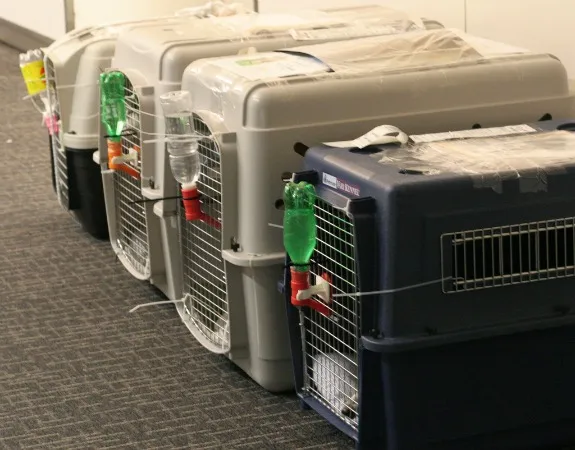
These crates each contain a dog bound for a destination hours away. The water bottles affixed to the door of each crate will help the animals endure the rigors of flying. Photo courtesy of Flickr user ilovemytank.

Theisen recommends that travelers with pets “do their homework” before flying. She points to Delta’s website, which provides lengthy and detailed information on the possible hazards for pets traveling by plane. Delta, like many airlines now, prohibits pets as checked baggage between May 15 and September 15, when high temperatures in the Northern Hemisphere produce extreme dangers for pets stashed below the passenger cabin. Delta also says it will not carry pets in the cargo hold during periods of extreme weather, whatever the season. The company’s website also states that it will not accept animals as checked baggage if the high temperature at any location on a flight’s itinerary is forecast to be below 10 degrees or above 85 degrees Fahrenheit.

In other words, just that an airline accepts your animal as checked baggage does not mean that conditions will be comfortable or safe for an animal checked as baggage.

Unforeseen hazards can arise once a plane is loaded and prepped for takeoff. On airplanes that have been delayed after leaving the terminal and parked on the blazing tarmac, temperatures can escalate dangerously. Pets have also died due to low temperatures. In 2010, two dogs and a cat perished due to extreme cold in transit, according to the Huffington Post. One of these animals was a hairless kitten named Snickers. The cat’s owner had paid a $70 fee to ensure her pet’s swift removal from the plane. However, it reportedly took baggage handlers 50 minutes to remove the kitten’s kennel from the cargo hold. Snickers died shortly thereafter.

Nearly all animal incidents reported to the Department of Transportation involve pets in the cargo hold. But in 2012, a pug died inside the passenger cabin on a flight from New York City to Salt Lake City that was delayed before takeoff. KSL NewsRadio of Utah reported that a flight attendant told the dog’s owner to keep the pug’s carrying case under the seat throughout the 45-minute delay. The dog reportedly began panting in its confined space and, later during the flight, was discovered to be dead.

Pugs, boxers, bulldogs and chow chows are just several of the snub-nosed, or brachycephalic, dogs, whose physiology impairs easy respiration—especially in hot or stressful conditions. Many airlines will not carry snub-nosed dogs or cats. Photo courtesy of Flickr user desxiree.

Pugs, in fact, are one of several breeds now prohibited on many airlines because of their natural vulnerability to respiratory stresses. They are among the brachycephalic dogs and cats, commonly called snub-nosed, or pug-nosed. Brachycephaly is considered a disorder in humans and many other species, while for a number of dog breeds, the condition is a natural variation. In addition to pugs, boxers, English bulldogs, American pitbull terriers, chow chows and about a dozen other breeds are brachycephalic. At least four cat breeds—Burmese, Persian, Himalayan and exotic short-hair—may also be defined as “snub-nosed.” These animals, more frequently than others, may have breathing problems or difficulties when placed in the stressful conditions of an airplane’s cargo hold and face a relatively high risk of in-flight suffocation as a result. Of 189 flight-related animal deaths reported by the Department of Agriculture between June 2005 and June 2011, ninety-eight were brachycephalic breeds, according to The New York Times.

Delta, American, United and many other companies have strict regulations regarding brachycephalic cats and dogs on their flights. A company called Pet Airways launched in 2009 to cater to pet owners, and about a quarter of the airline’s animal passengers were snub-nosed breeds. Pet Airways did not last long, however. The company, which received some poor customer reviews on Yelp, was showing signs of financial distress by early 2012, according to the New York Times. The company has since ceased operations.

Owners of non-pug-nosed breeds should not be caught off guard. In February 2011, a 3-year-old Labrador retriever reportedly arrived safe and sound an hour past midnight in Singapore on Delta Flight 281. The dog was placed in a baggage storage area, was reported to be in good condition at 5:35 a.m. but was found motionless in its cage at 6:20 a.m. In late July of 2011, a 6-year-old yellow Lab died while in the cargo hold of a Delta flight from Pensacola to Baltimore, with a stop in Atlanta. On the second leg of the journey, the aircraft was delayed for hours in Atlanta and was eventually cancelled entirely. The dog was later found dead in its kennel. A year later, in September 2012, a 2-year-old golden retriever named Beatrice died of heatstroke on a United Airlines flight from New York City to San Francisco. The dog’s owner, supermodel Maggie Rizer, wrote on a blog that the airline acted with dishonesty and callousness after the dog’s death—though the airline reportedly refunded the $1,800 that Rizer paid for Beatrice’s travel. Still other animals bite or chew themselves bloody, presumably unnerved by the stresses of travel. Still others have been lost entirely—like two cats in 2011 whose kennels were discovered open and vacated upon arrival at their destinations. Neither has been reported found.

Current regulations require that airlines—those based in America, anyway—report all incidents involving animals. But Theisen explains that a troubling loophole excludes from this requirement any animals traveling for commercial purposes. Thus, animals that are injured, lost or killed while in the hands of an airline need not be reported if they were being shipped from a breeder to a retailer, or to a new owner, or to a dog show.
“If your dog is at that moment technically not a pet, then it doesn’t need to be reported if something happens to it,” Theisen explains. She adds that the deaths, injuries and animals missing numbers reported by the Department of Transportation are certainly not comprehensive and that many incidents slip quietly, and legally, under the radar.

Suggestions to Keep Your Pet Safe When Flying

  • Visit your veterinarian to be sure your pet is fit to fly.
  • Don’t fly your pet during the hot summer months.
  • Arrange for direct flights. Transfers increase the chances of delays, which can cause stress to animals contained in the cargo hold, and other mishaps, like a pet being sent to the wrong destination.
  • If possible (it depends on the animal’s size), purchase your pet a space in the passenger cabin.
  • If you must check your pet into the baggage hold, remind airline staff and baggage handlers that there is a live animal on board to ensure gentle handling. Also ask baggage handlers during your check-in that your pet’s cage be placed in a well-ventilated space, and be sure your pet has water.
  • Don’t fly snub-nosed cats or dogs. These animals die on airlines, often of respiratory problems, more frequently than other breeds.
  • Leave your pet at home if you will be returning soon, and look forward to a happy reunion of wagging tails and hearty purrs.
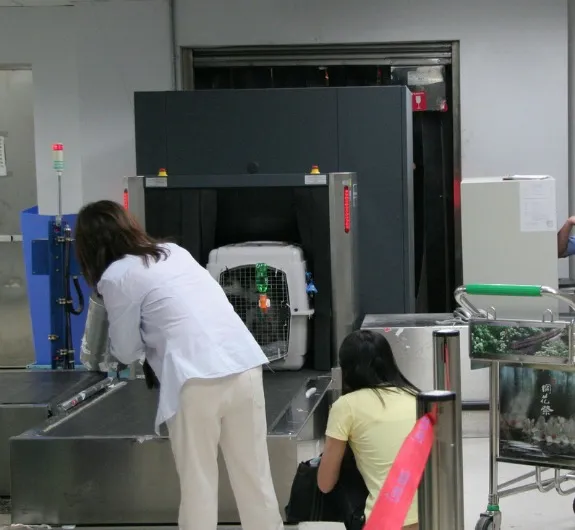
Anxious travelers say goodbye to their dog as it disappears through the baggage curtain prior to a trans-Pacific flight. Photo courtesy of Flickr user ilovemytank.


***

Sign up for our free email newsletter and receive the best stories from Smithsonian.com each week.

19 Comments »

  1. antiedebe says:

    Alaska, Bering, and Era have great records flying pets and work dogs. When the only way to travel is to fly and many animals are Iditarod level athletes, it behooves them to care for them well.

  2. RNB says:

    If two million pets flew in a given year and 29 died, that’s about a one-in-70,000 chance that a given pet will not complete its journey safely (without factoring in the pet’s health to begin with). You call this a “high rate of incidents”?

    • Alastair Bland says:

      Compared to the reports from other airlines, yes, this is a high rate of animal deaths. The concerning part for pet owners is that animal stress and death can occur on flights that otherwise go smoothly in every way.

  3. CarolAnne says:

    I absolutely would NEVER fly my pets. I don’t care if I had to travel by boat, I just would not take the risk.

  4. Anxious Passenger says:

    You may like to compare the ratio of human passengers that pass away when flying. In a vast majority of cases it’s not a result of flight. You may also look into your statements regarding pressure as its the same in the passenger compartment and holds….

    • Alastair Bland says:

      The air pressure in the cargo hold is not necessarily different than anywhere else inside the plane–but it can indeed fluctuate rapidly within the cargo hold (as elsewhere on the plane), where most animal deaths occur. This is an excerpt from the website of JAL CARGO, which addresses in detail the matter of transporting animals by plane: “Air pressure inside the cargo compartment during flight is about 0.8 atmospheric pressure. This is said to be equivalent to air pressure at the peak of a 2000m mountain. Also changes in air pressure during ascent and descent may affect the ear.”

  5. Roy says:

    Delta Airlines without a doubt is the absolute worse. I even avoid flying just myself with them. On the other hand, Alaska Airlines is the best for traveling with a pet. Excellent service and they appear to ensure your pet is onboard. Continental use to be great too but now that they merged with United I’m not quite so sure.

  6. Valynn says:

    I for one will Never take my Dog on Air Travel. For one: Like they say, The handlers may not do things right. You are taking a very high Risk bringing your dog with you on a Flight. I realize that some people can’t do without there pets and rather have them with them in their travels. but they are taking a Risk of them getting stressed out. Exception is like Working dogs, Service Dogs. I bet they are handled with care. As for my Dog, Ginger? She is not a Traveling dog at all. I mean even going to the Vet she shivers and shakes. that is stressful enough for her!! besides she is 13 years old and I wouldn’t want my dog dying on a flight. When we go on vacations we usually board our dog with a Reliable Vet and she is use to that but that is just my dog. Now I use to have a small dog, George, that would travel anywhere. He was a Corgi/Terrier. he would have done good on a flight. but I bet most dogs are frightened unless they are use to flying. That is my take on Pets in flight.

  7. Lee Patterson says:

    If we travel by land we always bring the dog, but flying he goes and visits grandma and auntie at the country club (Kennel) and he love them there and he is spoiled just like home would you take a chance with another family member, but on the other hand My in laws brought a dog home with them from Korea and didn’t have a problem, but I would never fly with my dog,

  8. In August of 2011, Jack – a cat that American Airlines said was too big to fly under the seat – was lost by the airline before he even boarded the plane. Jack was lost within JFK airport (NYC) for 61 days. He then fell through the ceiling in the Customs & Border Patrol office, was treated in veterinary ICU for 12 days, and ultimately had to be euthanized because the he could not recover from his wounds, which were exacerbated by being without food and water for 2 months.

    During this ordeal I started a Facebook page in the hopes of finding someone with access to the airport who could help us search for Jack. That page, “Jack the Cat Is Lost in AA Baggage at JFK”, remains active with over 24,000 fans. In addition, we have begun a non-profit organization, Where Is Jack? Inc., which maintains the website http://www.WhereIsJack.org – providing information to pet parents about the hazards of flying with pets, and steps they can take to minimize the risks if flying with a pet is absolutely unavoidable.

    What we have learned is that animals are in danger at every step on the flight process – both on the ground and in the air. Jack was lost when his crate fell and came open because it had been stacked on top of another crate. This is in violation of USDA animal transport regulations. (Ironically, it looks like the picture at the top of this article may be showing one crate stacked on another as well.)

    We hope all pet guardians will review the information we provide on our website and will think very carefully about other options before flying with their pet – especially if they will have to be separated for any time at all. We will continue to work hard to expose the full range of hazards in the current system, and to create options that will make it safe for pets and their people to fly together.

  9. Mi Lau says:

    To RNB,
    What many people don’t know that DOT only reports the incidents that happen to those pets traveling with people. If the pet is being shipped from breeder to owner, or owner to someone else, and something happens to them, they are not reported. The actual incident numbers are staggeringly higher than what this article quotes. That is the unfortunate truth. See NBCs investigation on the topic here: http://www.nbcbayarea.com/investigations/Pet-Owners-Pressure-Airlines-to-Stop-Treating-Animals-As-Cargo–199945321.html

  10. Tom Kirshbaum says:

    To call Brachycephaly “a natural variation” misses the mark by a mile. Brachycephalic dogs are designed and bred to be that way to suit human tastes. These poor creatures may struggle to breathe their entire lives and often die young. Many are so compromised that they will never be able to run and play normally. It would be a cruel Mother Nature indeed who would allow dogs to evolve “naturally” to suffer in this way.

    • Alastair Bland says:

      Tom, you make a great point and I read you loud and clear. Yes, Nature might never create a creature like a snub-nosed dog unless humans had a hand in the job. However, insofar as brachycephaly is written into such an animal’s genetic code, it may not be a great stretch to call it “natural.” Can we say I missed the mark by a kilometer?

  11. Having owned and shown American Pit Bull Terriers and American Staffordshire Terriers for many years, I can unequivocally state that well-bred APBTs and ASTs are *not* brachycephalic, despite the airlines’ misconceptions. (This makes travel with our easy-breathing dogs & more difficult than it would otherwise be.)

  12. Kathryn K says:

    What this article doesn’t mention is that traveling in the cabin is also hazardous for pets — or, rather, the juggling required of owners bringing pets through the security checkpoint is. The TSA currently requires all animals coming on board as carry-on to be removed from their kennels and carried through the metal detector so the kennels can be scanned. That means hauling a terrified cat out of its kennel and trying to hang onto it and then stuff it back inside. I have a pair of parakeets, and I can pretty much guarantee that one or both would escape if I tried to carry them through airport security in that fashion, and I would never see them alive again.

  13. Tim says:

    It’s tough to tell how much of a problem this is. Scientifically we would need to know the “control”–i.e. how many of these pets may have died at home or at their kennel during the same times. It seems unlikely with a supposedly healthy 3-year-old dog, but possible. I’ve definitely heard a number of stories of pets who die while their owners are on vacation, and it would be rather difficult to blame that on the airlines.

  14. Tom Kirshbaum says:

    Alastair,

    By all means let’s call it a kilometer and be friends.

  15. Virginia says:

    Last month my husband and I left New England to start a new life in the Pacific Northwest, and we brought our 3 cats with us in their 3 separate kennels. We not only looked for a direct flight to lessen the possibility of anything horrible happening to the cats, we read everything we could about flying with pets. It turned out that Alaska Air was not only the one airline that had a direct flight, but also touted its pet travel program.

    At the airport we walked immediately to the check in counter and after paying for their flight($100 each)the cats,still in their separate kennels, were put on a cart and we were all escorted to a small room where TSA people were to check them out.

    Inside, they asked me to remove two of the cats from their kennels, and did not demand that the one I said was really freaked out be removed, but rather opened the door and felt around inside with their hands. Everything was done quietly, patiently, and gently. We were told that everything was fine, and we could go to the boarding area.

    We did not see the cats again until we went to the baggage claim where all 3 kennels had been lined up waiting for us. All 3 seemed as calm as they could be given the circumstances. A big sigh of relief, and praise for Alaska Air!

  16. If your traveling cat did get loose in an airport, you would need them to be wearing a Cat Flasher Robot Locator Tag to be found. If it’s a large airport, that locator would probably be their only hope because of the limited access given to searchers. Only works for cats, though.

RSS feed for comments on this post. TrackBack URI

Leave a comment

Comments are moderated, and will not appear until Smithsonian.com has approved them. Smithsonian reserves the right not to post any comments that are unlawful, threatening, offensive, defamatory, invasive of a person's privacy, inappropriate, confidential or proprietary, political messages, product endorsements, or other content that might otherwise violate any laws or policies.

Spam protection by WP Captcha-Free

Advertisement


Follow Us

Travel with Smithsonian


Advertisement