October 10, 2012
Painting Portraits With Bacteria
![]()
“I’m a microbiologist masquerading as an artist. Or am I an artist masquerading as a microbiologist?” says Zachary Copfer on his personal Web site, Science to the Power of Art. “I can’t seem to remember anymore.”
His confusion over how to describe himself is understandable. Copfer is an artist in a lab coat.
Copfer graduated from Northern Kentucky University with a bachelor’s degree in biological sciences and secondary education in 2006. He then worked as a microbiologist for Proctor & Gamble and Teva Pharmaceuticals for five years. However, he quickly learned that the commercial lab setting wasn’t the best fit for him. ”I began to lose sight of all that I had found romantic about science,” says Copfer, on his site.
Copfer instead channeled his creative energies into art, pursuing a masters in fine art in photography at the University of Cincinnati. “Photography developed into my new method of inquiry. Everything that I had missed about science I rediscovered in photography,” he adds. He completed his coursework in June.
Already, Copfer’s experimentations have led to the creation of a medium he calls “bacteriography.” Essentially, the microbiologist-turned-artist borrows techniques from traditional darkroom photography to develop recognizable images in growing colonies of—yes, you got it—bacteria.
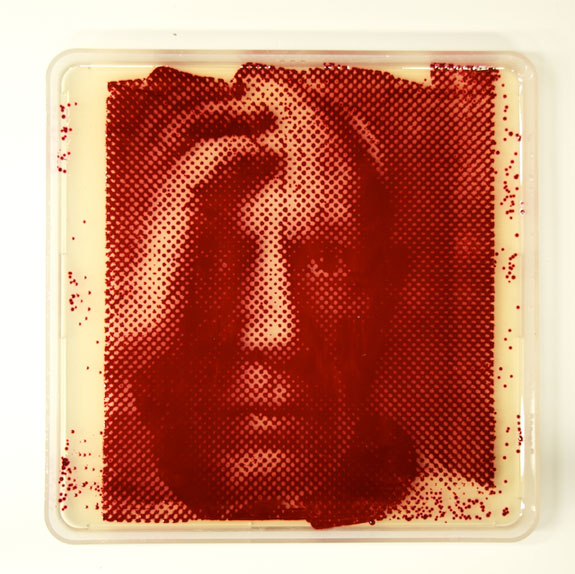
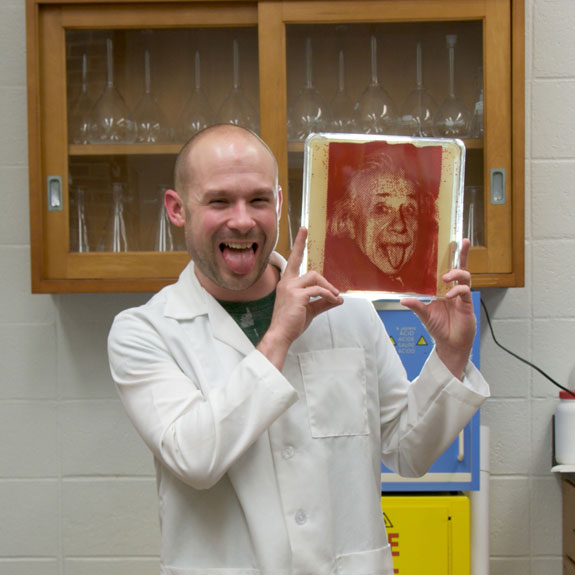
Copfer has created a series of “bacteria portraits” of famous artists and scientists, including Leonardo da Vinci, Pablo Picasso, Charles Darwin and Albert Einstein. For each one, he covered a large petri dish, measuring 9.5 by 9.5 inches, in Serratia marcescens, a bacteria responsible for some hospital-acquired infections. “I use it because it is red and it pops and it gives you that great color,” Copfer told Cincinnati Public Radio.
Then, the artist placed a photograph in the dish. For instance, in one, he laid the famous photograph of Einstein sticking his tongue out, captured by UPI photographer Arthur Sasse on the scientist’s 72nd birthday. Instead of exposing the setup to ultraviolet light, as you would when developing a photograph in a darkroom, Copfer exposed it to radiation. The image cast a shadow on the bacteria. In that shadow, the bacteria grew, but in areas where the radiation passed through, they did not. Once those colonies of bacteria grew to his liking, and the piece was finished, so to speak, Copfer irradiated the portrait, killing the bacteria. Finally, he sealed the portrait with a layer of acrylic, so that it could be safely displayed.
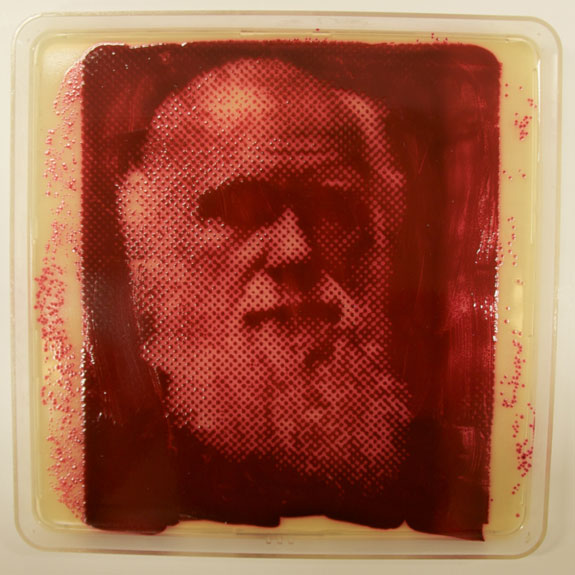
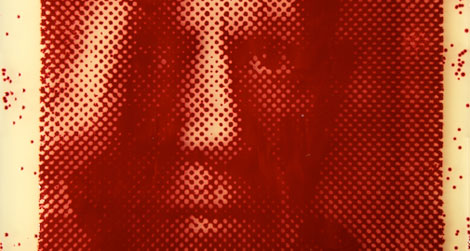
The resulting portraits are bold, pop art-like reproductions of the original photographs. Comprised of red dots—each a tiny colony of bacteria—the images call to mind Roy Lichtenstein‘s comic-strip style of portraiture.
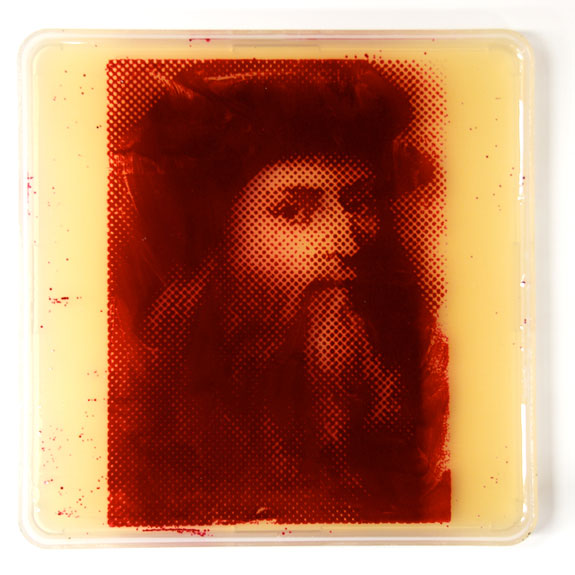
In the titles of his works, Copfer refers to artists da Vinci and Picasso as “scientists” and scientists Darwin and Einstein as “artists.” He believes that for many others, like himself, the titles are interchangeable.
“For me, the two seemingly disparate fields of study serve the same purpose, a way to explore my connection to everything else around me,” he says, on his site.
Sign up for our free email newsletter and receive the best stories from Smithsonian.com each week.
9 Comments »
RSS feed for comments on this post. TrackBack URI


Just seems wrong. There are certain divisions that should remain in place. Bateriology and art should be left in seperate worlds. Just because something can be done doesnt mean it should be done.
Interesting article. As a (retired) microbiology instructor with an interest in both photography and “microbial art,” I have a few comments that I hope will be useful to your editor and readers.
First, your writer or editor needs to know that saying Serratia marcescens is “a bacteria” is as ungrammatical as saying Lassie is “a dogs”. Serratia marcescens is a bacterium! (
Second, I think the writer was confused about the difference between conventional darkroom procedures and the image reproducing technique used by Mr. Copfer. Conventional dark room printing does not use ultraviolet light to expose images onto printing paper!! It uses ordinary visible (tungsten filament) light for this purpose. Mr. Copfer, instead, uses UV to kill bacteria in the lighter parts of the image, allowing the unexposed bacteria on the plate, representing the darker areas, to grow.
Third, it would be very misleading to imply that Mr. Copfer’s efforts to use bacteria as a medium for producing pictorial art is especially original. In my last year of teaching, 8 years ago, I asked my students to produce “Microbe Masterpieces” by executing original paintings on petri dishes using differently pigmented bacteria – and subsequently discovered that many others had had that “original” idea before me – including Alexander Fleming (discoverer of penicillin) in the 1920s! A wonderful collection of such creative works (including my students’ work, and Flemings’!) is on display at http://www.microbialart.com. Another interesting collection contains this “bacterial photograph,” also of Einstein (tongue discreetly hidden in mouth): http://www.newscientist.com/gallery/microbe-art/8 (part of another beautiful collection). Note that this latter “bacteriograph” uses a very sophisticated genetic switching mechanism to create the pigment, and accomplishes the gray-scale gradations at the resolution of individual bacterial cells, without the intrusion of a Lichtenstein-like dot matrix effect. The two methods are analagous to “subtractive” vs. “additive” methods in lithography.
Ben Wise
Great artwork. Alexander Fleming also used to amuse himself by ‘painting’ pictures using different chromogenic bacteria cultured on agar.
Really, folks? What are you questioning? Art is where you find it! While this may be odd, it’s still art. I admire Dr. Copfer’s experimentation. Is it original? Who cares? It’s very cool. Cudo’s to Dr. Copfer!
On Valentine’s Day in 1958, as a young bride and a new bacteriologist in a Philadelphia, PA hospital, I ‘wrote’(with my wire and glass stylus-can’t remember the proper name)using Staph. aureus I LOVE YOU within a heart on a red blood-agar petri dish , and brought it home (well sealed) after I’d incubated it overnight. I KNOW this doesn’t begin to compare to the artistic talent I’ve just read about. But, I’m so glad you young folks are just as inspired as I was!
Very impresive! But before I applaud the great bacteriiographic artist, I dare him to do also pictures of photographs of Jesus, and some of the most popular mythological “saints,” of the christian churches; and while he’s at it may be the so colled popes, specially the current most hypocritical one.
tori. you have just defined everything art is supposed to be.
the drive of humanity is to do things that have not been done. to stir an honest emotion, such as tori’s, is exactly what makes this art.
My father has a series of photographic prints he is calling his Bacteria collection – and so it was with great interest that we discovered that others had created photographic works using bacteria as well. In my Dad’s case, some kind of microbes invaded various layers of emulsion in some of his vintage advertising work to create amazingly detailed and colorful prints, which we blew up to 40×60 inch prints and are currently on display in a gallery exhibit at the Rochester Institute of Technology. Some of the works can be viewed at http://www.montanusphotography.com/bio.
As I wrote on our web site: …they are a stunning series of utterly unique psychedelic prints using a never-seen-before photographic process which ultimately arose from a mistake when he unwittingly discovered that various types of fungus and bacteria had invaded the individual layers of photographic emulsion of some of his vintage advertising work kept in an unusually damp part of his basement.
The results are a stunning juxtaposition of vintage madmen-era advertising photography with an amazingly detailed and unexpected metamorphosis between the real and the surreal. They have been totally transformed into beautiful abstract colors that you see in the attached prints. And none of this work is digitally manipulated in any way – no Photoshop, no tricks – nothing.
Kodak film scientists have verified that these images were caused by microscopic bacteria getting into images in the layers of film. Millions of the microbes are attracted by the gelatin within the various layers. As one of the technicians told me, “the bacteria eat into the gelatin because it’s like food to them” (think Jell-O).
I’ve been told that they’ve never seen any thing like this before and that it is probably the first time anyone has seen this kind of transformed film product. Interestingly, these photos nearly never saw the light of day. In fact, during a mission to clean out his basement, Neil had already tossed these slides into the garbage when he decided to take another look. At first glance, they appeared to be ruined after decades of improper storage. But after further inspection, he began to realize the amazing transformation that had taken place.
All this is within the context of an epic photographic career. Again, as I recently wrote about a recent exhibit:
Neil Montanus was Kodak’s most famous photographer. For nearly four decades, his images promoted photography to millions of people around the world through Kodak Advertising.
For the first time in a generation, many of his most iconic images are on display here. Some of these images have never been displayed publicly, having recently been discovered in his archives.
At times, Neil’s job was more like a National Geographic photographer than a Kodak photographer. During his career, he traveled to more than 32 different countries and some of the most beautiful places on the earth. He toured Europe on multiple occasions, Africa, Australia, South America, India, Taiwan, the South Pacific and even spent several nights with a former headhunting tribe in the jungles of Borneo. As a result, Neil’s career at Kodak has been called legendary by many.
Neil’s portrait of Walt Disney in 1961 was called the ‘best portrait ever taken’ of Walt Disney and is still in use at Disney facilities today. Originally hired as a portrait specialist by Kodak, Neil was asked to do the official White House portrait of President Gerald Ford, taken in the Oval Office after Nixon’s resignation in 1974. And he worked with many top models, such as Cybil Shephard – long before her acting fame.
More on our web site…