May 29, 2012
Judging an Airline by its Uniform
![]()

Uniforms for Pan Am (1969-1971), United (1968-1970), and Southwest (1995-2004) (image: Cliff Muskiet)
A few weeks ago I spent some idle time at the international arrivals gate at San Francisco International Airport. My husband’s plane from Seoul had landed but he was stuck in a long customs line somewhere behind the Great Wall of security, so I stood with the throngs of greeters and watched weary passengers and flight crews pour out the sliding door.
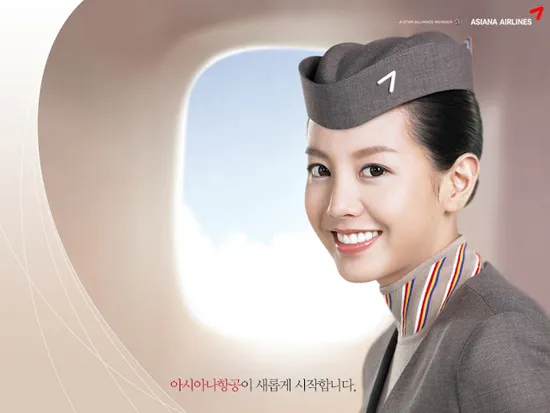
An Asiana Airlines advertisement
First came a team of women from Asiana Airlines, wearing collarless blazers, neat pencil skirts, and little Peter Pan-style hats. The headwear imparted such a whimsical image, it seemed it could be a subliminal antidote for nervous passengers, suggesting that a commercial jet flies as easily as a Disney character. After that, a Korean Air fleet paraded past in robin’s-egg blue uniforms with neck scarves tied identically at a gravity-defying angle so one end resembled an outstretched wing. Designed by Gianfranco Ferré and worn on board since 2005, the jacket’s color seems inherently calming, approaching some of the hues employed strategically by Apple to give users a pleasant experience. The blouse beneath is made from a shimmery synthetic material the resembles water under bright light.
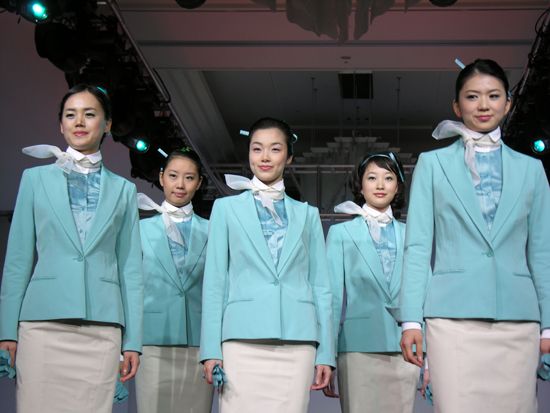
The current Korean Air uniform, designed by Gianfranco Ferré
Finally, a few Emirates attendants emerged wearing ultra-plain khaki blazers topped with bright red hats and veils. ”It is a nice touch of ‘national identity,’” says Cliff Muskiet of the Emirates outfit, pointing out that the color of the suit, while subtle, is not arbitrary. “It’s the color of sand.” Muskiet is a Dutch-born flight attendant (more specifically, a purser) for KLM airlines, and a self-declared uniform freak. He has been collecting flight attendant uniforms since 1980, accumulating over 1000 garments from hundreds of airlines around the world.
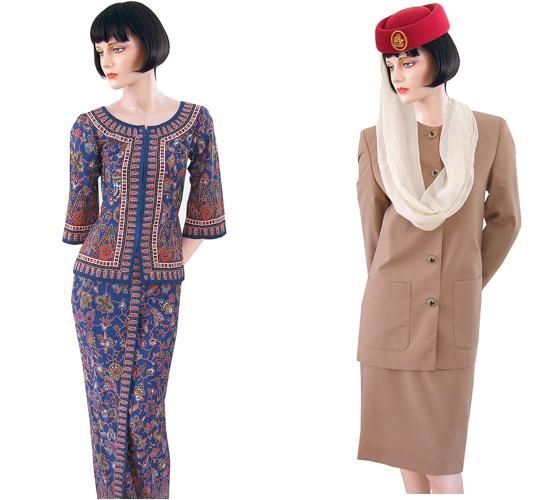
Uniforms for Singapore Airlines (current) and Emirates (1990s until 2009) (image: Cliff Muskiet)
Having surveyed the fashions across decades of commercial aviation, Muskiet thinks today’s uniform styles play it safer than before, and while his observation is based on aesthetics, it’s not a stretch to think that airline apparel has come to reflect the overall tightening of flight safety. In the 1960s and 70s, stewardess uniforms (indeed, they were all women) were designed to be overtly sexy and appealing to male passengers. Designers like Emilio Pucci were hired to bring current high-fashion cuts and patterns onto planes. ”The airlines used bright colors and different psychedelic prints—stripes, flowers, dots,” Muskiet recalls, “Everything was possible!”
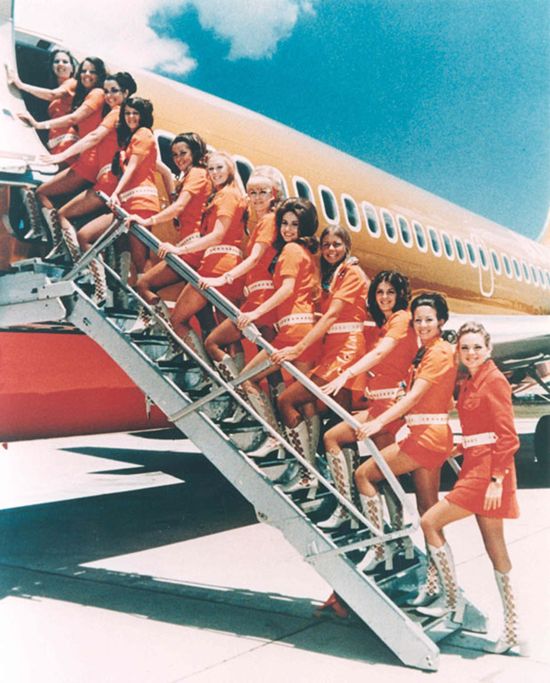
Southwest Airlines uniforms in the early 1970s (image: Museum of Flight)
Today’s travel atmosphere is more about inspiring trust and calm than it is about giving people a thrill. Plus, Muskiet points out, ”nowadays stewardesses would not feel comfortable wearing short skirts or hot pants. Uniforms have become more professional and more like business outfits.” The addition of male flight attendants to the field, and the focus on comfort and safety, led to a less distracting and more gender-neutral look. Distinguishing cultural identity markers tend to be integrated more subtly, such as with Kenya Airways’ leopard-print blouse, which is worn under a conservative blazer.
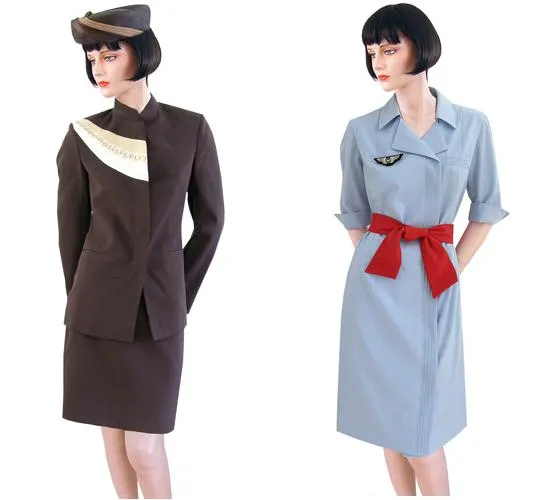
Current uniforms for Air Uganda and Air France (image: Cliff Muskiet)
Thai Airways splits the difference, with flight attendants dressing in Western-style suits pre- and post-flight, and changing into traditional Thai dress once on board. But one of their national airline competitors, Bangkok Airways, which bills itself as “Asia’s Boutique Airline,” has taken another tack, moving back into high-fashion by enlisting Thai label, Asava, to design a new look. As a clear indication of the airline’s couture-oriented approach, they debuted the modern line at Bangkok International Fashion Week in 2011, and now their flight crew is pulling the pendulum back toward uniform design that favors style and aesthetics, even in the era of rigid safety measures and no-frills travel.
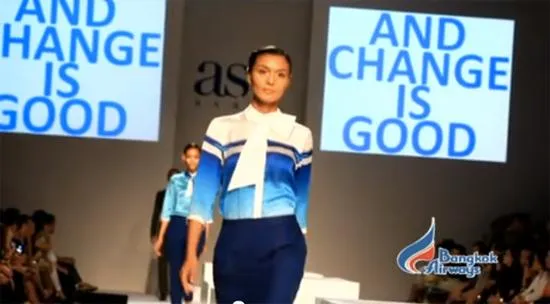
Bangkok Airways' new uniform, debuting at Bangkok International Fashion Week, 2011
Sign up for our free email newsletter and receive the best stories from Smithsonian.com each week.
30 Comments »
RSS feed for comments on this post. TrackBack URI


Amongst the uniforms demonstrated on this page, my favourites are Emirates, with their flowing veils and red caps, as well as the ultra elegant Korean Air.
The Singapore outfit is too tight and showy, more suited to an evening gown than a uniform for flight attendants. The Southwest uniforms appear garish and provocative.
Allowing male flight attendants has to be the most asinine decision in the history of transportation, bar none. Sigh!
Seriously, can you imagine working in some of these get-ups (the Emirates one in particular)?
My vote goes to the new Bangkok uniform – it looks chic, elegant and comfortable.
@pep lopez: I take it that you are not a woman.
Great post! But Southwest didn’t start service or introduce the first uniforms until 1971.
There’s an error in the caption on the final photo, showing a line of flight attendants on the boarding steps. Southwest Airlines did not exist in the 1960s except on paper. Its first flight wasn’t until June 1971. Although the aircraft color scheme looks like Southwest’s, I’m wondering if the photo might actually be from the now-defunct PSA (Pacific Southwest Airlines), which pioneered hot-pants uniforms.
You are correct! It was Pacific Southwest. The adjustment has been made to the caption. Thanks!
why even compete with air france!
SAS said: “The Singapore outfit is too tight and showy, more suited to an evening gown than a uniform for flight attendants. The Southwest uniforms appear garish and provocative.”
While I’m not a fan of the airline’s earlier advertising campaigns (“Singapore Girl”), I think it’s only fair to point out to SAS that the Singapore uniform is based on a traditional form of dress called a Kebaya, which is very revealing indeed. Peranakan culture (which is the closest thing Singapore has to an indigenous culture) is not especially prudish. Many Kebaya are practically translucent.
So the “tight and showy” is actually a reflection of national values, in the same way the Emirates hat is.
As far as American carriers, I have to say the women on Delta are always the most smartly dressed. Svelt outfits crimson accents over crisp navy blue.
Just take me back to the good times of Pan Am!
PSA was my all-time favorite airline. Not least, because of the stews’ uniforms.
New Zealand airlines uniforms always look professional.
Braniff was unique!
It is service that counts, not what they wear international or domestic. It some case this is what is lacking. Unless you are going first or business class, how many are traveling that way though. What is now becoming iritating is the number of change in flights to get to a destination. Non-stops are becoming rarer at you are at the mercy of Aailines. Pick and chose wisely not what a flight attendant wears, but the service rendered.
For my 2¢, it’s the late 60s early 70s PanAm uniform. What a fantasy. Reality is frumpy by comparison.
I often flew Pan Am flights 1, 2, 116, and 119 in the 1960′s. Nobody has ever matched those hats – or Pan Am itself, for that matter.
Now that there are male attendants, where are the guys’ outfits? Not that I really care, but it does show the lingering sexism of the whole trade. Sexism that I must say I am sad to see departed, as politically incorrect as that is. “Coffee, tea or me” went away with all the other pleasures (like walking onto a plane without a patdown) when the idiots started messing with airlines as a way to demo their revolutionary machismo. Or maybe there was a relationship there?
Hughes Airwest in the late seventies, those were some Uniforms!!!
Way back in the late 60′s when I was US Army,serving in Korea instead of Viet Nam, It was an unwritten rule that if you had a choice of airlines to fly, Southwest had the hottest “Stews” and even more important they were very kind to returning servicemen! I mean in a platonic and professional way. I never had the chance to fly them, but a lot of my buddies did or had friends that flew with them and the word was always thumbs up! A belated Thanks to Southwest for taking care of so many of my comrades returning from unspeakable hell!!
I watch for uniforms that are sloppily worn. One steward had his wrinkled shirtail creeping out, and his buttons were too tight over his belly. Not confidence-inspiring! When I see unkempt attendants, I find that the service is sloppy, too.
Hmmm. I would like to see a comparison of the big airline uniforms with the tiny European low-cost….where as a general rule most attendants are still young girls, and the uniform includes funny hats and details…
I am tired of seeing US attendants looking like they just woke up and and boarded the planes…..and they are older and need to make sure that their hair and makeup is nice. I find that they also don’t have a uniform that is univeral. You see on the same flight some in pants, dresses or suits.
WHAT HAPPENED TO THE BEAUTIFUL AIRLINE STEWARDESS?
The photo was Southwest, not Pacific Southwest. This link will make it quite clear.
http://www.youtube.com/watch?v=TR7JApjgIGw
There is an excellent book entitled “Come Fly With Me!” by Elissa Stein. It is filled with incredible photos.
Cliff has stated in interviews that he only collects female uniforms because there is more variation between them whereas for males they are generally just suits. Not because he’s sexist! Also, he doesn’t have the room for both.
Whoa there! The photo that has been attributed to Pacific Southwest Airlines is actually Southwest. Pacific Southwest Airlines (PSA) operated from 1948 until its takeover by US Airways in about 1978.
Herb Kelleher, the founder and CEO of Southwest actually visited PSA and copied the type of color scheme, advertising, the uniforms, and enthusiastic customer service that was at PSA.
PSA lent Southwest some 737 manuals and trained Southwest’s first class of 737 mechanics in the late 1960s.
I proudly flew for Pacific Southwest Airlines from 1968 until 1979.
And a footnote… the hot pants uniforms started appearing in the 1970s.
The terms “Stewardess” and “Steward” are archaic, not used in the profession any more. They hark back to the days when men and women performed different jobs on the aircraft and women were barred from holding positions that paid more.
BTW, I wonder what ever happened to well-dressed and well-behaved passengers.
My father was a flight steward for 37 years, until he retired in the late 1970′s. He would tell tales of how originally no women were considered for such a position of responsibility for passenger safety, but RN’s were eventually allowed to apply. Later on single college educated women were hired, but if they got married they were let go – so my mother quit before they married. He flew all over the world for many more years, and every passenger on his flights knew they were the most important and interesting person he had ever had the pleasure of meeting. His original uniform was donated to the Smithsonian, and the aircraft hanging in the Air & Space Building is one on which he flew many miles.
@SK: man you date yourself. Flight attendants today (those “older” ones who need makeup?!) are the stewardesses of your generation.
and thank you DG_Air for your correction. PSA certainly DID NOT have those boots!
@Handlbarp: it was the PSA Pacific Southwest Airlines (affectionately poor sailors airline)crews of which you speak) that conducted many of those flights. I know other carriers of the day also were involved, mostly on the west coast. Southwest was still a glimmer in someone’s eye…