Blogs

  • News
  • |
  • Art
  • |
  • History
  • |
  • Food and Travel
  • |
  • Science
Dinosaur Tracking

Where paleontology meets pop culture

Hominid Hunting

Meet the members of the tangled human family tree

Innovations

How human ingenuity is changing the way we live

Surprising Science

Ideas, news and discoveries from the world of science


December 15, 2011

Nedoceratops: To Be, or Not to Be?

A comparison of Triceratops (left) and Nedoceratops (right). From Scannella and Horner, 2011.

When the “Toroceratops” controversy broke in the summer of last year, I felt sorry for Nedoceratops. Hardly anyone said a word about this unusual horned dinosaur. Fans of Triceratops wept, wailed, and gnashed their teeth at their misapprehension that Museum of the Rockies paleontologists John Scannella and Jack Horner had exterminated the beloved horned dinosaur while paleontologists wondered if this dinosaurian mainstay of the Late Cretaceous could have grown into what had previously been called Torosaurus. But no one shed a tear at the proposition that Nedoceratops, too, might have been just a growth stage of Triceratops.

Known from a solitary skull on display at Smithsonian’s National Museum of Natural History, Nedoceratops has perplexed paleontologists since it was first described more than 100 years ago. The skull was found from the same end-Cretaceous strata that yielded Triceratops and Torosaurus, yet the dinosaur eventually labeled Nedoceratops was different from both. The skull had the general Triceratops-Torosaurus shape, but was distinguished by the lack of a nasal horn, a small opening in the preserved parietal portion of the frill, and two asymmetrical holes in the wing-shaped squamosal bones which made up the border of the frill. (These holes were thought to be old battle scars from some Cretaceous clash, but later studies showed these unusual perforations to be natural parts of the animal’s bone growth.) Scannella and Horner disagreed. Some of the unusual features, such as the apparent absence of a nasal horn, fell within the expected variation of Triceratops, and they interpreted the small hole in the parietal to be an early stage of the larger, rounded openings seen in the elongated frills of Torosaurus. Therefore, Scannella and Horner proposed, the Nedoceratops skull was a dinosaur virtually caught in the act of transitioning between the traditional Triceratops and Torosaurus forms, linking all three animals together into a single, late-life growth series.
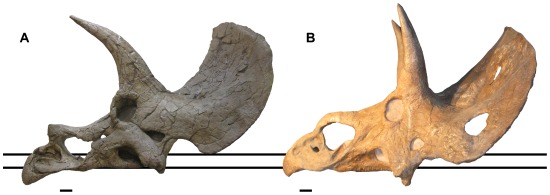
Andrew Farke, a ceratopsian expert at the Raymond M. Alf Museum of Paleontology, came to a different conclusion when he published a reanalysis of the Nedoceratops skull earlier this year. The mix of features exhibited by Nedoceratops distinguished the dinosaur from both Triceratops and Torosaurus, Farke argued, which would remove the form with transitional features from the growth series. More than that, Farke offered up additional criticisms of the growth series Scannella and Horner proposed—Torosaurus might not be sunk, after all.

Now Scannella and Horner have published a response to Farke’s response. To an outsider, this might look like an echo of the 19th century “Bone Wars,” when the cantankerous naturalists Edward Drinker Cope and Othniel Charles Marsh battled each other in print over the proper identification and interpretation of dinosaurian remains. The headline for LiveScience’s report on the new paper states that the “debate rages,” though the argument is probably better cast of a difference of opinion that has generated some friendly competition. Farke and Scannella are close colleagues, and as Farke mentioned in a behind-the-scenes post on his Nedoceratops work, the paleontologists have helped critique and strengthen each other’s arguments prior to publication. The paleontologists are not about to assault each other at the next Society of Vertebrate Paleontology meeting, either.

Despite the collegiality between the parties, however, Scannella and Horner object to Farke’s critique. For one thing, the Montana-based researchers argue, each of the seemingly unique features of Nedoceratops can be found within the variation of Triceratops (which they count as including Torosaurus-type animals). Though Triceratops is classically portrayed as being a “three-horned face,” when I asked about the apparently absent horn of Nedoceratops, Scannella pointed out that “there are many Triceratops specimens which show similar low, subtle nasal ornamentation—not quite to the degree seen in ‘Nedoceratops’ but certainly approaching that state.” Alternatively, the nasal horn of Nedoceratops might have been broken off or lost after death since the horn does not actually fuse to the nasal bones until late in life. At the moment no one knows for sure whether the horn was lost or was simply never there, but Scannella emphasizes that none of these scenarios hinders the idea that Nedoceratops might be better categorized as a Triceratops.

And that’s not all. Some of the features thought to mark the Nedoceratops skull as an old individual that had finished growing are ambiguous, Scannella and Horner say. The rough bone texture and fusion between certain skull bones—thought to be indicators of maturity, and even old age—are variable in Triceratops and don’t necessarily represent the age range of the animal accurately. They uphold their original interpretation of the dinosaur as a Triceratops, and I have to admit that I was amused that Scannella and Horner pointed out that Nedoceratops translates to “insufficient horned face” in their paper. Though this refers to the apparent lack of a nasal horn, there is a certain poetic justice to it in a paper which seeks to sink the name. “I think ‘insufficient horned face’ is a very appropriate name given that the genus likely represents variation within Triceratops,” Scannella said.

Scannella and Horner offer an explanation for the slit-like opening on one side of the specimen’s frill. (The completed Nedoceratops skull on display was partially reconstructed, so we don’t know for sure if there was a matching hole on the other half.) The projected sequence of transformation from Triceratops to a Torosaurus-type form predicts that there would be a stage in which the solid frill of Triceratops would develop depressions or holes that would eventually open to create large, circular fenestrae. Scannella explains the transformation happening like this:

As Triceratops matured, the parietal developed increasingly thin areas which eventually formed the holes previously thought to be characteristic of “Torosaurus.” If you take a typical Triceratops with a thick, solid frill and have it undergo this transformation to “Torosaurus,” there’s going to come a point where the parietal is going to begin to develop openings. These openings will likely start off rather small and continue to grow as resorption continues and the parietal expands. This is what we see in “Nedoceratops“—it’s a fairly mature specimen, the squamosals are slightly elongate (approaching the morphology observed in “Torosaurus“), and the parietal has a small opening in the same place where in Triceratops we see thinning occurring and in “Torosaurus” we see holes. So—one possibility is that this is a distinct genus of dinosaur that has tiny holes in its parietal. Another is that this is simply a Triceratops caught in the act of becoming “Torosaurus.” Jack and I favor the hypothesis that “Nedoceratops” is actually a transitional morphology, between Triceratops and “Torosaurus.”

One of the areas of debate has been the number of triangular, bony ornaments called epiossifications around the border of the Triceratops frill, which is composed of the parietal and squamosal bones. Previous studies have established that these bones start off being prominent, pointed ornaments, but as Triceratops aged these bones flattened out until they were barely visible. The question is whether the number of some of these epiossifications could change during growth, thus bridging the gap between the different number of these ornaments on the parietals of Triceratops and Torosaurus.

While Triceratops typically has five or six of these bones, called epiparietals, Torosaurus have been found with spots for 10 to 12, requiring the number to double if Scannella and Horner are right. This kind of addition has not been seen in well-sampled populations of horned dinosaurs before, but Scannella and Horner propose that such changes were indeed possible. As evidence, they cite a single epiossification marked by two peaks, which they hypothesize is an ornament in the process of splitting into two. Additional specimens will be needed to determine whether this double-peaked adornment truly was splitting during a transformative growth stage or is an unusual and unique variant. While Farke cautions that he hasn’t seen the specimen in question himself, he does offer an alternative interpretation. The double-peak shape “could also just be resorption of the tip without splitting a single element into two,” he says. “This is relatively common in ceratopsids—many of them tend to resorb the tips of the ‘high points’ on the skull, and that may be what is happening here.” If this is the case, then the epiossification would be part of the typical transformation into flatter adornments and not indicative of splitting.

This aspect of debate brings up the question of how useful epiossification counts might be for identifying distinct ceratopsids in the Hell Creek Formation. Individual variation, changes in growth and possibly even variation from one slice of time to the next might complicate matters. “As we are finding more and more Triceratops in the Hell Creek Formation of Montana,” Scannella says, “we are seeing specimens with quite a bit of variation in both the number and position of frill epiossifications–a finding which urges caution before considering epiossification number and position a set in stone indicator of taxonomic identity, at least in taxa closely related to Triceratops.” Farke takes a different view. “[Scannella and Horner are] almost certainly correct that there is stratigraphic variation in epiossification count (presumably related to evolutionary change in a lineage),” he says, but points out that “This would strengthen the argument that epiossification count has phylogenetic significance … [I]f early Torosaurus have one count and late Torosaurus have another count, this would suggest that this trait changes through time and we can use epiossification count to distinguish different species.” Though all this argument over ceratopsid ornaments might seem esoteric, it is a key part of the discussion over what Nedoceratops and Torosaurus truly were. Did some ceratopsid dinosaurs add—and even double— frill ornaments as they matured? The answer to that question will have a major influence on the future of this debate.

What was Nedoceratops? That still depends on who you ask, and there is more than one possible answer. Farke, while noting that “Scannella and Horner raise some valid critiques of my diagnosis of Nedoceratops” in the new paper, still doesn’t see the dinosaur as an intermediate growth stage. “[W]e do still disagree on the taxonomic relevance of things like the parietal fenestrae,” Farke says. “[T]hey cite [the fenestrae] as transitional morphology between the Triceratops-morph and the Torosaurus morph of a single animal’s growth trajectory, whereas I would posit it as the end-member morphology for whatever Nedoceratops is.” And these aren’t the only options. “Of course, Nedoceratops might be an unusual or pathological individual of Triceratops. I’m not particularly married to any hypothesis at this point,” Farke says.

If Nedoceratops is an intermediate growth stage between the classic Triceratops and Torosaurus body types, further sampling of the Hell Creek and Lance Formations should eventually turn up still-growing Triceratops with similar features. Then again, if Nedoceratops is a distinct genus we would expect to eventually find juvenile individuals which share specific features with the single known skull to the exclusion of Triceratops and Torosaurus. Or maybe Nedoceratops is just a weirdo Triceratops.

This isn’t just a bit of paleontological arcana. The scientific conversation about Triceratops growth emphasizes the difficulties of recognizing prehistoric species and understanding their biology. What were once considered to be different species may just be growth stages or variants of one dinosaur, and these revisions affect our understanding of dinosaur evolution, biology, and ecology. I asked Scannella for his thoughts on the implications for his hypotheses, particularly given the fact that many dinosaurs are known from single, and often partial, specimens:

Increasingly, we are learning that many skeletal features in a wide variety of dinosaurs change throughout development.  There is also individual variation to consider. If all the differences between specimens are considered taxonomically informative, then it is easy to see how 16 species of Triceratops were named based on small differences in cranial morphology. Dinosaurs changed as they grew—and so, we need to evaluate which features are the most taxonomically informative. This can be hard to do if there is only one specimen of a particular dinosaur. We can start by examining developmental trends in dinosaurs thought to be closely related to that one specimen – as we’ve done with “Nedoceratops.” Examination of the bone microstructure is also important, in order to get an idea of relative maturity.

Paleontologists have recognized the problems of identifying slightly different specimens as new species before, but the debate over Triceratops—as well as Tyrannosaurus, Pachycephalosaurus, and other Hell Creek dinosaurs—has helped reinvigorate interest in how little dinosaurs grew up. Paleontologists are still in the relatively early phases of this investigation, and there are far more questions than there are definitive answers. The clues that will resolve the question of whether Triceratops was the lone ceratopsid of the Hell Creek still wait in museum collections and the expansive fossil graveyard that is the badlands.

References:

Farke, A. (2011). Anatomy and Taxonomic Status of the Chasmosaurine Ceratopsid Nedoceratops hatcheri from the Upper Cretaceous Lance Formation of Wyoming, U.S.A PLoS ONE, 6 (1) DOI: 10.1371/journal.pone.0016196

Scannella, J., & Horner, J. (2010). Torosaurus Marsh, 1891, is Triceratops Marsh, 1889 (Ceratopsidae: Chasmosaurinae): synonymy through ontogeny Journal of Vertebrate Paleontology, 30 (4), 1157-1168 DOI: 10.1080/02724634.2010.483632

Scannella, J., & Horner, J. (2011). ‘Nedoceratops’: An Example of a Transitional Morphology PLoS ONE, 6 (12) DOI: 10.1371/journal.pone.0028705


***

Sign up for our free email newsletter and receive the best stories from Smithsonian.com each week.

10 Comments »

  1. BJ Nicholls says:

    I think that it’s very unlikely that the numerous unique features of Nedoceratops that perhaps have analogs in various Triceratops specimens would somehow all be manifest in one individual.

    And statistically, the odds of fossilization and discovery for a morphologically odd or pathological individual have to be relatively small.

  2. 220mya says:

    They still fail to address Torosaurus utahensis

  3. As is noted in the comments to this blog post on the subject, the work continues and is not complete, but is certainly designed to eventually discuss what to so with all of the Maastrichtian chasmosaurine ceratopsids involved in this whole complex of species. This includes what is typically called ?Torosaurus utahensis.

    The oddest element to this is that both Farke and Scannella and Horner may be correct, in many ways: the ontogeny can be peculiar and unique to ceratopsids, with investigation into how weird it is to other ceratopsids, especially in the paedomorphic retention of a solid frill until into late adulthood, or the peramorphic facial elongation and metaplastic trasformation of the frill ultrastructure and horns. Farke’s proposition may result in multiple taxa among a complex of what can be “chronospecies,” segments of an anagenetic lineage of forms, all essentially one long continuous transition through time, but broken up into useful elements. The work is continuing, and is certainly not settled.

  4. arani says:

    and what about juvi Toroaurs?

  5. Hikaru Amano says:

    Good Day, everyone.

    As what I have written in other blog sites before, both the supporters and critics of this hypothesis have strong arguments and counter-arguments. The single example of a double-peaked squamosal eppocipital may have been caused not by resorption but by a traumatic event(such as being hit by another Triceratops horn). But even if division (via resorption) happened in squamosal epoccipitals, it does not necessarily mean the same thing happened in parietal epoccipitals. More specimens of both chasmosaurines and centrosaurines from all ages (starting from youngsters that possess nodes corresponding to eppocipital positions to old adults where fusion of eppocipitals to the crest margins is complete) needed to be examined to discover if epoccipital numbers doubled and positions varied throughout ontogeny. Also, the depressions on the coalesced pair of parietals which Farke claimed were regions of neck muscle, and claimed by Scanella and Horner to be areas of fenestration, needs further investigations since even the latter themselves claimed that those regions may have been covered by periosteum, hence indirect muscle insertion may have happened after all (Muhl and Gedak, 1986). My view is that what will finally settle this issue are biomolecular examination. (as stated in my blog at Dr. Farke’s blogspot, but with few corrections as enclosed in a pair of dashes) “…subject the skin samples from the Triceratops (?T. horridus) “mummy” found by Dr. Bakker plus preserved soft tissues in Triceratops bones (if present and in good quality) to a qualitative molecular examination to see if there are any usable traces of peptides from that ‘mummy’; if there are, collect as many samples”-as possible-”to determine the consensus amino acid sequence of Triceratops as comprehensively as possible. Do the same for the ‘Torosauri’ specimens; then subject them to amino acid sequence analysis (one can even perform probabilistic reverse genetics since the present sequence of amino acids hints at the possible sequence of DNAs that produced it). As I have said before, in even a 1% or 2% difference-in amino acid sequences-(with regards to equivalent genes; other factors such as the differences in respective numbers of those identical genes’ copies and gene expression control mechanisms present in those taxa are anybody’s guess with our current technology) in the molecular composition of two taxa can render them as separate but very closely related (i.e. humans and chimps). If the molecular data contradicts the morphological ontogeny implied by histological data, then there is a significant possibility that Torosaurus is indeed valid. “. Compare the results from molecular examination with morphological analysis and if the results of the two have high degree of similarity, that would refute the ontogeny being implied by the histological tests. Wiht regard to histological analysis, I find it quite unreliable (and potentially in establishing synonymy via ontogeny considering that in many different groups of animals, very closely related yet separate species and/or genera can have identical skeletal mophologies and are distinct only at the genetic level or have morphological variations that are not based on the skeleton at all (such as pattern and/or color distribution in the integument, relative sizes to one another, etc.). I have written before that it’s possible for sister species or genera to have highly identical skeletal morphologies, and that if individuals of two very closely related yet distinct genera (let’s say, grey whales and right whales) happened to have died and fossilized at the same site (with the individuals of the former being subadults and the individuals of the latter species being young adults and old adults), then it’s highly possible that subjecting the bones of those individuals to histological analysis will falsely result in the individuals of grey whales being regarded as subadults of right whales. Another approach, although less reliable than molecular analysis, is the discovery of monospecific bonebeds where there are Triceratops of all ages(nestlings, puppies, juveniles, subadults, young adults, and old adults). If there are Torosauri there, then perhaps the latter scientists are right (that Torosaurus is the old adult phase of Triceratops).

    Literature cited:

    Muhl, C.F., and Zedak, G.K. (1986). The influence of periosteum on tendon and ligament migrations. J. Anat. (1986), 145:161-171.

    Hikaru. (2011, November 22). Re: Nedoceratops – fun with science [Web log message]. Retrieved from The Open Source Paleontologist Blog, http://openpaleo.blogspot.com/2011/01/nedoceratops-fun-with-science.html.

  6. Doug says:

    Suffice to say i find Tri->Toro much easier to but than the proposed growth series for Pachycephalosaurus.

  7. Boesse says:

    Hikaru,

    Several points, some more minor than others:

    1) There aren’t any “skin samples” from Triceratops. There are specimens with skin impressions, but it is effectively a trace fossil – an impression in the sediment from the skin. There’s no soft tissue preservation. Fossilized ‘soft tissue’ samples would be needed from the interior of bones – and thus far the samples to my knowledge have not been obtained.

    2) That being said, the field of molecular paleontology is so new and there are still so many skeptics that I doubt your suggestion would really persuade many people. Otherwise, any perceived differences in chemistry could just as easily be due to diagenetic alteration.

    3) You should probably read more on histology. If you find it so unreliable, perhaps you should publish something.

    4) If there were crania or jaws, any cetologist who made a mistake of confusing eschrichtiid and balaenid skeletons even of different sizes would be laughed at.

    5) So far, no monospecific bonebeds have been discovered for Triceratops or “Torosaurus”. That being said, these are the only ceratopsians that occur at all in Maastrichtian strata like the Hell Creek Formation (discounting “Tatankaceratops”). Lastly, although I frequently hear people chanting “more fossils…”, the sample size for Triceratops (& Toro) is now one of the largest for ceratopsids, and one can easily view the birth of the Triceratops/Torosaurus hypothesis as being the result of the improved sample size.

  8. Hikaru Amano says:

    @ Boesse:

    No offense intended for anyone in here. When I used grey whales and right whales here for examples, I am referring to a hypothetical situation wherein these animals have lived and became extinct a long time in the past and we only have their bones for analysis. Without knowledge of their external morphology (or molecular profile for that manner), one could actually make the mistake of regarding the size differences in cranial material and mandibles as different phases of ontogeny. To cite another group, suppose tigers and clouded leopards (the genera Panthera and Neofelis, respectively, are sister taxa) have been extinct for the past 65 million years, (with only their skeletons available for study) and happened to have lived in the same area. Taking the same scenario as what I’ve mentioned in the earlier comment (this time a subadult snow leopard died in the same area as an old adult tiger), the person who will conduct histological axamination of those animals’ remains may falsely result in the clouded leopard skeleton as the subadult form of the tiger skeleton found in the same formation.

    I don’t actually disagree with the concept of Torosaurus as the senescence phase of Triceratops. But personally, I still think that even with a large sample size for Triceratops and Torosaurus, we still need the evidence for monospecific bonebeds (not just the Homer bonebed of adolescent Triceratops, we should also examine the bonebeds that Bruce Erickson and Barnum Brown claimed to have found and then try to find some more). If Torosaurus are also found to be associated rather consistently with those bonebeds, then perhaps Scanella and Horner may be right. Also, I have read a news article where Dr. Nick Longrich will perform histological analysis on the Torosaurus skulls in Yale collections since according to him such specimens have features of adolescent or subadult individuals (such as unfused skull bones). I just wonder if he has finished his research and it will surely be noteworthy to know about that. About molecular paleontology, I think what should be done with Triceratops and Torosaurus is put a slightly less emphasis on fossil skulls and more emphasis in post-cranial bones that could harbor preserved soft tissues(just like what Asara, Horner, and Schweitzer did with the T. rex and Brachylophosaurus fossils, or the research done by Dr. Manning and his team on the preserved soft tissues of the Edmontosaurus mummy in 2007). Schweitzer had published in 2007 about the preservation of blood vessels in 65-million year old Triceratops horridus rib.

    As what is being demanded by other scientists, more post-cranial fossils (ribs, hip bones, femora, humeri, etc.) from different preservation conditions (such as Triceratops and Torosaurus remains from sandstone deposits vs. Triceratops and Torosaurus remains from mudstone deposits) should be collected examined for the presence of soft tissues in good condition. Then perform a qualitative molecular analyses to determine if diagenesis occurred in the molecular profile of soft tissues recovered from Torosaurus and Triceratops. If the consensus molecular profiles of Triceratops and Torosaurs remain consistent even if different samples are obtained from different preservation conditions, then diagenetc alteration may be eliminated rather safely from potential sources of chemistry differences.

    I strongly agree with with Dr. Horner, Dr. Schweitzer, Dr. Asara, and Dr. Manning in their advocacy of using molecular examination methods to discover the phylogeny of dinosaurs as accurately as possible in ways that skeletal morphology and/or histology alone cannot satisfactorily solve. And as I have said before, many distinct yet closely related species may have identical skeletal morphologies yet vary only in their molecular profiles and/or have morphological characters that are not based on the skeleton at all (for example, Ashe’s spitting cobra was regarded as a subspecies of Black-necked spitting cobra due to slight color differences-it is only in 2007 when molecular profiling rendered the two as separate yet closely-related species).

    Literature cited:

    Lindgren J, Uvdal P, Engdahl A, Lee AH, Alwmark C, et al. (2011) Microspectroscopic Evidence of Cretaceous Bone Proteins. PLoS ONE 6(4): e19445. doi:10.1371/journal.pone.0019445

    San Antonio JD, Schweitzer MH, Jensen ST, Kalluri R, Buckley M, et al. (2011) Dinosaur Peptides Suggest Mechanisms of Protein Survival. PLoS ONE 6(6):
    e20381. doi:10.1371/journal.pone.0020381.

    Schweitzer, M.H., Wittmeyer, J.L., and Horner, J.(2007). Soft tissue and cellular preservation in vertebrate skeletal elements from the Cretaceous to the present. Proc. R. Soc. B. 274, 183-197.

    Wuster, W. and Broadley, D.G. (2007). Get an eyeful of this: a new species of giant spitting cobra from eastern and north-eastern Africa (Squamata: Serpentes: Elapidae: Naja). Zootaxa 1532, 151-168.

    Yu, L. and Zhang, Y. (2005). Phylogenetic studies of pantherine cats (Felidae) based on multiple
    genes, with novel application of nuclear β-fibrinogen intron 7 to carnivores. Mol Phylogenet Evol. 35(2): 483-495.

  9. Hikaru Amano says:

    Here is a clarification about my stand regarding histological analyses:

    I don’t question it as a method to establish the degree of maturity of individuals being studies. My argument revolves around the issue of using histology as a means to synonymize/split taxa. As I’ve argued many times here and in other blog sites, without knowledge to the molecular profiles and/or external morphologies of the closely-related taxa being studied, finding individuals from those taxa (with individuals of one taxon/taxa having a different degree of maturity to the individuals of the other taxon/taxa) histogolical analysis could result in a superficial lumping of the taxa being studied.

    Concerning the Triceratops horridus bonebed Homer site, here is the citation for that paper(which I forgot to include in the earlier comment). And oh, I forgot to edit the felid example I have written in the last parenthesis of my earlier comment’s first paragraph(that should have been clouded leopard instead of snow leopard).

    Reference:

    Mathews, J. C., Brusatte, S. L., Williams, S. A. and Henderson, M. D. 2009. The first Triceratops bonebed and its implications for gregarious behavior. Journal of Vertebrate Paleontology 29(1):286-290.

  10. ReBecca says:

    Regarding Bobby’s #5:

    There are 2 bonebeds for Triceratops/Torosaurus that have been published on – the Burpee’s Homer site (not monospecific) and the Torosaurus cf. utahensis site in the Javelina Formation in Big Bend National Park (Monospecific)

    Reference:

    Hunt, R., & Lehman, T. (2008). Attributes of the Ceratopsian Dinosaur Torosaurus, and New Material from the Javelina Formation (Maastrichtian) of Texas Journal of Paleontology, 82 (6), 1127-1138 DOI: 10.1666/06-107.1

    Mathews, J. C., Brusatte, S. L., Williams, S. A. and Henderson, M. D. 2009. The first Triceratops bonebed and its implications for gregarious behavior. Journal of Vertebrate Paleontology 29(1):286-290.

RSS feed for comments on this post. TrackBack URI

Leave a comment

Comments are moderated, and will not appear until Smithsonian.com has approved them. Smithsonian reserves the right not to post any comments that are unlawful, threatening, offensive, defamatory, invasive of a person's privacy, inappropriate, confidential or proprietary, political messages, product endorsements, or other content that might otherwise violate any laws or policies.

Spam protection by WP Captcha-Free

Advertisement


Follow Us

Travel with Smithsonian


Advertisement