
The Past Keeps Getting Cooler
As cartoonist Randall Munroe points out, feathers make dinosaurs cooler than ever
/https://tf-cmsv2-smithsonianmag-media.s3.amazonaws.com/accounts/headshot/RileyBlack.png)
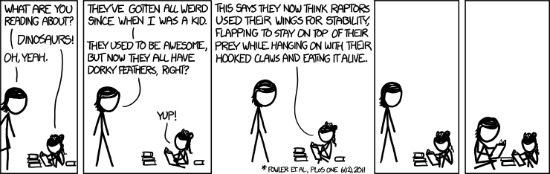
“Feathers” by Randall Munroe, from http://xkcd.com/
Anyone who regularly reads this blog knows that there’s a very easy way to make me annoyed–all you have to do is start whining about how dinosaurs are less cool since paleontologists discovered that many non-avian species sported tufts and coats of fluff, fuzz, bristles and feathers. My reaction is usually along the lines of “Brian SMASH!” Even though I understand that some people find scaly, monstrous dinosaurs aesthetically appealing, I have no patience for the callow assertion that science has somehow ruined dinosaurs through the addition of plumage.
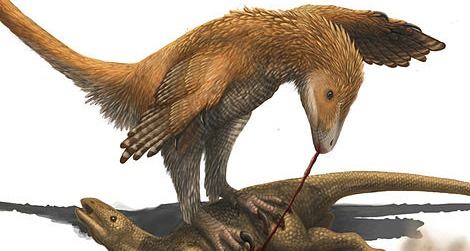
Cartoonist Randall Munroe summed up my feelings–albeit in a more concise and positive way–this week at XKCD. Restoring dinosaurs with protofuzz and feathers isn’t just about giving Tyrannosaurus, Velociraptor and company a new look. Dinosaur feathers, and feather-like structures, are allowing paleontologists to think of dinosaurs in new ways. In particular, Munroe cites a PLoS One study about how feathers may have played into the predatory behavior of sickle-clawed dromaeosaurs such as Deinonychus. According to paleontologist Denver Fowler and co-authors, Deinonychus may have used its famous “killing claw” to pin down small prey just like modern hawks and eagles do. More than that, the avian raptors flap to help stabilize themselves while immobilizing their prey, and Deinonychus–almost certainly a feathered dinosaur–may have done the same.

Deinonychus might have flapped its arms to help restrain prey. Art by Emily Willoughby, image from Wikipedia.
We can’t know for sure whether Deinonychus killed prey like a big, grounded version of a hawk. But it’s possible. Either way, though, studies like these show that prehistoric dinosaur feathers are allowing paleontologists to look to modern birds to generate new hypotheses and tease out previously-unknown aspects of dinosaur lives. As I’ve mentioned before, feathers are the key to figuring out dinosaur colors. How wonderful is that? Again, Munroe says it better than I can: “The past keeps getting cooler!”
Post script: Munroe isn’t the only cartoonist to take on dinosaurs this week. FoxTrot’s Bill Amend had a few suggestions for the Smithsonian National Museum of Natural History’s dinosaur hall renovation. Paleontology curator Matt Carrano responded to the idea of installing a “Tourist Chompsognathus” at our Around the Mall blog.
/https://tf-cmsv2-smithsonianmag-media.s3.amazonaws.com/accounts/headshot/RileyBlack.png)