Blogs

  • News
  • |
  • Art
  • |
  • History
  • |
  • Food and Travel
  • |
  • Science
Dinosaur Tracking

Where paleontology meets pop culture

Hominid Hunting

Meet the members of the tangled human family tree

Innovations

How human ingenuity is changing the way we live

Surprising Science

Ideas, news and discoveries from the world of science


September 28, 2012

Triceratops Wasn’t Toxic

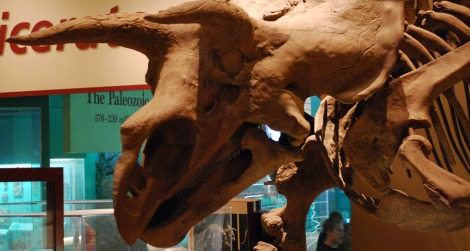
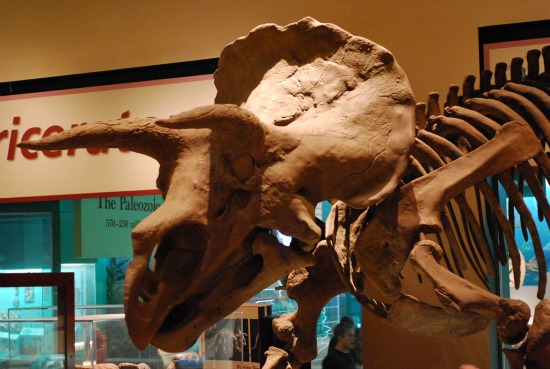
Triceratops at the Smithsonian National Museum of Natural History. Photo by the author.

Triceratops was an A+ dinosaur. But, awesome as the hulking ceratopsid was, it didn’t have mutant superpowers. Indeed, despite a website’s claim to the contrary, there’s no evidence that this three-horned behemoth defended itself with poisonous quills.

Even though it was posted over a year ago, I’ve received a few emails this week asking about a Listverse post by user “TyB” titled “Top 10 Dinosaurs That Aren’t What They Were.” For the most part, the list is a simple summary of how new discoveries and ideas have revitalized images of dinosaurs. When the article gets to Triceratops, though, the scientific accuracy careens off the rails.

Rather than being covered in smooth, wrinkly skin, the article states, Triceratops had “alligator-like, flat scales, called scutes, on its belly, and the rest of its body was covered in large scales and knobs.” I don’t know of any published study on Triceratops’ body covering, but it wouldn’t be surprising if, like other dinosaurs, Triceratops had bumpy skin with larger knobs or ornaments here and there. But here’s where things get strange:

Its back and tail also had a series of weird, fist-sized bumps, each one holding a nipple-like structure which has yet to be explained by scientists. These structures may very well be anchoring points for porcupine-like quills, like those found on Triceratops’ older cousin, Psittacosaurus. Or perhaps, some scientists suggest, they were poison glands, oozing toxins to protect the Triceratops’ hindquarters from T-Rex attacks.

I have no idea what this blogger is talking about. I had never heard the idea of a poisonous Triceratops before reading the list, and I don’t know of any paleontologist who has advocated such a notion. I think I know where the post’s author got the basis for their idea, though. For years, there have been rumors of a Triceratops–now on display at the Houston Museum of Natural Science–that was preserved with skin impressions and possible evidence of bristles along the tail. The scuttlebutt, along with evidence of feather-like bristles in the archaic ceratopsian Psittacosaurus, spurred artists to start putting tufts of quills on Triceratops tails.

No one has formally published a description of these structures, though. Whether they’re truly bristles, some other true body covering or a preservational artifact is unknown. It’s not unreasonable to think that Triceratops had patches of bristles, but the truth is that there’s no positive evidence that such ornamentation actually adorned the dinosaur, either.

But I’m confounded by the suggestion that the base of the quills provided space for “poison glands.” Bristles on Triceratops are iffy to start with, and no one has ever demonstrated that dinosaurs used venom or other toxins for defense. In 2009, one group of researchers proposed that the feathered, sickle-clawed Sinornithosaurus had a venomous bite, but their suggestion was quickly refuted. There’s so evidence that dinosaurs were venomous, poisonous, toxic or otherwise relied on biological warfare. As far as I can tell, the toxic Triceratops is entirely the invention of the list’s author.

That’s not all. In the same post, the author states that “After examining the beak and jaws, paleontologists reached the conclusion that Triceratops may have been partially carnivorous, probably scavenging after T-Rex, or even scaring smaller predators away from their kills.” Again, no one has actually studied this in detail, but, unlike the poison hypothesis, this idea is actually plausible.

Paleontologist and artist Mark Witton raised this point in a description of a gorgeous Styracosaurus illustration he drew a few years ago. As Witton pointed out, the scissor-like jaws of big ceratopsids were probably capable of slicing through flesh as well as plants, and it’s not unreasonable to think that these dinosaurs occasionally picked over meaty carcasses to supplement their diets with some protein. After all, as paleontologist Darren Naish has illustrated, cows and deer do the same thing today. Herbivores can indulge in a meaty meal, just as carnivores sometimes chomp fruit and greens. What we need now is someone to model how a Triceratops skull would handle munching on flesh and bone to put some more science behind the speculation.


***

Sign up for our free email newsletter and receive the best stories from Smithsonian.com each week.

17 Comments »

  1. The idea of “ceratopsians as carnivores” has floated about a bit before Mark Witton ever illustrated the idea. For example, Tracy Ford not only illustrated, but described the concept of ceratopsian omnivory for his series of self-published booklets well over ten years ago. It has been further argued that Protoceratops andrewsi was the aggressor in the “Fighting Dinosaurs” pair, although this has largely been anecdotal and has yet to be formally argued in publication outside of Ford’s “How to Draw” booklets.

    It is further necessary to note that new analysis of tooth wear and jaw action indicates ceratopsian jaws are NOT strictly orthal, forming a pair of effective “scissors,” but indicated a complex arrangement of orthal, diagonal, and palinal movement, while wear facets preserve indications of largely vegetative diets.

    While the intake of meat in extant largely-herbivorous mammals is known, it is generally occluded on the basis of likelihood and circumstance: various “herbivores” such as most rodents or pigs, can and will opportunistically consume meat, and these animals typically lack the “carnassial-like” arrangement of teeth that almost certainly spurs Witton to remark this of ceratopsids. Indeed, many herbivores mammals, including taxa with flat, grinding teeth, can and will eat meat.

    Of rodents and pigs, in the former, there have evolved small species which are almost exclusively predatory on small invertebrates or even vertebrates. Shrew-rats are insectivores and have spiky teeth, rather than bladed, and extreme forms have lost all cheek teeth entirely yet specialize on earthworms. Predatory behavior in entelodonts, large pig-like artiodactyles, is not well-documented, but implied bone middens of some taxa are, bones covered as they are in tooth marks that can be interpreted beyond merely scavenging. So, it’s not implausible, but the dental morphology itself isn’t extremely useful to describe these things.

  2. Brad McFeeters says:

    The meme that ceratopsian quills were poisonous likely originated with the Psittacosaurus entry in “A Field Guide to Dinosaurs: The Essential Handbook for Travelers in the Mesozoic,” a work speculative fiction by Henry Gee and Luis Rey (2003).

  3. Joshua says:

    My avian dinosaurs at home certainly enjoy the chicken meat we occasionally give them, even though they’re primarily herbivorous. ;)

  4. Mettiina says:

    From what I’ve heard from a friend who has actually seen photos of the specimen, the mummified Triceratops nicknamed “Lane” (the same one you mention) has skin impressions just as described, including something resembling large quills broken at the base. No poison glands though!

    This is all second-hand information, of course, but I have no reason to doubt said friend. I don’t think anything about the skin impressions has been published so far.

  5. Timothy Larson says:

    The Triceratops on exhibit at HMNS, LANE, was preserved with fossil skin. There are “nipple” like structures evenly spaced across the large sections of skin that were preserved, in situ, across the flank of the animal. No skin was found that could be directly related to the tail of the animal to be able to even hypothesize (with physical evidence) that the tail would have been bristled. At least one piece of skin found with LANE has been subjected to surface X-RAYs, the result of which shows no indication of any sort of vascular system which would supply any sort of a toxin to quills or quill like structures. The paleontologists who have done the work on LANE do plan to publish on the skin, but there is still more research to do.

  6. Mettiina says:

    Now that I re-read your post I realized you were well aware of the Triceratops skin and that it’s already on show for public. I guess I’m not at my brightest today. Don’t do hypothyroidism kids. It gives you the dumb.

  7. http://brassgoggles.co.uk/forum/index.php?topic=5729.0

    and one of the comments at:

    http://blog.hmns.org/2012/05/introducing-lane-a-mummified-triceratops-with-a-new-address-at-5555-hermann-park-dr/

    Pics at: http://www.childrensmuseum.org/blog/family-programs/day-5-digging-the-black-hills-institute

    The blogger sounds like s/he grossly over-interpreted what little had already been written…which is, of course, how lots of dinosaur misinformation get started!

  8. TyB says:

    Hi, Brian.

    I am the one who wrote that list under the name of TyB (that was some time ago, tho!). I apologize for any confusion that my list may have caused.

    The info on Triceratops was given to me by a member of the Dinosaur Mail Listing whose name, I believe, was Mike, but I can´t remember his last name. We kept correspondence for a while, and he mentioned that skin impressions of Triceratops had been found and that they showed this series of strange nipple-shaped bumps of which no one knew the function. The poison-gland thing was just one of many possibilities he mentioned, each one as unlikely as the other; I apologize if the list made it sound as if it was proven fact or as if the poison idea was more likely than the others. He too was the one who mentioned the gator-like scales on the belly of which I haven´t heard anything ever since.

    There were other things he told me about Triceratops but some of them seem to have been incorrect, so it may be that the other info he gave me wasn´t right either. Problem with the internet is that anyone can pose as an expert. All I tried to do with the list was to share new discoveries that excited me- and what I wrote was what I believed to be true at the time.

    Best regards!

  9. TyB says:

    * That would be Dinosaur Mailing List. Sorry bout that.

  10. albertonykus says:

    I suspect this may have been the result of someone taking the intentionally speculative book A Field Guide to Dinosaurs (by Henry Gee and Luis Rey) too seriously. Said book describes the bristles of Psittacosaurus as being poisonous, but this is completely fictitious and the book itself says as much.

    Incidentally, the idea that Triceratops had crocodilian-like belly scales is also based on rumors of the well-preserved Triceratops skin at the HMNS.

  11. Anonymous says:

    I think this may be partially my fault. Way back when the Triceratops with skin impressions was first discovered, I asked Dr. Michael Ryan at the Cleveland Museum of Natural History whether or not he thought this discovery was legit. He replied that the large scales were more likely remnants of poison glands or something like that rather than quills, since quills were restricted to coelurosaurian theropods (this was before the diversity of feathered dinosaurs, and ESPECIALLY integument-covered ornithischians like Psittacosaurus and Tianyulong) were well known. Not sure what Dr. Ryan thinks of this now, but I passed the information along to a couple of other people when they brought up the Houston specimen, and it must have spread from there. Sigh, another stupid paleo-meme.

  12. Anonymous says:

    It may also be a result of Luis Rey and Henry Gee’s Field Guide to Dinosaurs book. In that book, the authors try to present the Mesozoic in the form of a field guide, including all the interesting behavior that you see in living animals but don’t necessarily see in extinct forms (parasitism, parthenogenesis, etc.). They mention that the book is speculative at the beginning, but this is very easy to overlook. I can’t begin to tell you how bummed I was that the “wooly tyrannosaur” they mentioned did not exist.

    Anyway, one of the “added details” they presented in the book was that the quills of Psittacosaurus were venomous, and so someone could have extrapolated this “phylogenetic information” to Triceratops based on the possible presence of quills.

  13. Jason S. says:

    The idea of ceratopsian “poison-glands” is a fanciful speculation from the book “A Field Guide to Dinosaurs” by Henry Lee and Luis V. Rey. In the book, the tips of Psittacosaurus quills contain “small reservoirs of venom which explode on contact”; the quills attach to the mouths of predators like porcupine spines, and cause painful side effects.

  14. Anonymous says:

    @Jaime

    “Predatory behavior in entelodonts, large pig-like artiodactyles, is not well-documented, but implied bone middens of some taxa are, bones covered as they are in tooth marks that can be interpreted beyond merely scavenging. So, it’s not implausible, but the dental morphology itself isn’t extremely useful to describe these things.”

    Entelodonts have really weird skulls compared to pigs/peccaries. The premolars are triangular and almost reminiscent of early whale teeth, and are often worn solely at their tips. Supposedly there is also a trackway documenting what may be an entelodont/early rhino chase, but I am unaware if this has ever been published. There’s actually a lot of information on entelodont predatory behaviors out there, from the trackways to the bone middens you mentioned and more.

  15. Herman Diaz says:

    @Anonymous

    “I can’t begin to tell you how bummed I was that the “wooly tyrannosaur” they mentioned did not exist.”

    To be fair, we now know that it did exist in the form of Yutyrannus.

  16. Tom Hopp says:

    Let’s not forget the Polish-Mongolian Expedition’s prized “fighting dinosaurs” fossil, in which a protoceratops has clearly bitten a velociraptor fatally. In return for the favor, the velociraptor demonstrated foot-claw killing on the protoceratops. Then both conveniently expired and got fossilized. Now, hold on a minute before the speculations begin: did proto have a venomous bite? Did veloci have a venomous claw? It seems to me that either one could kill without the need for poison. Bloodletting was sufficient.

  17. Aaron Doyle says:

    Seems I’m also partly responsible considering my unothodox reconstuction (which was included in the article without credit or my consent). To be fair it was something I did it for myself in my spare time and I never intended for it to make the rounds as it has. I literally posted it in two relatively small art forums and somehow it’s popping up everywhere. I wanted to represent how weird dinosaurs could be, and all I had were poor cell phone cam photos of the skin to work with at the time. I never speculated anything weird like venom glands though. I’m actually kind of ashamed of it due to some glaring anatomical innaccuracies. I have since refined my image to fix some errors and reflect the much better skin reference out there now.

    http://img.photobucket.com/albums/v732/battle-brak/Dinosaurs/TrikeVer2.jpg

    I’ll probably put some form of quills on him down the line, but I wanted to keep speculation to a minimum on this version.

RSS feed for comments on this post. TrackBack URI

Leave a comment

Comments are moderated, and will not appear until Smithsonian.com has approved them. Smithsonian reserves the right not to post any comments that are unlawful, threatening, offensive, defamatory, invasive of a person's privacy, inappropriate, confidential or proprietary, political messages, product endorsements, or other content that might otherwise violate any laws or policies.

Spam protection by WP Captcha-Free

Advertisement


Follow Us

Travel with Smithsonian


Advertisement