
The Best and Worst of Canarian Food
There are two delicacies unique to the Canary Islands that every visitor should try at least once—and in the case of one of them, once is quite enough
/https://tf-cmsv2-smithsonianmag-media.s3.amazonaws.com/filer/20120216104024canarian-potatoes.jpg)
The Canary Islands are said to have the most original gastronomy in Spain. The islands, about 60 miles off the coast of Africa, have culinary influences from Africa, Latin America and the Spanish peninsula, as well as recipes of the islanders’ own creation. There are two “delicacies” unique to the Canaries that every visitor should try at least once—and in the case of one of them, once is quite enough!
Potatoes
The humble potato was brought from Latin America to Europe by Spanish conquistadors, although no one can say exactly when the first one was imported or from exactly where it came. Despite claims that Sir Walter Raleigh and Sir Francis Drake introduced it to England, this appears to be the stuff of legend. Historians believe that the tuber arrived in the latter part of the 16th century. There are records of potatoes being sent from Tenerife, the largest of the seven Canary Islands, to Antwerp in 1565. It is thus assumed that this dietary staple of most of Europe first arrived via the Canaries.
The sweet potato also may have arrived via the Canary Islands; in England it was the most common potato during the Elizabethan years. At that time, sweet potatoes were sold in crystallized slices with sea holly (Eryngium maritimum), a thistle-like plant with a blue flower that grows on sand dunes throughout Europe, as an aphrodisiac. Shakespeare mentions this sweetmeat in “The Merry Wives of Windsor” (“Let the sky rain potatoes…hail kissing comforts and snow eringoes”), and the Empress Josephine introduced sweet potatoes to her companions, who were soon serving them to stimulate the passion of their lovers. (Shakespeare also mentioned Malmsey, also known as Sack, an important wine export in the 16th and 17th centuries. Originally produced in Tenerife, the main area of production is now the Canary Island of Lanzarote.)
Known locally by the original Indian name of papas, the Canarian potatoes people dine on today are direct descendants of those said to have come from the Andes in the 16th century. Small, wrinkled and knobbly, black, red and yellow, they have their own distinctive flavor. (You may well hear of two local varieties, Kineua and Otudates—versions of “King Edwards” and “Out of date,” respectively, words said to have been stamped on the sacks when they first came to Spain and were mis-read by the non-English-speaking locals. But this story smacks of a local giggle at the dumb tourists’ expense, given that it was the Spanish who introduced the potato to the English.)
The traditional way of cooking papas is with a large amount of sea salt (they were originally cooked in sea water), the quantity being decided on by putting the potatoes in fiercely boiling water and pouring in enough salt until the potatoes float. They are served in a small dish, with a white encrustation of salt on them and known as papas arrugadas (wrinkled potatoes). Traditionally they are accompanied by mojo picon, a piquant sauce made from garlic, paprika, cumin, breadcrumbs and wine vinegar.
The dish is an accompaniment to almost any meal or can be eaten on its own, washed down with Canarian wine. Simple and simply delicious, no one should leave the Canary Islands without having tried papas arrugadas con mojo picon.
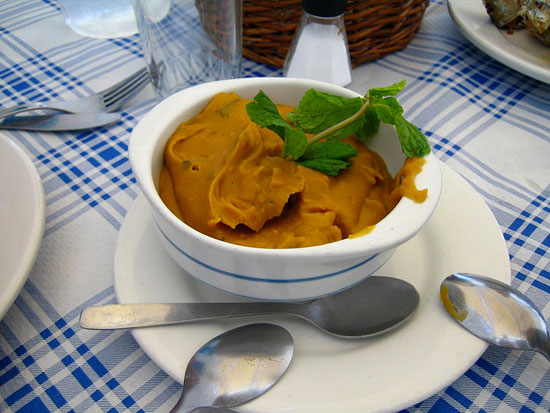
Gofio is another traditional Canarian dish. Image courtesy of Flickr user Fernando Carmona
Gofio
Few gastronomical products can be used in either sweet or savory dishes, added to white coffee and stews, toasted, combined with almonds and raisins to make sweet sausages, to create a fake ice cream and ersatz crème caramel, spooned into glasses of milk for children’s breakfast, or used as a bread substitute. Gofio is one of them—and whatever you do with it, the net result is usually disgusting.
Endemic to the Canary Islands, gofio is milled grain that resembles wholegrain flour. Once the basic food of the Guanches, the original inhabitants of the islands, every Canarian is brought up on the stuff and cannot understand why foreigners would rather eat deep-fried cockroaches than this exemplar of island cuisine. It was always a vital staple when food was in short supply and was taken to the Americas by Canary Island emigrants, where one hopes it faded away.
Such is the islanders pride in the product that in 1990 they founded the Canary Island Gofio Producers Association, which has “successfully promoted gofio and won it its own quality label ‘Gofio Canario.’” After the first mouthful you wonder why; it is an acquired taste, but one not worth the time and cloggy mouth to acquire.
The following recipes illustrate the wide use of gofio.
Paella de Gofio (Lump of Gofio, according the Spanish translation)
Ingredients: ½ kg of gofio, ½ glass of oil, sugar, salt
Method:
- Knead the gofio with the water, salt, sugar and oil until you get a thick paste.
- Form a cylinder with it and cut into slices.
In other words, oily dough with a sweet and salty flavor.
Gofie Escaldao (Scalded Gofio)
Ingredients: 1 liter strained fish broth, 1 sprig of mint, ¼ kg of gofio
Method: Place the gofio in a dish with the sprig of mint and slowly add the boiling broth. Keep stirring to avoid lumps.
In other words, a waste of good fish broth.
Perhaps the best description of gofio is found in Paul Richardson’s excellent book on Spain, Our Lady of the Sewers.
Canarian friends of mine had warned me it was vile, and it is. Mixed with milk, it forms a thick sludge that sticks to your palate and has to be removed by increasingly desperate movements of the tongue. It would be like eating wallpaper paste, except that the cloying pale purée is partly redeemed by the toasty malty taste that could be kindly described as ‘comforting’. On the whole, though, gofio is one local speciality I would cross the street to avoid, along with Tibetan yak-butter tea and jellied eels.
Best avoided by everyone other than those who take a gastronomic delight in day-old coagulated salted porridge with lashings of condensed milk on it.
Guest blogger Derek Workman has written for Food & Think about paella and English puddings.