December 21, 2012
The History of the Teddy Bear: From Wet and Angry to Soft and Cuddly

This 1902 cartoon in the Washington Post was the inspiration behind the birth of the “teddy bear.” Photo: Wikipedia
Boxed and wrapped in paper and bows, teddy bears have been placed lovingly underneath Christmas trees for generations, to the delight of tots and toddlers around the world. But the teddy bear is an American original: Its story begins with a holiday vacation taken by President Theodore Roosevelt.
By the spring of 1902, the United Mine Workers of America were on strike, seeking shorter workdays and higher wages from a coal industry that was suffering from oversupply and low profits. The mine owners had welcomed the strike because they could not legally shut down production; it gave them a way to save on wages while driving up demand and prices.
Neither side was willing to give in, and fearing a deadly wintertime shortage of coal, Roosevelt decided to intervene, threatening to send in troops to the Midwest to take over the anthracite mines if the two sides couldn’t come to an agreement. Throughout the fall, despite the risk of a major political setback, Roosevelt met with union representatives and coal operators. In late October, as temperatures began to drop, the union and the owners struck a deal.
After averting that disaster, Roosevelt decided he needed a vacation, so he accepted an invitation from Mississippi Governor Andrew Longino to head south for a hunting trip. Longino was the first Mississippi governor elected after the Civil War who was not a Confederate veteran, and he would soon be facing a re-election fight against James Vardaman, who declared, “If it is necessary every Negro in the state will be lynched; it will be done to maintain white supremacy.” Longino was clearly hoping that a visit from the popular president might help him stave off a growing wave of such sentiment. Vardaman called Roosevelt the “coon-flavored miscegenist in the White House.”
Undeterred, Roosevelt met Longino in mid-November, 1902, and the two traveled to the town of Onward, 30 miles north of Vicksburg. In the lowlands they set up camp with trappers, horses, tents, supplies, 50 hunting dogs, journalists and a former slave named Holt Collier as their guide.
As a cavalryman for Confederate General Nathan Bedford Forrest during the Civil War, Collier knew the land well. He had also killed more than 3,000 bears over his lifetime. Longino enlisted his expertise because hunting for bear in the swamps was dangerous (which Roosevelt relished). “He was safer with me than with all the policemen in Washington,” Collier later said.
The hunt had been scheduled as a 10-day excursion, but Roosevelt was impatient. “I must see a live bear the first day,” he told Collier. He didn’t. But the next morning, Collier’s hounds picked up the scent of a bear, and the president spent the next several hours in pursuit, tracking through mud and thicket. After a break for lunch, Collier’s dogs had chased an old, fat, 235-pound black bear into a watering hole. Cornered by the barking hounds, the bear swiped several with its paws, then crushed one to death. Collier bugled for Roosevelt to join the hunt, then approached the bear. Wanting to save the kill for the president but seeing that his dogs were in danger, Collier swung his rifle and smashed the bear in the skull. He then tied it to a nearby tree and waited for Roosevelt.
When the president caught up with Collier, he came upon a horrific scene: a bloody, gasping bear tied to a tree, dead and injured dogs, a crowd of hunters shouting, “Let the president shoot the bear!” As Roosevelt entered the water, Collier told him, “Don’t shoot him while he’s tied.” But he refused to draw his gun, believing such a kill would be unsportsmanlike.
Collier then approached the bear with another hunter and, after a terrible struggle in the water, killed it with his knife. The animal was slung over a horse and taken back to camp.
News of Roosevelt’s compassionate gesture soon spread throughout the country, and by Monday morning, November 17, cartoonist Clifford K. Berryman’s sketch appeared in the pages of the Washington Post. In it, Roosevelt is dressed in full rough rider uniform, with his back to a corralled, frightened and very docile bear cub, refusing to shoot. The cartoon was titled “Drawing the Line in Mississippi,” believed to be a double-entendre of Roosevelt’s sportsman’s code and his criticism of lynchings in the South. The drawing became so popular that Berryman drew even smaller and cuter “teddy bears” in political cartoons for the rest of Roosevelt’s days as president.
Back in Brooklyn, N.Y., Morris and Rose Michtom, a married Russian Jewish immigrant couple who had a penny store that sold candy and other items, followed the news of the president’s hunting trip. That night, Rose quickly formed a piece of plush velvet into the shape of a bear, sewed on some eyes, and the next morning, the Michtoms had “Teddy’s bear” displayed in their store window.
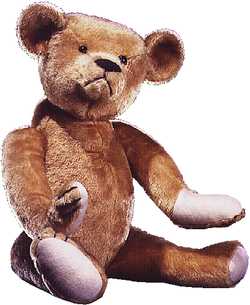
One of the original teddy bears, donated by the Michtom family and on display at National Museum of American History. Photo: Smithsonian
That day, more than a dozen people asked if they could buy the bear. Thinking they might need permission from the White House to produce the stuffed animals, the Michtoms mailed the original to the president as a gift for his children and asked if he’d mind if they used his name on the bear. Roosevelt, doubting it would make a difference, consented.
Teddy’s bear became so popular the Michtoms left the candy business and devoted themselves to the manufacture of stuffed bears. Roosevelt adopted the teddy bear as the symbol of the Republican Party for the 1904 election, and the Michtoms would ultimately make a fortune as proprietors of the Ideal Novelty and Toy Company. In 1963, they donated one of the first teddy bears to the Smithsonian Institution. It’s currently on view in the American Presidency gallery at the National Museum of American History.
Sources
Articles: ”Holt Collier, Mississippi” Published in George P. Rawick, ed., The American Slave: A Composite Autobiography. Westport, Connecticut: The Greenwood Press, Inc.,1979, Supplement Series1, v.7, p. 447-478. American Slave Narratives, Collected by the Federal Writers Project, Works Progress Administration, http://newdeal.feri.org/asn/asn03.htm ”The Great Bear Hunt,” by Douglas Brinkley, National Geographic, May 5, 2001. “James K. Vardaman,” Fatal Flood, American Experience, http://www.pbs.org/wgbh/americanexperience/features/biography/flood-vardaman/ ”Anthracite Coal Strike of 1902,” by Rachael Marks, University of St. Francis, http://www.stfrancis.edu/content/ba/ghkickul/stuwebs/btopics/works/anthracitestrike.htm “The Story of the Teddy Bear,” National Park Service, http://www.nps.gov/thrb/historyculture/storyofteddybear.htm “Rose and Morris Michtom and the Invention of the Teddy Bear,” Jewish Virtual Library, http://www.jewishvirtuallibrary.org/jsource/biography/Michtoms.html “Origins of the Teddy Bear,” by Elizabeth Berlin Taylor, The Gilder-Lehrman Institute of American History, http://www.gilderlehrman.org/history-by-era/politics-reform/resources/origins-teddy-bear “Teddy Bear,” Theodore Roosevelt Center at Dickinson State University, http://www.theodorerooseveltcenter.org/Learn-About-TR/Themes/Culture-and-Society/Teddy-Bear.aspx
Sign up for our free email newsletter and receive the best stories from Smithsonian.com each week.


Somewhat less well-known is the attempt to “brand” President Taft with an equally adorable, cuddly mascot, a seriously misguided marketing scheme which gave America the poorly-conceived “Billy Possum”. The story is regurgitated all over the web these days, such as here:
http://www.fruitlesspursuits.com/2012/01/nerd-history-billy-possum.html
When I saw your blog on The History of the Teddy Bear I was optimistic – hoping that some of the many errors accumulated over the 110 years would be corrected, and authenticated by such a prestigious magazine. It was dismaying to discover the article not only repeated several old myths, but introduced a number of new errors.
The cartoon you showed was not the 1902 cartoon in the Post, but one redrawn some time later depicting the bear as a cub. The original on Nov. 16th showed the 235 pound bear as large as the man holding its rope, and did not include Berryman’s signature in that cartoon.
Roosevelt declined the invitation by Gov. Longino – he thought that would be too large a hunting party with political implications. But a hunt on the way to a speaking engagement in Memphis the 19th appealed to him, and Mr. Stuyvesant Fish, president of the Illinois Central Railroad, offered to arrange a hunt with a smaller party.
The destination was the Smedes plantation where there was a railroad siding – Onward, about two miles north, is not mentioned in 1902-3 accounts.
T.R. and Longino did not set up the camp – it was set up with tents and facilities beforehand.
It was not a ten day hunt – T.R. arrived Thursday afternoon Nov. 13th and traveled several miles to the camp on the bank of the Little Sunflower. The hunt began on Friday; the bear he declined to shoot was captured in the first day of hunting (not second). It was “put out of its misery” by John Parker, not Collier.
Saturday the W. Post headline ran “ One Bear Bagged – but it did not fall a trophy to the President’s Winchester”. Sunday 16th, (not 17th) Berryman’s famous cartoon appeared as one in a montage of five on the front page of the Post. The President does not hunt on Sunday.
Other hunters shot two bears and a deer before the hunt ended on the 18th. On Nov. 19th Berryman’s cartoon of the departing party showed a cub with a tag “BACK TO THE ZOO” on its rope, thus creating the myth of a cub being spared.
The story of Michtom’s creating the Teddy Bear in 1903 is in dispute – evidence suggests that he did not make bears any earlier than 1906. And his was a cigar store, not a confectionary shop. He began the Ideal Novelty Company in Jan. 1907 – years later the name was expanded to “Ideal Novelty and Toy Co. “
In 1963 Benjamin Michtom gave an early Ideal teddy to Kermit Roosevelt who donated it to the Smithsonian. Michtom is said to have asked TRs permission to use his name for the jointed plush bear, but I have heard of no report that he sent one to the White House. In December T.R. received three toy bears (one mechanical, all “looked like the real thing”) but no makers were named.
The teddy bear was not used as a symbol in TR’s 1904 campaign. The term “teddy bear” was not used until 1906, following the explosion of their popularity based on Seymour Eaton’s series on the Roosevelt Bears, Teddy-B and Teddy-G.
My information has come from papers, magazines and documentation contemporary with the event – you have used later material into which errors, misinterpretations and speculations have accumulated.
For a detailed description of the 1902 hunt, see: “Holt Collier : his life, his Roosevelt hunts, and the origin of the teddy bear “ © 2002, by Minor Ferris Buchanan.
Mr. Moose,
I also had problems with this article and the historical accuracy of many of its details. Using original letters I accessed on-line through the Theodore Roosevelt Center’s Digital Library, I have learned that a Mississippi bear hunting in mid-Nov. had been discussed with the president sometime prior to February 24, 1902 (letter with this date from D. Deloy Dresser to Roosevelt) and it was being put together by Stuyvesant Fish, who did organize the famous bear hunt. Seemingly this is the same trip. In addition, there is a letter of introduction on behalf of Gov. Longino from Edgar Wilson to Theodore Roosevelt dated April 10, 1902 which among other things mentions that Gov. Longino could NOT run for re-election.
What is the primary source for the information that Gov. Longino had sent an invitation to hunt to Roosevelt?
Lastly, of the numerous reinditions of this story I have read, this is the only that states that the bear was STILL in the water when it was killed.
I would appreciate any additional information regarding the numerous primary sources you mentioned.
Thanks,
John Olsen
Ankeny, Iowa
Mr. Moose,
Thanks very much for your comment, and I apologize for the delayed response. As you say, “errors, misinterpretations and speculations have accumulated” in the published history of the teddy bear and Roosevelt’s Mississippi hunting trip in November 1902; sorting through them takes time. I notice that you have reached out to other authors regarding lingering “myths” that find their way into print. I hope you will consider commenting again in the interest of clarifying the record.
Naturally, the points you made sent me scrambling to check sources and do further research. I’ll start with the fate of the bear, since another commenter, Mr. Olsen, has called attention to the account of its demise in the water. Holt Collier, in his slave narrative, describes a scene in which the bear was in the water at the time, but he is a bit vague in describing the bear’s final moments: “When the knife went in, the bear jumped. Mr. Parker nearly pushed me on top of the bear, trying to get out of the lake and left me to pull the knife out of the bear he had stabbed.” However, according to Douglas Brinkley, in The Wilderness Warrior: Theodore Roosevelt and the Crusade for America (HarperCollins, 2009), writes, “According to [Collier biographer] Minor Ferris Buchanan, a hesitant Parker, following instructions from Collier, plunged the knife into the bear’s side; but he failed in his effort to kill it in a single stab, and an obliging Collier had to finish the job, on a very angry animal.” So where exactly the animal died is unclear.
Mississippi Governor Andrew Longino’s involvement with the hunt is another source of confusion. By all accounts—and newspapers covered the matter extensively at the tie—Longino initially invited Roosevelt to the hunt. As you note, however, plans were changed at the last moment and Roosevelt instead accepted the invitation of Stuyvesant Fish. Longino was no longer involved. In answer to Mr. Olsen’s comment, Longino and James Vardaman were political adversaries, and when Vardaman attacked the sitting governor at the time, the election plans of both men were not yet set in stone. The next year, Longino ran unsuccessfully for the Senate, while Vardaman ran for governor of Mississippi and won.
The original bear cartoon has often been misidentified over the years, as you point out. The first Clifford K. Berryman hunt cartoon to appear in the Washington Post appears to be this one, found here at the Library of Congress:
http://www.loc.gov/pictures/resource/cph.3a34770/
Berryman did at least two newer versions shortly after the original cartoon appeared, including the one at the top of this piece. He dated it 1902, but there’s no indication when or where it was published. However, “Bruin” the bear became a conspicuous presence in Berryman’s political cartoons involving Roosevelt, and the Washington Post began to sell a 1904 “Post Bear Calendar” in late 1903, featuring Berryman’s bear drawings, helping to cement the image of Roosevelt and his bear sidekick. It’s possible Berryman provided a redrawn version for that calendar.
Despite two later mentions in the New York Times that the bear was a “mascot” for Roosevelt’s 1904 presidential campaign, I found no contemporary reports that this was true. However, Berryman, in his frequent drawings and cartoons, certainly made “Bruin” the bear an unofficial mascot of the Roosevelt’s 1904 campaign, though no one, as you note, was calling them “teddy bears” until 1906.
With regard to the Michtoms, the Roosevelt Institute at Dickinson State University keeps copies of Roosevelt’s personal and presidential papers, and it acknowledges that there are differing stories of the Mississippi hunt. The institute maintains that Roosevelt did indeed grant permission to the Michtoms to market the “teddy bear.” This matches Benjamin Michtom’s recollection. However, I do not know of any Roosevelt correspondence confirming this.
Again, thank you for your attention to my post. If there’s anything else you can add to clear up the lingering mysteries, please feel free to comment.
Best,
Gilbert
Dear Gilbert,
I appreciate the professional manner in which accepted the critiques of your blog post.
One of the sources I have previously not mentioned which not only explores the original story through reprinting the “press pool” accounts originally printed by the Washington Post, but also the whole confusion over the cartoon is Linda Mullin’s book: Teddy Bear Men: Theodore Roosevelt and Clifford Berryman. I highly recommend this book.
In trying to clear up my confusion about Gov. Longino, I was finally able to track an account in Outing Magazine dated February 1903, only a few months after the event. It is clear to me now that Gov. Longino did issue an invitation to President Roosevelt but the hunt that Longino envisioned would have involved way to many people for Roosevelt’s liking. Yes, I agree Longino and Vardaman were rivals but it seems clear that legally Longino could not run for re-election hence why he ran for U.S. Senate. Check the documents I mentioned previous through Dickinson State University’s digital library to see the evidence.
As for the Outing Magazine article, it is volume 41 and can be found as a FREE e-book on Google. I did a search for Governor Longino bear hunt and it came up within the first few search results.
This account seems to state that the dog was taken out of the water. I have not yet read Holt Collier’s slave account or Minor Ferris Buchanan’s book on Holt Collier. So, I am sure these would give me further insights.
Lastly, the letters I have read about Roosevelt’s feelings about the hunt were not so positive. He still thought that there were too many people.
All the best,
John Olsen
Dear Gilbert:
Thank you for the link to the excellent copy of the original cartoon, which better represents history; while the second reflects teddy bear mythology, created by Berryman’s Nov. 19th “Back to the Zoo” cartoon.
I was not aware that more than one cartoon was redra wn; the one which hung in the National Press Club (D.C.) for many years (shown in “Our Times” by Mark Sullivan, who said it was “repeated thousands of times” ). Did the Washington Post Bear Calendar show the hunt scene?
You agree that the 1902 date identifies the actual event, not necessarily the date it was redrawn. The date of the original cartoon was in the masthead of the Washington Post. I quibble with your use of the word “shortly.”
The full-sized redrawn cartoon shows more detail than the original cartoon, which is 1/5th of a montage. The original cartoon depicts Roosevelt as he was known to the public in 1902 – trim, like a Rough Rider – but the redrawn cartoon depicts him as he appeared several years later, widely traveled, now older and heavier.
I have evidence supporting the theory that the second cartoon was drawn after the teddy bear fad exploded in 1906, and after Berryman went to work for the Star in 1907. He was promoted as “The Teddy Bear Man,” made many appearances doing “chalk talks” and demonstrations, and was invited to membership in the prestigious Gridiron Club. He was its first cartoonist and eventually its president.
I have searched and found no evidence that the first cartoon was seen in the New York area, nor evidence that Morris Michtom started his teddy bear business earlier than 1907. I believe that earlier dates for the business are based on Michtom’s son’s assumption that his father had seen the cartoon in 1902. After his father’s death in 1938, Benjamin took over the business and related the family story of starting the business. Michtom has earned credit for contributing greatly to the toy business – but not, in my opinion, for starting the teddy bear craze.
The letter from Morris Michtom to Theodore Roosevelt has been diligently sought; Edmund Morris has said that if it existed it, or the reply, should have shown up in comprehensive White House records. If Dickenson State University has evidence that this letter exists, what was its date? Prior to 1906, there is no evidence of a teddy bear fad: Steiff had displayed plush bears at the 1904 World’s Fair in St. Louis, but they did not reflect a teddy bear “craze.”
Were the references to “mascots” in the New York Times printed in 1904, or later? There are some small stuffed bear pins that collectors believe were used in 1904, but these were bruins, not teddy bears. There were some reports of teddy bears being used in Roosevelt’s second Presidential campaign – true, but 1904 was his first campaign, and 1912 his second.
The identity of the person who killed the bear is tangential: Parker stabbed the bear and Holt pulled the knife out. On page p. 172 of the Holt Collier book, which I consider the most accurate and detailed – Holt says “…left me to pull the knife out of the bear he had stabbed.” Reporters at the camp got the story when Holt brought the bear to camp, and Buchanan probably got later versions from Holt’s retellings of the story. There are variations of the kill in summaries of the book, even by Buchanan.
The Longino invitation had suggested a big party with “…twenty or thirty distinguished statesmen and planters and businessmen” from three states, according to one of the three correspondents allowed into the campsite by day. Mr. Fish “… invited the President to enjoy a bear hunt without political complications, and without becoming one of an invading army in the swamps.”
There were press reports which erroneously assumed that the Longino invitation was the one accepted, even as TR was on his way to Smedes.
One more incentive for a bear hunt I credit to a delegation from Valdez, Alaska that gave Roosevelt a moose head (54 inches between antler tips) for his birthday in October and invited him to hunt bear in Alaska.
Thank you for your efforts to get it right. I second Mr. Ohlsen’s commendation.
Charles Moose
Request: This refers to the comment on Billy Possum. If you use it, would you please place it to follow the first comment? Placing it after the last comment would make it too far separated.
^^^^^^^^^^^^^^^^^^^^^^^^^^^^^^^^^^^^^^^^^^^^^^^^^^^^^^^^^
For more on Billy Possum see the October issue of teddy bear & friends – p.23. An article “All the President’s Mascots” by Ken Yenke, Teddy Bear expert and historian, has a photograph of the banquet where President-elect Taft ate possum and taters, January 15, 1909. (His inauguration was March 4th.) Remarkable picture, full page width, showing hundreds of guests seated at rows of long tables. Below it is a photograph of a gray plush Billy Possum. (p. 25B).
Taft’s remark “…for possum, first, last and all the time” was picked up by the press – the post card suggests a successor to the teddy bear had been found. Predictions were that when Roosevelt left office, “the bears would be down and out.”
The failure of the possum to replace the teddy bear in popularity had one benefit – the rarity of the few remaining collectables makes them quite valuable.
The article also shows a brass clothing button with a raised possum, a three inch plush lapel pin and a poster with a poem about Billy.
Charles Moose