
A Newly Restored Wings
The first Best Picture Oscar winner emerges to help Paramount celebrate its centennial
/https://tf-cmsv2-smithsonianmag-media.s3.amazonaws.com/accounts/headshot/daniel-eagan-240.jpg)
/https://tf-cmsv2-smithsonianmag-media.s3.amazonaws.com/filer/20120117022153Wings_0004_thumb.jpg)
It was the highest-grossing film of the year, and helped inspire an entire genre of movies about aviation. And for several years it was one of the most difficult Best Picture Oscar winners for fans to see. Now, as part of the studio’s centennial celebration, Paramount Pictures is presenting a restored version of its World War I blockbuster Wings. The film is screening tonight at the Academy of Motion Picture Arts and Sciences, and comes out on Blu-ray and DVD on January 24—the missing link, as it were, since it is the last of the Best Picture Oscar winners to appear on those formats in this country.
Wings helped launch several careers when it was released in 1927, including John Monk Saunders, who went on to write The Dawn Patrol, and director William Wellman, director of such classics as The Public Enemy and A Star Is Born. Nicknamed “Wild Bill,” Wellman was an ambulance driver in the French Foreign Legion before joining the Lafayette Flying Corps as a pilot after the United States entered the war. Barnstorming after the war, he met and befriended Douglas Fairbanks, who helped him get established in Hollywood.
Wings was Wellman’s first big project, and he responded by securing some of the most thrilling aviation scenes ever filmed. Seventeen cameramen received credit along with cinematographer Harry Perry, and Wellman even had cameras installed in cockpits that actors could operate. Location footage was shot mostly in Texas, where the production received the cooperation of the Army’s Second Division, garrisoned in San Antonio. As a result, a single shot in Wings might include machine gunners, a tank spinning left, planes flying overhead, a tree exploding, and a full complement of fighting troops.
Paramount was responding in part to The Big Parade, a similarly massive WWI film made by MGM the previous year. Wings starred Clara Bow, soon to be the nation’s “It” girl, as well as Charles “Buddy” Rogers (who later married Mary Pickford) and Richard Arlen, who flew with the Royal Canadian Flying Corps during the war. Arlen’s career stretched into the 1960s. Featured prominently in a key scene is Gary Cooper, on the verge of stardom after supporting roles in several movies.
Wings would be a “road show” movie for Paramount, one that would screen in big cities like New York and Chicago with a full orchestra, sound effects, and something called “Magnovision,” basically a lens attachment that enlarged the image. When Andrea Kalas, Vice President of Archives at Paramount since 2009, began overseeing the restoration of Wings, she and her staff researched periodicals and other materials to pin down exhibition details.
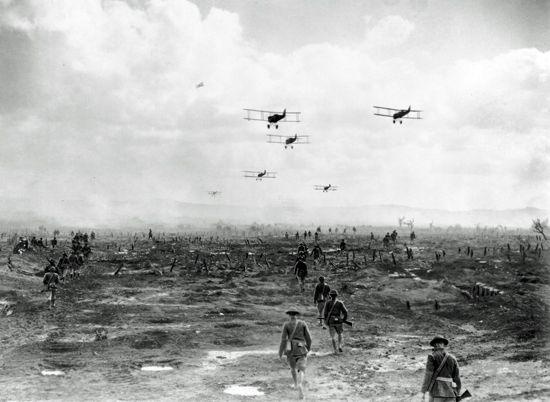
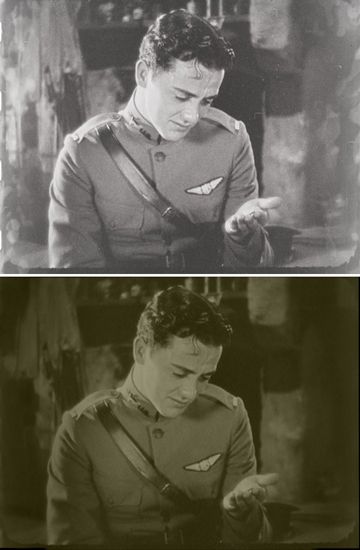
Kalas also spent months looking for the best possible picture elements before lab work began. “The actual process of restoring the picture and rerecording the original score took about four months,” said Kalas.
The materials presented several problems. “There was printed-in nitrate deterioration that I really didn’t think we could get past,” Kalas said. “We managed to actually fill the spaces of what the nitrate deterioration had eaten away at the image.” Special effects software enabled the team to duplicate the Handshiegl stencil process used for the original film’s bursts of color for gunfire and flames during air battles. A vintage continuity script gave the team cues for the tints used in other scenes.
Paramount not only hired a full orchestra to rerecord the original score by J.S. Zamecnik, but had Academy Award-winning sound designer Ben Burtt and the engineers at Skywalker Sound record an effects track that used authentic sounds from period library collections.
Paramount Home Entertainment is releasing a special edition of Wings on Blu-ray and DVD on January 24, but some lucky viewers will be able to see the film in theaters. The Academy of Motion Pictures Arts and Sciences will be screening Wings on January 18 in conjunction with “Paramount’s Movie Milestones: A Centennial Celebration,” an exhibition of photographs, posters, design sketches and personal correspondence highlighting some of Paramount’s most celebrated films and filmmakers over the past 100 years. Wings will also be showing on February 13 at the Northwest Film Forum in Seattle.
The first manned flight had occurred only about 20 years before Wings was released. For many viewers of the time, this was the closest they would ever come to experiencing what flying was like. “It was an amazing time for aviation,” Kalas said. “People were really fascinated with World War I aviation.” Wings would be Paramount’s way to cash in on that curiosity. “I think they really wanted to do The Big Parade with planes,” was how Kalas put it.
Kalas also enthused about seeing the film in a theatrical setting. “It’s a highly reactive film—there are thrills and gasps, and you really do feel the movie in a much different way when you’re seeing it with an audience.”
Interestingly, Kalas recommends viewing a Digital Cinema Print (DCP) over film. “With 35mm film, you basically have to cut off a part of the silent film frame in order to fit a soundtrack on it. With a digital cinema print, you can actually see the entire full frame silent image and hear what I think is a really incredible rerecorded soundtrack.”
Wings is one of several box-office hits Paramount released in the silent era, but only a handful are available for home viewing. “It’s hard out there for silent films,” Kalas acknowledged. “There’s preservation and restoration in archives, and then there’s the actual release of the films, and those are two different steps. We will keep preserving and restoring and hoping that people will distribute.”
/https://tf-cmsv2-smithsonianmag-media.s3.amazonaws.com/accounts/headshot/daniel-eagan-240.jpg)