Blogs

  • News
  • |
  • Art
  • |
  • History
  • |
  • Food and Travel
  • |
  • Science
Paleofuture

A history of the future that never was

Past Imperfect

History with all the interesting bits left in


April 30, 2012

Resurrecting the Dead With Computer Graphics

Marilyn Monroe getting ready for her close-up in a movie of the future (March, 1994 Popular Mechanics)

A couple of weeks ago audiences at the Coachella music festival got to see Tupac perform live (NSFW language), despite the fact that he’s been dead for fifteen years. Countless websites have already dissected why the technology used to create this “Tupac hologram” isn’t actually a hologram, but rather a Pepper’s Ghost effect that dates back to the mid-19th century, so I won’t get into that. But the other fascinating element to this story is the fact that we can now RESURRECT OUR FAVORITE ENTERTAINERS FROM THE DEAD.

Bringing back popular entertainers was the promise of the future in the 1980s and ’90s. As computer graphics improved in the 1980s (with movies like Tron) and then in the 1990s (with movies like Terminator 2: Judgement Day and Jurassic Park) people imagined that actors like Clark Gable, Marilyn Monroe and even a Laurence Olivier/Abraham Lincoln mash-up would be able to star in the computer-enhanced movies of tomorrow.

Arthur C. Clarke’s 1986 book July 20, 2019: Life in the 21st Century includes a fictional movie listing for the year 2019:

Still Gone with the Wind. The sequel picks up several years after where the 80-year-old original left off, with Rhett and Scarlett reuniting in their middle age, in 1880. Features the original cast (Clark Gable, Olivia de Havilland, and Vivien Leigh) and studio sets resurrected by computer graphic synthesis. Still Gone sets out to prove that they do make ‘em like they used to (Selznick Theater, 2:00 and 8:00 P.M.)

The June, 1987 issue of Omni magazine featured an article by Marion Long, who spoke with six directors to get their ideas for the kinds of movies that they would want to direct in the year 2001. One of the directors that Long spoke to was Susan Seidelman, who in 1987 directed a movie called Making Mr. Right starring John Malkovich.

Seidelman’s hypothetical movie of the year 2001 was called Yankee Doodle Sweetheart, and was imagined as starring Marilyn Monroe, Robert De Niro, Debra Winger and Jimmy Stewart. Marilyn Monroe had been dead for 25 years by the time this article came out, and though Jimmy Stewart didn’t die until 1997, he was still pictured as playing a much more youthful (and completely computer-generated) version of himself. The synopsis of the film is below:

Seidelman electronically recreates Marilyn Monroe. The sex goddess of the Fifties plays a showgirl off to the front lines of a war on a Bob Hope USO tour. In sharp contrast to Monroe’s innocence and naivete stands Debra Winger, a military nurse acutely aware of the horrors of war. But this is Monroe’s story—her coming-of-awareness. Robert De Niro, a Marine sergeant deadened to human emotion, wants one thing: the showgirl. So does his friend, a young recruit, played a computer-simulated Jimmy Stewart. Monroe falls in love with—you’ll have to see the film.

The 1982 book The Omni Future Almanac also imagined even more radical computer creations, being able to include the acting skills of one actor with the appearance of another historical figure:

It is possible that dramatic performances, even actors’ lines, will be altered, via computer synthesis, yielding a perfect first “take” every time. Some actors, specifically character types, might be totally synthesized. One actor’s performance might easily be combined with another person’s distinctive physical look or voice. By using computer synthesis, a director would be able to marry the acting skills of Laurence Olivier to photographic images of Abraham Lincoln.
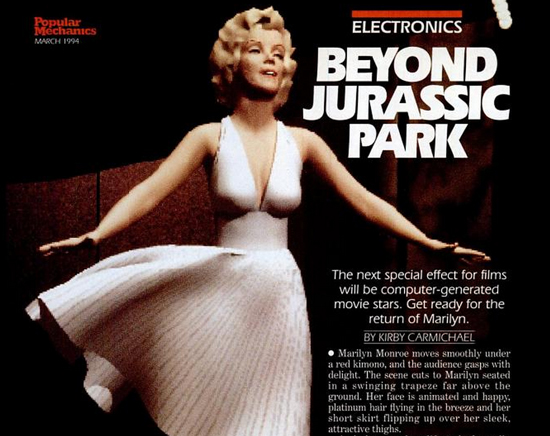
Marilyn Monroe as a computer simulation (March, 1994 Popular Mechanics)

Marilyn Monroe popped up a number of times in predictions about future movies, which may have had something to do with the fact that she died so young—she was just 36 years old. A 1993 article in the San Francisco Examiner predicted that one day, “dead actors such as Humphrey Bogart and Marilyn Monroe could be ‘resurrected’ by using computers to generate their visages and act out scenes they never did,” while the following year, Popular Mechanics ran a story that also featured Marilyn Monroe. The March, 1994 issue had an article called “Beyond Jurassic Park,” which predicted a world of resurrected movie stars now that Jurassic Park had shown just how far computer graphics had come.

Marilyn Monroe moves smoothly under a red kimono, and the audience gasps with delight. The scene cuts to Marilyn seated in a swinging trapeze far above the ground. Her face is animated and happy, platinum hair flying in the breeze and her short skirt flipping up over her sleek, attractive thighs.

As in her previous life, nobody really knows this Marilyn. This Marilyn is a computer construct—a proof-of-concept synthetic human actor used to advance the science and art of realistic 3D digital animation.

The 1990s saw TV advertisements wherein Fred Astaire danced with a vacuum cleaner and John Wayne drank beer, long after both had passed away, but it seems the “Tupac hologram” has for those of the 2010s revived interest in the idea that we might see our favorite celebrities perform for us once again.

There’s speculation that Michael Jackson may be next to take the stage from beyond the grave. Or that maybe a digital Lisa “Left Eye” Lopes will allow TLC to reunite. But allow me to be the first to request a “hologram Sheb Wooley.” Because why not, that’s why.

And, what about you? If you were making a computer-enhanced film, who would be in your dream cast of living and dead actors?


***

Sign up for our free email newsletter and receive the best stories from Smithsonian.com each week.

17 Comments »

  1. james says:

    I would like to see the original cast from Romero’s ‘Night of the Living Dead’ digitally resurrected, only for them to be eviscerated again in 3D IMAX glory.

    That, or Bruce Lee kicking some ass in ‘The Game of Death’.

  2. Digicon Media is preparing to launch and represent VM2© – the CGI virtual character who adopts the persona of Marilyn Monroe – for use as a live, interactive spokesperson, model, actress, singer, talk show host, film, food and fashion critic and more. Digicon Media owns the copyright that provides the right to produce and exploit a CGI Virtual Actress performing in any genre of entertainment – particularly when using CGI in any form or variation. Digicon Media will be creating a contemporary VM2© to be consistent with the attributes and persona, that the popular culture identifies as the icon she has become since her death.

    For more information, contact
    Dennis Gelbaum, Executive Director
    Becky Altringer, Managing Director

  3. Sarah says:

    Remember the creepy Orville Redenbacher commercial where Orville was resurrected?

    http://www.youtube.com/watch?v=Fcn4p213Zg8

  4. beni says:

    will want to see tarzan with jonny weissmuller

  5. Kathy says:

    I like Jame’s suggestion of resurrecting Bruce Lee!

    It would be interesting to see a mash-up of David Carradine (dead), Uma Thurman (still alive), and Bruce Lee (dead) for a Kill Bill revival and maybe a cameo appearance of Brandon Lee (dead)as his character in The Crow.

  6. Jeff Sherry says:

    I dislike the idea of resurrecting the dead to sell products or to act in future productions. It says to me there is in trust in the present and future actors.

  7. Horacio H. Martinez says:

    …how about Freud teaching psychology, Einstein lecturing physics or Darwin explaining evolution?

  8. Benoit says:

    Instead of resurrecting the dead, I see more interest to stage actors more young than they are . Imagine Lauren Bacall playing herself in a movie today and looking 25 !

  9. Paul says:

    This was all before the “Uncanny Valley” was truly appreciated. Getting a simulated person sufficiently close to real to avoid the UV is a seriously difficult problem.

  10. Nancy says:

    No technology could duplicate distinctive voices like those of Gregory Peck or Gary Cooper.

  11. Ted says:

    Why do we need to resurrect anybody? Is not the interest in potentially doing so not a sign of the paucity of true acting talent available today? Our current crop of talent is not good enough, attractive enough, charming enough to hold our interest? We have to bring the dead back to life? I suspect this is either nostalgic narcissism, or narcissistic nostalgia. Either way, it’s a bad commentary.

  12. Lucifar says:

    this is really stupid, the dead are dead, why want to bring them back to life

  13. Bruce says:

    Its alittle controversial to some seeing long dead stars resurrected. I don’t know the legalities of such a thing but movies are technically resurrected all the time. Like a release of Wizard of Oz on Blu Ray etc. I surmise the same will occur in the future while old classics make their jump to new medium, first 3d recreations like Titanic. Then holographic and later interactive. When movies become interactive immersions where audiences can branch off and make their own alternate ending to movies like Gone with the Wind, the lines will be blurred between what is allowed by post humorous performances of late stars of the yesteryear.

  14. Corbin Supak says:

    I think we will continue to see this. I’m waiting for the first performer who is completely synthesized, and has no reportable ‘death’ – that’s the ultimate cash cow for the entertainment industry. Animation icons, of course, have this advantage already. But for humans, I think it could be someone like Tom Cruise, who gradually morphs into a synthetic, and we just don’t get to see the aging version, only the ‘healthy adult’ version that we are used to who continues to perform in film after film. Don’t know how promotion gets handled, but hey – the more that’s online, the more it can feature synthesized subjects.

  15. dog says:

    I find the whole idea of “resurrecting” the dead and making them perform for us to be intensely distasteful. These aren’t just characters on a screen–these were real human beings who lived and died and had their own hopes and dreams and fears. And for actors and other artists, that’s a huge part of what made their work so enduring.

    Computer-generated resurrections have an effect similar to watching someone puppeteer a corpse. I’m not just referring to the uncanny valley, but seeing a seemingly “live” version of someone you know is quite dead, whose performance is being created by someone else. There’s no reason for it that doesn’t come across as really gross–it’s either a cash grab or a refusal to let go of an idol. There is no role that could be played by Marilyn Monroe’s digital ghost that couldn’t be played just as well (or better) by a living actress.

  16. Jeff says:

    I would like to see Marilyn Monroe’s last, uncompleted film, SOMETHING’S GOT TO GIVE, completed but too much material of any star recreated this way would cause me to lose interest. With SOMETHING’S GOT TO GIVE, we already have real footage of a film that truly begs for completion.

  17. Laura says:

    I agree with dog, with the added question of, “how dare we?” It seems disrespectful (to say the least) to digitally resurrect someone who, being dead, has no capacity to consent to whatever performance they are being made to give. The whole idea just grosses me out.

RSS feed for comments on this post. TrackBack URI

Leave a comment

Comments are moderated, and will not appear until Smithsonian.com has approved them. Smithsonian reserves the right not to post any comments that are unlawful, threatening, offensive, defamatory, invasive of a person's privacy, inappropriate, confidential or proprietary, political messages, product endorsements, or other content that might otherwise violate any laws or policies.

Spam protection by WP Captcha-Free

Advertisement


Follow Us

Travel with Smithsonian


Advertisement