
The Eastern Pacific Black Ghost Shark
Hydrolagus melanophasma, a new species of fish, was named from specimens collected over the last several decades off the coast of California
/https://tf-cmsv2-smithsonianmag-media.s3.amazonaws.com/accounts/headshot/greg-laden-240.jpg)
I'm Greg Laden, and I usually blog at here at Scienceblogs.com and Quiche Moraine. I'm a biological anthropologist interested in human evolution, the biologies of race and gender, human hunter-gatherers, science education and African prehistory. I've been asked to fill in here at Surprising Science for a couple of weeks, and I promise to try not to break anything while I'm here. On to my first post.
A new species of fish has been named from specimens collected over the last several decades off the coast of California called Hydrolagus melanophasma, and will go by the common name "Eastern Pacific black ghost shark." This is the first new species of cartilaginous fish to be described from California waters since 1947, and is a member of the Chimaeridae family. Technically, according to ichthyologist Doug Long of the California Academy of Sciences, Hydrolagus melanophasma is "a big weird looking freaky thing. They have some shark characteristics and they have some that are very non-shark."
Chimaeridae is a family of fish related to sharks. Sometimes they are called ratfish. Sometimes they are called ghost sharks. Some have a venomous spine on their backs. They live in the ocean, usually quite deep, and the most recently discovered species in this family is gaining fame because it is said to have its sex organ on its head.
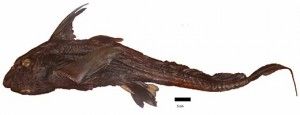
This "sex organ on the head" is actually quite normal for ghost sharks, though it is one of the big differences this sort of fish has with sharks. The feature in question is a tentaculum. A tentaculum is any of several sensory organs found on fish. In male ghost sharks the tentaculum is specially adapted as a grasping organ used during mating. So it is not the male's penis, but rather, a grabby thing that the male uses to facilitate copulation with the female. So, referring to the ghost shark's tentaculum as a "sex organ" on "its head" is a little like calling a finely chosen wine and just the right music a sex organ .... perhaps related to sex, but not sufficient for reproduction, anatomically speaking.
Hydrolagus melanophasma, was described in the September issue of the journal Zootaxa by a research team including California Academy of Sciences David Ebert (also with Moss Landing Marine Laboratories) and Douglas J. Long (also with the Oakland Museum of California) and Kelsey James, a graduate student at Moss Landing Marine Laboratories, and Dominique Didier from Millersville University in Pennsylvania.
The closest living relatives of the Chimaeras are sharks, and the Chimaera-shark split is probably about 400 million years ago, which is a long time ago by any standards. Chimaeras have cartilage instead of bone for skeletons, as do sharks. Chimaeras were once a very diverse and abundant group of species, and today are present in all oceanic waters though rare in any given locality.
The genus Hydrolagus means "water rabbit" and is so named because of its grinding tooth plates that resemble a rabbit's front teeth. The term "melanophasma" means "black ghost" which is a reference to the common term "ghost shark" as well as its dark, nearly black color. Hydrolagus melanophasma was originally collected as early as the mid 1960s, but went unnamed until now because its taxonomic relationships were unclear. This fish is found in deep water and is believed to range from the coast of Southern California, along the western coast of Baja California, and into the Sea of Cortez (Gulf of California). This species is known from a total of nine preserved museum specimens, and from video footage taken of it alive by a deep-water submersible in the Sea of Cortez.
/https://tf-cmsv2-smithsonianmag-media.s3.amazonaws.com/accounts/headshot/greg-laden-240.jpg)