
The Sea Monster Bathynomus
The hulking crustacean has razor-sharp mandibles and eyes that catch the light like a cat’s. Now it has turned into a high-tech saboteur
/https://tf-cmsv2-smithsonianmag-media.s3.amazonaws.com/filer/20120607104042Bathynomus-mandibles-web.jpg)
A foot-long ringer for a wood louse, Bathynomus is a hulking crustacean with razor-sharp mandibles and eyes that catch the light like a cat’s. A few years ago, the species briefly became an Internet sensation when the technician of a remotely operated submarine posted online photographs of one specimen. At first the critter was dismissed as an April Fool’s joke. Later it was decried as a “monster bug” and an “abomination of the seas.”
But now among marine biologists, who are otherwise rather fond of the unlovely isopod, Bathynomus is earning a reputation as a high-tech saboteur.
Its victims were a group of scientists and students studying deep-sea sharks in the Bahamas’ largely unexplored Exuma Sound this spring. They were deploying an expensive far-red camera system called the Medusa, which rests on the sea bottom and gathers great footage of elusive animals like six-gill sharks, beardfish and deep-sea lobsters.
But as they downloaded the latest video to a laptop, Edd and Annabelle Brooks—part of the Shark Research and Conservation Program at the Bahamas’ Cape Eleuthera Institute—realized that their footage had been cut short. The final images showed four Cuban dogfish slinking across the screen, a seldom-described bonyfish hanging out and then—nothing. It appeared Medusa’s power cable had somehow fizzled.
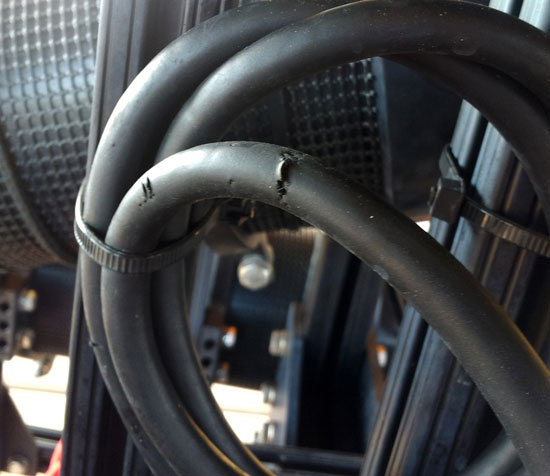
The first cable attack. Photo by Edd Brooks.
Examining the cable, Edd Brooks noticed what looked to be little nibbles in the rubber coating. Then, with a sinking heart, he remembered that the camera had also that day captured shots of several sizeable Bathynomus lurking nearby. He conferred with the camera’s engineer: Could the crustacean have gnawed on the power supply?
“There’s nothing else with mandibles that sharp,” says Brooks. “It was an apparent Bathynomus attack.”
Edith Widder, one of the Medusa’s inventors and who had loaned out the camera for the investigation, was fascinated to hear of the shorted-out cable’s fate. “This is not one of the hazards of deep-sea investigation that anyone warns you about,” says Widder, head of the Ocean Research & Conservation Association in Fort Pierce, Florida. Perhaps Bathynomus is attracted to the electrical current in the cable, she says.
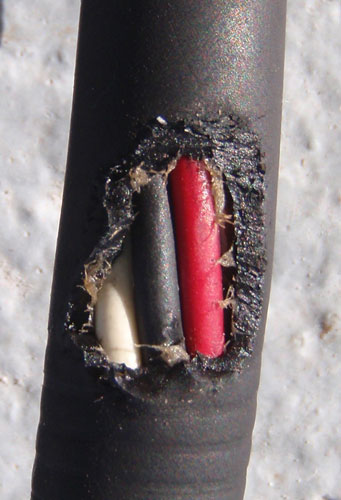
The second cable attack. Photo by Lee Frey.
Or maybe it just likes to eat rubber.
After the cable was replaced, the shark team continued to gather more arresting footage….until, that is, their screen went dark again. Bathynomus had struck a second time. They called it quits soon afterward and Widder is now fitting a new cable with plastic coils to guard against future crustacean attacks.
The scientists won’t hold a grudge. Although Bathynomus closely resembles “the thing that pops out of the lady’s chest in Alien,” Brooks says, it is an important ocean scavenger that cleans up whale carcasses and whatever else comes to rest on the bottom. (Its nibbling pattern sometimes reminds Widder of “eating corn on the cob;” watch them join in this time-lapse feeding frenzy.) But if the scientists ever did want revenge, there are avenues available to them: boiled and served with rice, Bathynomus is apparently considered tasty in Taiwan.