
How the Star-Nosed Mole ‘Sees’ With Its Ultra-Sensitive Snout
The utterly strange-looking creature sees the world with one of the most sensitive touch organs in the animal kingdom
/https://tf-cmsv2-smithsonianmag-media.s3.amazonaws.com/accounts/headshot/joseph-stromberg-240.jpg)
/https://tf-cmsv2-smithsonianmag-media.s3.amazonaws.com/filer/20130130041140mole-small.jpg)
That’s an actual, earthly animal you’re looking at in the photo above—not, as you might have assumed, a creature out of Star Wars. The star-nosed mole, which resides in the bogs and wetlands of the eastern U.S. and Canada, is roughly the size of a rat when fully-grown. It’s functionally blind and eats insects, worms and small fish.
But the most noticeable aspect of the animal is its utterly strange appearance, dominated by its 22-tentacled ultra-sensitive snout, called a star (those aren’t its eyes and face at the center of the pink fleshy area, but rather its nostrils). This snout, used to hunt and grab prey, features more than 100,000 nerve endings packed into an area barely more than 1 cm in diameter, making it one of the most sensitive touch organs in the whole animal kingdom.
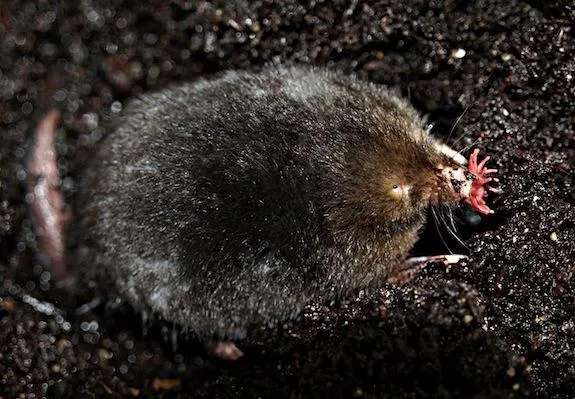
In a paper published today in the journal PLOS ONE, a team of biologists and neuroscientists from UC Berkeley and Vanderbilt University have examined the activity of the mole’s star on a molecular level to figure out just how it conveys information to the animal’s brain. One of the team’s most interesting findings is that the star is relatively poor in neurons sensitive to pain, but extremely rich in neurons specifically adapted to be touch-sensitive.
Each of the star’s 22 tentacles (called “rays”) is covered by small domed structures known as Eimer’s organs—the average snout has some 30,000 in total. By way of contrast, an entire human hand contains roughly 17,000 touch fibers (which are analogous to Eimer’s organs), but the mole’s star is smaller than a single human fingertip.
One of the study’s authors, Vanderbilt neuroscientist Kenneth Catania, has studied the strange animal for more than two decades and has previously suggested that, for the mole, the sensory information it receives from its star most closely resembles the visual information we get from our eyes. That is, just as our world is largely defined by visual stimuli, the star-nosed mole’s is most directly defined by touch.
For evidence, he points to the fact that the moles’ brains are spatially organized around tactile signals coming from their stars in much the same way our brains are arranged the visual information generated by their eyes. Their neocortex—the outer layers of each of the brain’s hemispheres—features a map of nerves that spatially corresponds with the data coming from each of the star’s rays. That is, the brain region that matches up with one particular ray is adjacent to the region that matches with the next ray over. Our visual cortex is arranged in much the same manner.
The moles’ use of their stars also resembles the way we (and many other mammals) use our eyes to understand our environment. When Catania and other researchers filmed the moles’ behavior, they discovered that upon coming into contact with an object of interest, the moles immediately began rapidly probing it with their smallest rays (the two hanging at the bottom-center of the star).
This is similar to the way primates use vision, relying on short, rapid eye movements so that the fovea centralis—the central, highest-resolution part of the eye—to can discern visual details. What’s most fascinating is that both the moles’ smallest rays and our fovea centralis are over-represented in terms of area in the neocortex. Thus, instead of seeing the world with eyes, the functionally blind star-nosed mole apparently ‘sees’ its underground environment with its snout.
/https://tf-cmsv2-smithsonianmag-media.s3.amazonaws.com/accounts/headshot/joseph-stromberg-240.jpg)