
Citrus Greening Will Ruin Morning OJ, No Matter How You Slice It
/https://tf-cmsv2-smithsonianmag-media.s3.amazonaws.com/accounts/headshot/Rose-Eveleth-240.jpg)
/https://tf-cmsv2-smithsonianmag-media.s3.amazonaws.com/filer/201301301020242067048782_0f54d0d3ab_z1.jpg)
If you had orange juice this morning for breakfast, savor it, since it might not be around much longer. The United States citrus industry is engaged in a long battle with a disease called citrus greening, and the citrus growers are losing. A recent study from the USDA looked into whether the juice from the diseased plants, which produce small, shriveled and green fruits, can still be used for orange juice. The results were mixed, the USDA writes:
They found that orange juice from the fruit with HLB symptoms was often higher in limonin and nomilin, compounds that can give the juice a bitter taste, but that the compounds were generally below levels that could be detected by human taste panels. Their results were published in the Journal of Agricultural and Food Chemistry.
This could be a good thing, because if growers can still use the fruits from infected plants somehow, the U.S. citrus industry might not experience the crash that some are predicting.
Citrus greening is really hard to fight, especially given recent research proving that the little insects that infect the plants can pass the disease between one another during reproduction. Scientific American writes:
In 2006 Florida citrus growers found the bacterium Candidatus Liberibacter asiaticus (Las) in their trees. Las causes a disease known as huonglongbing in Asia and citrus greening in the U.S.—and no matter what it is called, it spells big trouble for citrus crops. Infected trees produce bitter, lopsided fruit that often fails to ripen. (Las causes the biggest problem in oranges, but it can infect all citrus plants.) There is no cure, and slowly the whole tree turns yellow and dies. “This is the most important disease affecting citrus production in the world,” says Lukasz Stelinski, an entomologist at the University of Florida.
Every year, the citrus industry dumps $16 million into research on citrus greening, looking for a cure or an effective management strategy. The group Save our Citrus, founded and run by the USDA, writes:
Citrus greening is one of the most serious citrus plant diseases in the world. It is also known as Huanglongbing (HLB) or yellow dragon disease. Once a tree is infected, there is no cure. While the disease poses no threat to humans or animals, it has devastated millions of acres of citrus crops throughout the United States and abroad.
Citrus greening disease was first reported to have occurred in Asia during the late 1800s and the disease has already caused devastation in Asia, Africa, the Arabian Peninsula and Brazil.
Here’s what the infected fruits look like:
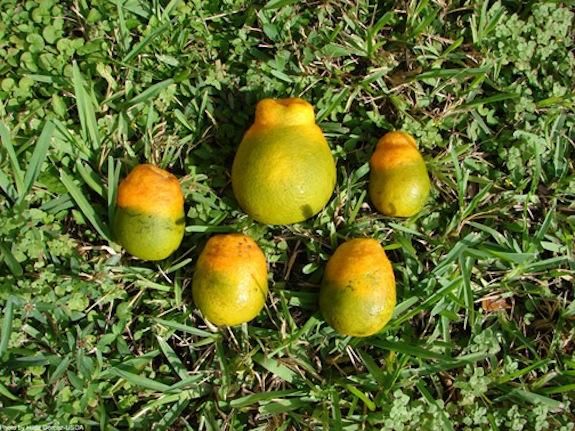
Basically, anything that the citrus industry can get out of those green trees is better than nothing. So while it’s possible that the green fruits might make your juice a little bitter, having them in there could prevent a total collapse of the industry. Either way, things are bad for O.J.
More from Smithsonian.com:
Drones: The Citrus Industry’s New Beauty Secret
Airships and Oranges: The Commercial Art of the Second Gold Rush
/https://tf-cmsv2-smithsonianmag-media.s3.amazonaws.com/accounts/headshot/Rose-Eveleth-240.jpg)