
This Computer Program Uses Old Headlines to Predict the Future
By analyzing old news, this artificial intelligence program can predict the future
/https://tf-cmsv2-smithsonianmag-media.s3.amazonaws.com/accounts/headshot/smartnews-colin-schultz-240.jpg)
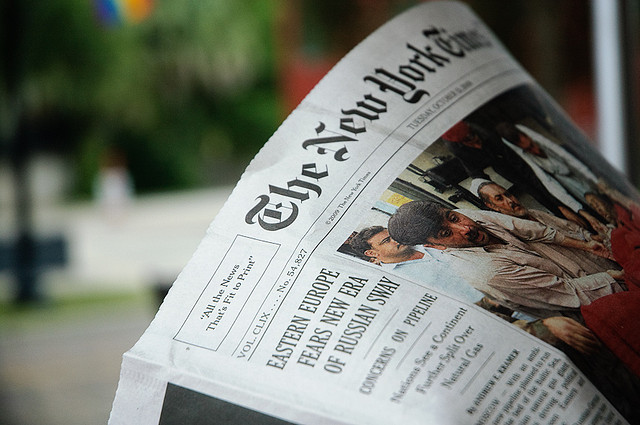
Photo: Ahmad Hashim
The news is often dubbed the “first rough draft of history,” the first crack at making sense of the struggles and triumphs of our time. A new artificial intelligence engine, however, might be able harvest those drafts to figure out the future. By using advanced computational techniques to parse through two decades of New York Times stories and other resources, Microsoft researcher Eric Horvitz and Technion-Israel Institute of Technology scientist Kira Radinsky, think they might be able to identify the underlying connections between real-world events and predict what will happen next.
The trick is that many newsworthy events—riots, disease outbreaks—says the BBC, are preceded by other other less dramatic news stories. But, by digging through such a vast wealth of stories, these otherwise overlooked associations can be pulled out.
In their research paper, the two scientists say that using a mixture of archived news reports and real-time data, they were able to see links between droughts and storms in parts of Africa and cholera outbreaks.
For example in 1973 the New York Times published news of a drought in Bangladesh, and in 1974 it reported a cholera epidemic.
Following reports of another drought in the same country in 1983, the newspaper again reported cholera deaths in 1984.
“Alerts about a downstream risk of cholera could have been issued nearly a year in advance,” wrote researchers Eric Horvitz, director of Microsoft Research, and Kira Radinsky, PhD student at Technion-Israel Institute of Technology.
This model doesn’t necessarily mean that, for Bangladesh, drought will always lead to cholera. But, by viewing the occurrences with an eye to the future, an impending drought could be a sign to Bangladeshi water managers to keep a closer eye on their treatment programs, or for healthcare workers to be wary of an outbreak.
Similar links between drought and cholera, says MIT’s Technology Review, were identified for Angola.
In similar tests involving forecasts of disease, violence, and a significant numbers of deaths, the system’s warnings were correct between 70 to 90 percent of the time.
Techniques like this one are used in science all the time. Neural networks, machine learning and artificial intelligence approaches have helped YouTube discover—without human intervention—what cats are and have helped paleontologists speed up the fossil hunt. Because they can analyze vast swaths of data, computers are particularly well-suited for pulling out some of the non-obvious trends that permeate history. MIT’s Tom Simonite:
Many things about the world have changed in recent decades, but human nature and many aspects of the environment have stayed the same, Horvitz says, so software may be able to learn patterns from even very old data that can suggest what’s ahead. “I’m personally interested in getting data further back in time,” he says.
More from Smithsonian.com:
With No Human Supervision, 16,000 Computers Learn to Recognize Cats.
Fossil Finding Goes High Tech
/https://tf-cmsv2-smithsonianmag-media.s3.amazonaws.com/accounts/headshot/smartnews-colin-schultz-240.jpg)