
Some Insect Wings Are Natural Antibiotics
Dotted with tiny spikes, this cicada’s wings are naturally antibiotic
/https://tf-cmsv2-smithsonianmag-media.s3.amazonaws.com/accounts/headshot/smartnews-colin-schultz-240.jpg)
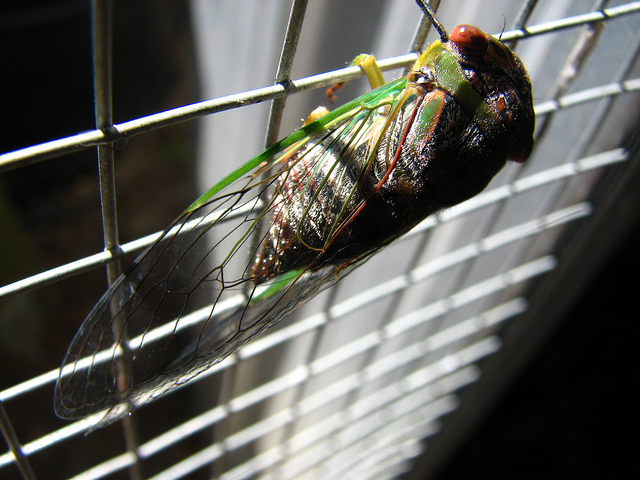
A clanger cicada. Photo: Melanie Cook
The wings of the Australia’s Clanger cicada are bumpy, strewn with unimaginably tiny spikes. These teeny bumps give the wings a special ability, according to new research: the cicada’s wings are naturally antibiotic—they kill some bacteria on contact. The cicada’s wings, says Nature, are one of the first natural surfaces found with such a power, and the finding could potentially pave the way for new passively-antibacterial materials.
The tiny spikes don’t kill the bacteria by puncturing it, says Nature. Rather, “the rupturing effect is more like “the stretching of an elastic sheet of some kind, such as a latex glove. If you take hold of a piece of latex in both hands and slowly stretch it, it will become thinner at the centre, will begin to tear.”
The tiny spikes only work on bacteria with sufficiently soft cell membranes, ones that can’t keep the bacterium rigid enough to not droop between the spires and tear. Having antibacterial materials, rather than chemical antibiotics, could be a good way to keep important surfaces clean—think hospital equipment or bus railings—without worrying about antibiotic resistance. (Or, it could be a way to drive the evolution of even more rigid bacteria, with whatever consequences that might entail.)
Though the finding is one of the first in the natural world, it is not the first material known to be passively antibiotic. Some metals, such as brass or silver, have a similar power.
More from Smithsonian.com:
Antiobiotics May Be Making You Fat
Blame Your Chicken Dinner for That Persistant Urinary Tract Infection
Gonorrhea Mutates Into Treatment-Resistant Superbug
/https://tf-cmsv2-smithsonianmag-media.s3.amazonaws.com/accounts/headshot/smartnews-colin-schultz-240.jpg)