October 19, 2012
Taking a Closer Look at an Odd Pair of Very, Very Old Socks
![]()
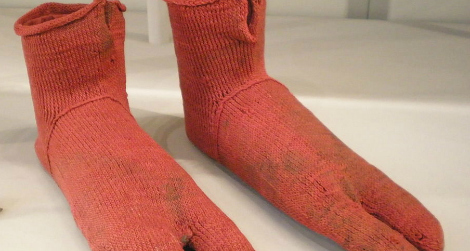
I can’t stop staring at these socks. A pair of very, very old socks made in Egypt sometime between A.D. 250 and A.D. 420.
While putting together Threaded’s Stocking Series (Parts 1, 2, 3, and 4), I did a double take when I came upon this different type of foot covering. Maybe it’s the angle of the photo, or the split toe style meant to be worn with sandals, but they’re disorienting, right? They don’t look 1,600 years old, but they don’t look new either. And they’re bright red! I don’t expect something that’s over 1,000 years old to look so vibrant. Maybe, too, it’s the size. They’re so long that they look as if they could fit Shaquille O’Neal’s famous size 23 feet—if his feet were also really narrow. After I incredulously posted this image on Facebook this past week and remarked on the antiquity’s unique qualities, a friend most succinctly responded with just: #ancientaliens.
But let’s get serious for a minute. These socks, and their provenance, can be found at the Victoria and Albert Museum:
The Romano-Egyptian socks were excavated in the burial grounds of ancient Oxyrhynchus, a Greek colony on the Nile in central Egypt at the end of the 19th century. They were given to the Museum in 1900 by Robert Taylor Esq., ‘Kytes,’ Watford. He was executor of the estate of the late Major Myers and these items were selected among others from a list of textiles as ‘a large number of very useful examples.’
Particularly intriguing about these “very useful examples” is the technique used to construct these red wool socks. Called nålbindning, or single-needle knitting, this time-consuming process required only a single thread. The technique was frequently used for close-fitting garments for the head, feet and hands because of its elastic qualities. Primarily from prehistoric times, nålbindning came before the two-needle knitting that’s standard today; each needle was crafted from wood or bone that was “flat, blunt and between 6 -10 cm long, relatively large-eyed at one end or the eye is near the middle.”
We don’t know for sure whether these socks were for everyday use, worn with a pair of sandals to do the ancient Egyptian equivalent of running errands or heading to work—or if they were used as ceremonial offerings to the dead (they were found by burial grounds, after all). I prefer to imagine an #ancientalien pulling them on to protect its E.T.-like feet from the extraterrestrial elements.
Sign up for our free email newsletter and receive the best stories from Smithsonian.com each week.
29 Comments »
RSS feed for comments on this post. TrackBack URI


Is it possible the wearer was simply missing a toe?
Maybe it’s due to ectrodactyly?
http://www.wisegeek.com/what-is-ectrodactyly.htm
There’s actually a genetic condition that could result in foot issues something like that. But they do seem larger than I’ve seen on reports of that. http://en.wikipedia.org/wiki/Ectrodactyly
What’s bugging me about this article is the continued mention of #ancientaliens as the explanation for why the socks are so large and so oddly shaped. Really, guys? The ancient Egyptians frequently dressed and “fed” statues of people and gods, who could often be depicted with animal features, and the feet these socks were made for look particularly birdlike to me. Dismissing the owner as an “alien” discounts that the ancient Egyptians were a people who could craft elaborate and amazingly constructed things like these socks, and ignores the history and cultural significance of this artifact in favor of a silly explanation. These socks could have been worn by a god or a guy with pigeon toes, but we may never know if everyone labels unfamiliar and strange objects of another culture as “alien” and leaves it at that.
This is the same idea of traditional Japanese Tabi socks.
http://en.wikipedia.org/wiki/Tabi
This could be a pair of socks for someone with ectrodactyly. This deformity results in hands or feet that are cleft and often missing all but two digits, giving the appearance of two large claws. It can run in families, and is still common in some parts of
Africa.
If you do a web search for “Ectrodactyly/split hand feet malformation” you’ll find a lot of information on it.
Re: My previous post
Sorry, the other comments didn’t load right away for some reason.
OK, let me see if I have this right….an ancient race so advanced that they were able to travel all the way to Earth to get a pair of hand-made Egyptian socks?
“Hey! You found my socks!” – Nightcrawler
As a ~continuation of MJ’s comment 4. There is no mention as to the context in which the socks were found. Were they found ON a person or object? Were they folded neatly together? Could they be as a gift for someone/something in the afterlife? Could they be an admired example of the deceased’s expertise in that style of knitting?
I’ve actually made a reproduction of these socks, and did a lot of research. They are actually fairly common items from the times and even children’s sizes have been found. Roman soldiers would write home requesting more socks like these, so they weren’t limited to Egypt. They are done with nalbinding, and make really comfy slipper socks.
What’s the difference between nalbiinding and crocheting?
It’s very simple – Big Bird is actually an ancient Egyptian.
Dear god. So it seems we have finally figured out who is to blame for the horrible trend of wearing socks with sandals.
Candyce, nalbinding uses a needle and yarn, passing the yarn through loops. Crochet uses a hook and makes loops of yarn. Crochet can be pulled out (like knitting), and nalbinding cannot be pulled out.
they look very much like bird feet, so don’t think they are so strange. They could have been for sculpture or idols because many ancients did dress their figures and idols.
They could also be costume devices for priests to imitate their dieties as Egyptians had many deities represented by birds. Doesn’t seem any stranger than the costumes worn by shamans or “doctors” during the Plague or for that matter the crane costumes that are used now for leading migration flights.
Camel socks!
Ancient Aliens appeals to me. The socks fascinated me as well. The My initial observation was that the toes were knitted to be equal in size and length. The shape and length reminded me of something I had read about ancient aliens in Egypt who were reported to have elongated heads and the headgear they wore reflected that shape. I love it when we who have lived in the 19th, 20th and 21st centuries attempt explain everything within the paradigm of what we do, how we look and what we wear.
I agree FeeBeeKay, I think they would be ideal for a camel or even a cow.
So is nalbiinding sorta like tatting?
Looks a lot like tabi, but it is strange that both “toes” are so narrow. Surprised to see so little specific mention of this.
Amazing that these are in such great condition!
Nalbinding, like knitting, is very stretchy, so these toes would easily fit a quite normal human foot. Hand knit tabi socks look quite similar at the toes. I am more interested in the heel shaping. Are they sewn across the instep? Or is the ridge there decorative or perhaps structural in some way? Is there a seam under the heel?
My wife does viking reenactment and has naalbound socks for the whole family. Ours only go just to the ankle but are quite tight fitting, yet do not need this attachment at the instep. I think it might just be a particular styling decision by the maker.
I lean toward the ectrodactyl hypothesis, but wonder about the dimensions. Perceptive and (unintentional) photographic distortion can play tricks. The absence of a device, or even written dimensions other than a reference to an athlete’s shoe size makes any evaluation speculative at best. So, the aliens win by default.
The biggest wonder is that it is a matching pair! :)
did anyone ever think that maybe these were made for camels?
These socks look like camel feet.
If you have an animal that is valuable to you and its feet need protecting, you will do what you need to do for it.
Check the material inside the socks and see what residue is there.
I bet you will find camel hair.
And note they had knitting machines as well as the unusual dye, and after 1500 plus years still look like they were amde yesterday – no deterioration – yeh right !
also a common condition among the “Doma People”