
This Is What a Watery Mars May Have Looked Like
Mars once had a vast ocean. What would that have looked like?
/https://tf-cmsv2-smithsonianmag-media.s3.amazonaws.com/accounts/headshot/smartnews-colin-schultz-240.jpg)
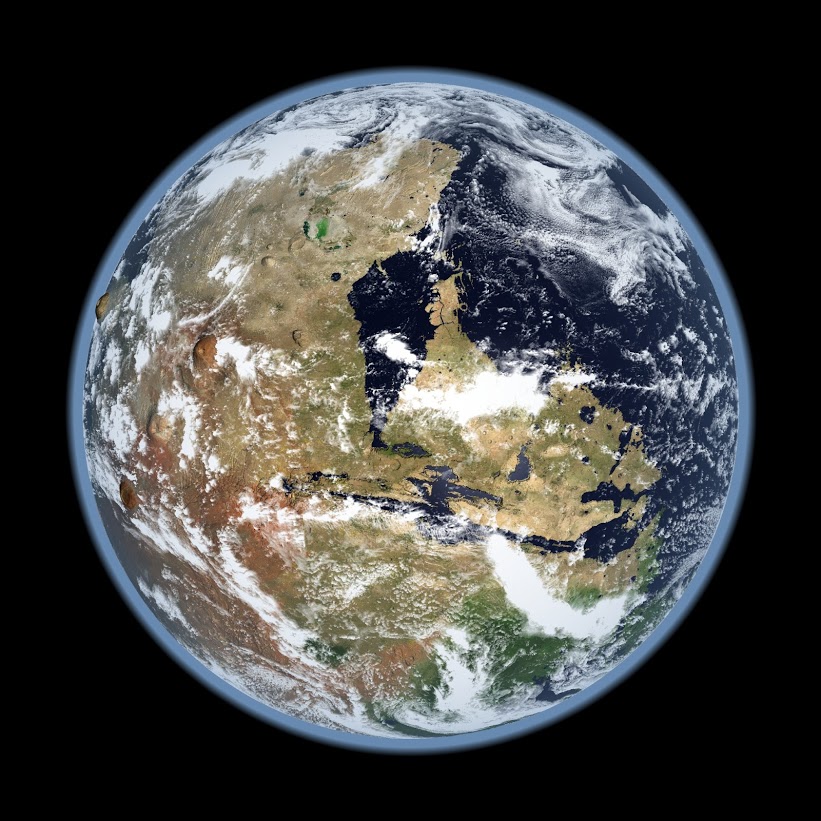
A simulation of a watery Mars, with the volcano Olympus Mons along the horizon. The topographic features were exaggerated to be more dramatic than they would really be. Photo: Kevin Gill
Mars, we now think, based on observations made by the Curiosity rover and other recent expeditions, was once a blue planet, covered in a vast ocean of water, says Universe Today. But what would such a watery Mars have looked like? Kevin Gill, a software engineer, wanted to find out. Using elevation measurements based on the observations of NASA’s Mars Reconnaissance Orbiter, Gill laid out what the planet’s surface would have looked like with a big global ocean. The recreation was more artistic than scientific: he picked what the land surface would have been like in different places, whether forested or desert, and picked a (consistent) sea level. Gill:
There is no scientific reasoning behind how I painted it; I tried to envision how the land would appear given certain features or the effects of likely atmospheric climate. For example, I didn’t see much green taking hold within the area of Olympus Mons and the surrounding volcanoes, both due to the volcanic activity and the proximity to the equator (thus a more tropical climate). For these desert-like areas I mostly used textures taken from the Sahara in Africa and some of Australia. Likewise, as the terrain gets higher or lower in latitude I added darker flora along with tundra and glacial ice. These northern and southern areas textures are largely taken from around northern Russia. Tropical and subtropical greens were based on the rainforests of South America and Africa.

A simulation of Mars’ southern hemisphere. Photo: Kevin Gill
So, while the recreations of an ancient Mars may not be perfect, says Universe Today, they are certainly a fun way to trigger the imagination, “turning the Red Planet into its own version of the Blue Marble.”
More from Smithsonian.com:
Curiosity Nails It: Mars Used to Have Flowing Water
Scientists Discover That Mars is Full of Water
/https://tf-cmsv2-smithsonianmag-media.s3.amazonaws.com/accounts/headshot/smartnews-colin-schultz-240.jpg)